
$100 million milestone: art museum’s centennial campaign surges past goal on major gifts from Cornelia and Dick Corbett, and Penny and Jeff Vinik
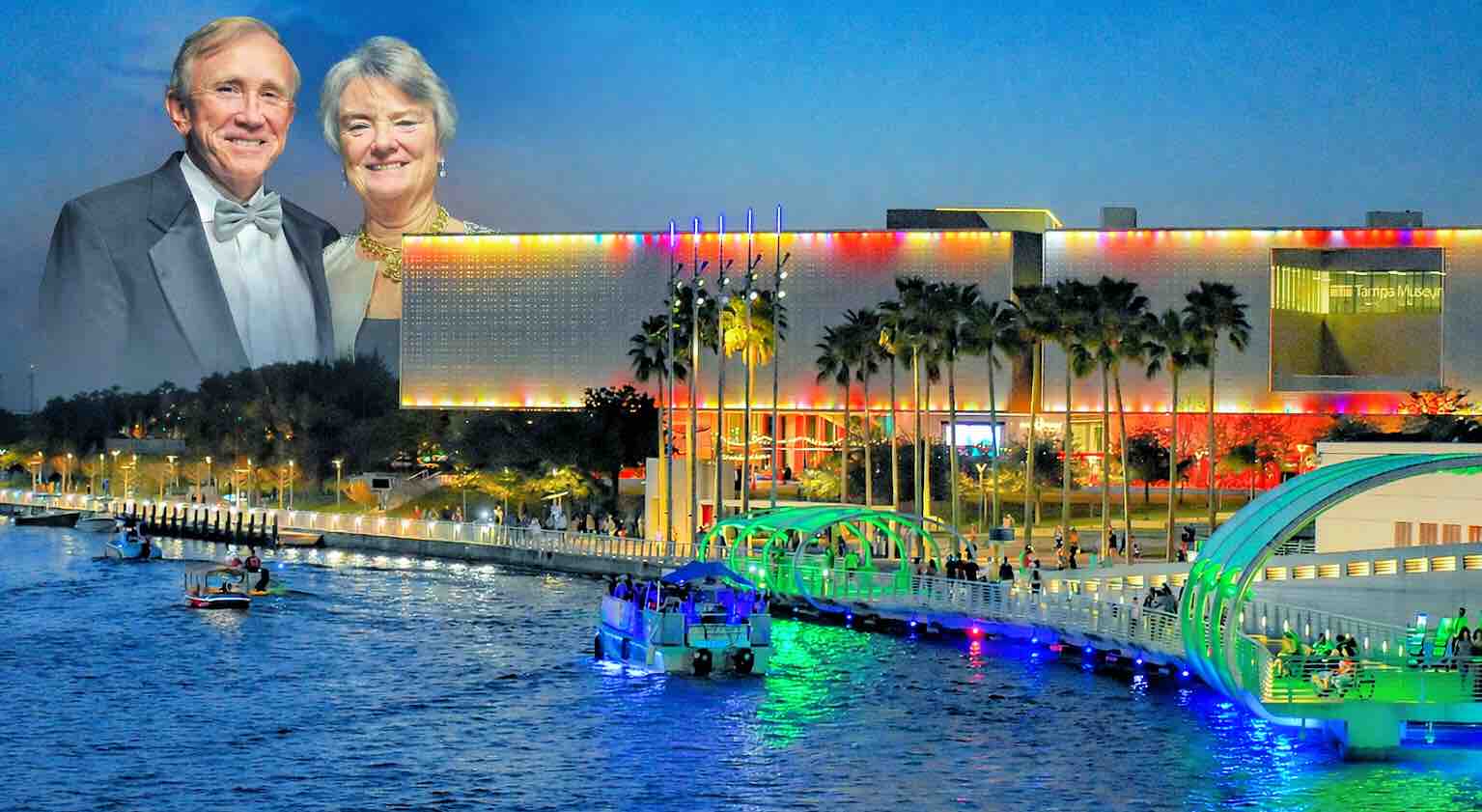
The Tampa Museum of Art is in a rare position for a regional institution: its future has been materially reshaped by a small group of donors whose gifts now define the scale of its ambitions.
At the center of that transformation is Tampa real estate investor and philanthropist Cornelia and Dick Corbett, whose lead contribution to the museum’s Centennial Campaign stands as the largest private donation ever made to a public art museum and art education center in Florida.
Museum officials, campaign materials and local coverage all describe his support as historic and catalytic, the kind of single commitment that turned a conceptual expansion plan into concrete, steel and an entirely different horizon for the institution.
With Corbett’s name attached to the campaign’s anchor gift, the museum could move quickly: reconfiguring existing galleries, planning a major expansion along the Riverwalk, and talking credibly about operating on a scale more commonly associated with larger metropolitan museums.
Corbett and his wife, Cornelia, have long been active in Tampa civic life, but insiders say this particular commitment changed the conversation about what the museum could ask for and what donors might reasonably expect in return: more space, more ambitious exhibitions, and a stronger role for the museum as a civic landmark.
Campaign documents and public statements note that once Corbett’s gift was secured, the Centennial Campaign shot past the symbolic “tens of millions” threshold, with total private and public commitments ultimately pushing overall expansion and renovation resources beyond the one hundred million dollar mark.
That scale of giving is unusual in the Florida museum landscape and has been cited by museum leaders as proof that Tampa’s philanthropic community is willing to back major cultural infrastructure when it is presented with a compelling, long‑term vision.
Running alongside Corbett’s support is a different but equally influential strand of philanthropy from Penny and Jeff Vinik and the Vinik Family Foundation.
Where Corbett’s giving is tied to the building and the overall campaign, the Viniks have deliberately attached their name to the museum’s intellectual and educational core: leadership and learning.
One major Vinik commitment permanently endows the museum’s top job, now titled the Penny and Jeff Vinik Executive Director of the Tampa Museum of Art, and museum and media accounts have described it as the largest gift ever made to the institution’s endowment.
That endowment means the position is funded in perpetuity, no longer dependent on annual operating budgets or short‑term fundraising swings, which in turn gives the board more freedom and confidence as it conducts a global search for the next director following the announced retirement of Michael Tomor.
A second headline Vinik gift underwrites and names the Vinik Family Education Center, an expanded suite of classrooms and program spaces that has become the hub of the museum’s educational outreach. Museum statements and local coverage emphasize that this facility is central to serving thousands of students, teachers and community members across Tampa and Hillsborough County each year, tying the family’s philanthropy directly to public benefit rather than only to bricks and mortar.
Taken together, the Vinik commitments to the Centennial Campaign reach into eight‑figure territory, placing the family alongside Corbett as one of the institution’s defining benefactors. Penny Vinik’s service on the museum’s board and involvement in strategic planning and executive search work underscore that this is not arm’s‑length giving; it is engaged, governance‑level stewardship that shapes how the museum thinks about its next decade.
The campaign’s architecture makes clear how concentrated this influence is. Public figures show that with the Corbett and Vinik gifts in place, private commitments reached well into the tens of millions of dollars, while a mix of other individuals, families and corporate partners filled in additional seven‑figure and high six‑figure support.
State and local governments have contributed, too, through appropriations and capital grants outlined in legislative funding requests, but those public dollars are explicitly described as leveraging, rather than replacing, private philanthropy. Museum sources say the rough balance is closer to three‑quarters private, one‑quarter public, with the Corbett and Vinik families underwriting a disproportionate share of the private side. In practical terms, that means a small circle of donors has become central not just to the museum’s growth but to its basic financial model.
Inside the building, their priorities are visible in the floorplan. Corbett’s name is closely associated with the expansion that pushes the museum further along the Riverwalk, adding gallery space and amenities that support larger, more complex exhibitions and a higher visitor capacity.
The Viniks’ name marks the executive suite and the education center, the spaces where decisions are made and where the museum meets its public through programs and partnerships. Museum officials have been open about the fact that these naming opportunities were designed with the donors, not simply offered to them after the fact; in that sense, the Corbetts and Viniks function as de facto co‑architects of the institution’s next phase.
All of this money and naming power comes to a head at a moment of leadership change. After more than a decade, director Michael Tomor is stepping down, and the board has installed longtime trustee and Deloitte executive Tom Hochhausler as interim Penny and Jeff Vinik Executive Director while a global search proceeds.
Tomor is widely credited with guiding the museum through the early stages of the Centennial Campaign, securing transformational gifts from Corbett, the Vinik family and others, and overseeing a significant renovation that expanded the number and quality of galleries on site. Search firms and trustees involved in the current recruitment have said publicly that maintaining the confidence of these cornerstone donors is a central consideration as they define the profile of the next leader.
For now, the story of the Tampa Museum of Art is as much a story of its benefactors as of its exhibitions. With Corbett’s record‑setting support anchoring the capital campaign and the Viniks’ endowment and education gifts underwriting the institution’s core functions, the museum has effectively vaulted into a different league of cultural players in the Southeast.
The open question, as the board works through its leadership transition, is how the next director will translate that concentrated generosity into lasting influence, broader audiences and a civic role worthy of the scale of the philanthropy that now surrounds the Tampa Museum of Art.