
$750 million latest gift from Lifestyles Magazine/Meaningful Influence exclusive cover subjects Michael and Susan Dell will power university’s pioneering ‘AI‑Native’ medical center and a billion‑dollar era of health innovation
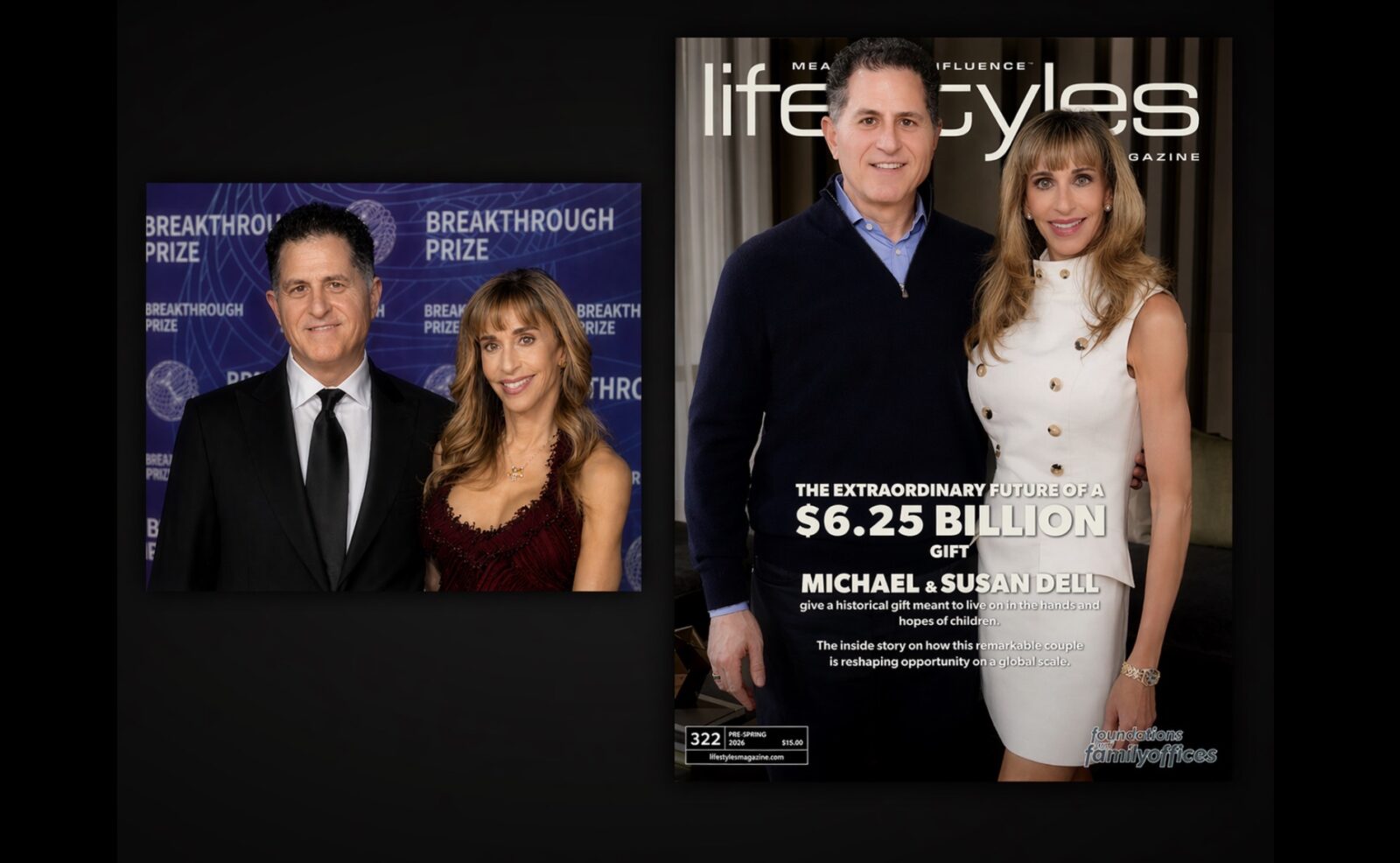
Michael and Susan Dell are making one of the most ambitious bets in the history of higher education and academic medicine, committing $750 million to the University of Texas at Austin to create what is being hailed as the nation’s first truly “AI‑native” medical center.
Their gift will anchor a sweeping new 300‑plus‑acre advanced research campus in Austin and fund a next‑generation academic hospital designed from the ground up around artificial intelligence, high‑performance computing, and human‑centered care.
It is a statement not only about their loyalty to Texas and to UT, but about their conviction that technology, applied thoughtfully, can fundamentally improve how people receive care and how doctors practice medicine.
The planned UT Dell Medical Center, expected to break ground this fall and open in 2030, is being cast as the crown jewel of the university’s long-term vision for a health and innovation district that rivals the leading medical hubs in the country.
The idea is not to retrofit a traditional hospital with tech add‑ons, but to weave AI into the very fabric of the institution: the building design, the clinical workflows, the research engine, and the patient experience.
From the start, UT leaders have emphasized that this will be a place where data, computing power, and clinical expertise work together in real time to catch disease earlier, personalize treatments, and make care smoother and more accessible for a metropolitan region that badly needs more capacity.
For Michael Dell, this is in many ways a homecoming at scale. He launched his company as a UT Austin student in 1984, assembling custom computers in his dorm room; today, he is one of the world’s wealthiest entrepreneurs, and he has never been shy about crediting the university and the city of Austin as central to his story.
He and Susan were both born in Texas, and he has framed this gift as a deeply local commitment: a way to build a stronger health system, drive more innovation, and support the growth and stability of a region whose population has roughly doubled in recent decades.
In a sense, the Dells are taking the fortune built from the digital revolution and deliberately reinvesting it in the physical and social infrastructure of their home state.
The philanthropic significance of this moment is hard to overstate.
With this gift, Michael and Susan Dell become the first donors in the University of Texas’s history to cross the $1 billion threshold in total giving to the system aftertwo decades of major support for computer science, Dell Medical School, and scholarships for students with the greatest financial need.
Their latest commitment arrives in an era when colleges collectively raise record sums but rely on an extraordinarily small sliver of donors for the vast majority of that funding.
That they have chosen to channel such unprecedented support into a flagship public university sends a powerful signal at a time when public institutions are simultaneously under financial pressure and political scrutiny.
It is the kind of megagift that tends to unlock other large commitments, and UT has been explicit about using this moment to kick off a ten‑year, $10 billion fundraising campaign built around a vision of world‑class research, teaching, and care.
At the heart of the new medical center is an ambitious reimagining of how technology can serve, rather than overshadow, the physician‑patient relationship.
Claudia Lucchinetti, dean of Dell Medical School and senior vice president for medical affairs, has described a model in which “ambient” AI allows the hospital itself to act as an intelligent, almost invisible member of the care team.
Instead of doctors hunched over keyboards, the aim is for systems in the room to listen, record, and draft notes; for sensors to monitor vital signs and other biometrics continuously; and for algorithms to detect patterns and early warning signs—especially of diseases like cancer—long before they might be apparent to the human eye.
The promise is that clinicians will be freed to spend more time truly present with patients, while the digital infrastructure hums along in the background, catching details, surfacing risks, and supporting decisions.
The center will not exist in isolation. UT plans to pursue deep integration with MD Anderson Cancer Center in Houston, widely recognized as one of the world’s leading oncology institutions.
That partnership is expected to bring some of the country’s top cancer specialists and protocols to Austin, marrying MD Anderson’s clinical depth with UT’s emerging AI and supercomputing capabilities.
The gift also feeds directly into the growth of the Texas Advanced Computing Center, where the university is building what it says will be the largest academic supercomputer in the nation, powered by Dell’s AI infrastructure.
That supercomputer will become a central engine for medical discovery, crunching enormous datasets to uncover new insights into disease, treatment effectiveness, and population health, all with a direct pipeline into the hospital and labs just down the street.
This move is entirely consistent with the Dells’ broader philanthropic worldview.
Through their foundation and personal commitments, they have long focused on education, health, and economic mobility, with an emphasis on scalable interventions that can change the trajectories of millions rather than thousands of people.
Their recent $6.25 billion pledge to help seed so‑called “Trump Accounts” for roughly 25 million American children—giving each newborn a $1,000 investment stake in the stock market, provided parents open the account—is a prime example: a structural bet on opportunity that compounds over time.
Taken together with the UT gift, this paints a picture of donors who are comfortable operating on a grand canvas, blending public policy, private capital, and institutional partnerships to tackle problems at the systems level.
At the same time, Michael Dell has been notably clear‑eyed about the responsibilities that come with wielding technologies as powerful as AI in domains as sensitive as health care.
In past addresses to medical graduates, he has urged them to ensure that AI models understand and reflect human ethics and that advances in automation make care more equitable, not more stratified.
He talks about AI as a way to augment caregivers, accelerate scientific breakthroughs, and bring cutting‑edge treatments into everyday practice more quickly—but always paired with the insistence that it must be done in ways that align with shared values.
That perspective is woven into the DNA of the UT project: there is an explicit acknowledgment that data governance, bias, and patient trust must be thought through from the earliest design decisions, not bolted on later.
For UT Austin, the Dell gift is both validation and a challenge. It validates the university’s aspiration to be not just a regional power but also a global leader in AI, life sciences, and patient‑centered care.
It also challenges the institution to rise to the scale of the opportunity: to recruit talent, build culture, and sustain the public trust required to make an “AI‑native” medical center a genuine model rather than just a marketing phrase.
The campus that grows up around this hospital will likely shape the trajectory of Austin’s innovation economy for decades, drawing in biotech firms, health‑tech startups, and new waves of students who see UT as a place where the future of medicine is being invented in real time.
In the end, this is a story about a Texas‑built fortune coming full circle. A student who once sold custom computers from his dorm room is now underwriting a medical center that uses unimaginably more powerful machines to improve human health on a massive scale.
A couple who trace their roots to Texas are placing yet another enormous bet on the people and institutions of their home state.
And a public university, often buffeted by political winds and funding uncertainties, is being given the resources and responsibility to demonstrate what is possible when philanthropy, technology, and public mission align.