
$65 million new contribution to Caring for Women and Children initiative announced by Camille Johnson
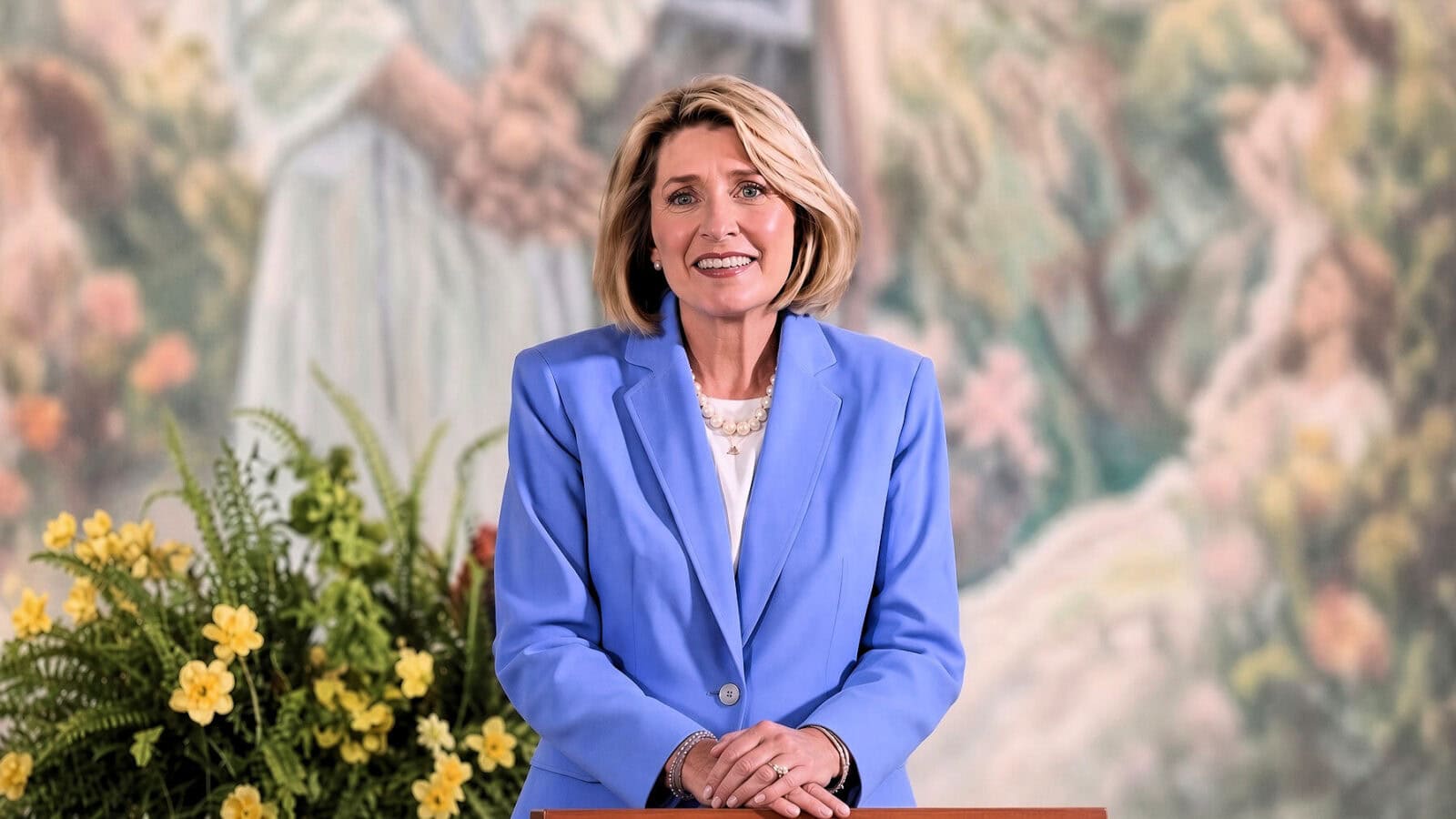
Camille Johnson spent nearly three decades cross-examining witnesses and negotiating settlements as a litigator in downtown Salt Lake City, eventually rising to lead her law firm as its president.
She built a career on being, as she once put it, “a problem-solver” rather than a fighter looking for a fight.
Few of her former colleagues at Snow, Christensen & Martineau could have predicted that the same instincts she honed in courtrooms — listening carefully, building consensus, getting disparate parties to work toward one outcome — would eventually be applied not to a legal dispute, but to seven of the world’s largest humanitarian organizations, and to the lives of more than 52 million women and children scattered across Africa and Asia.
Recently, standing before executives who had flown in from around the globe to the Church Office Building on Temple Square, Johnson — now the 18th General President of the Relief Society, the 8-million-member women’s organization of The Church of Jesus Christ of Latter-day Saints — announced that the church would commit another $65 million to an ambitious project she has quietly shepherded since its founding: the Caring for Women and Children Initiative.
The new pledge, covering the initiative’s third year, pushes the church’s total investment past $184 million over three years, a remarkable escalation from the $44 million with which the effort began in 2023.
What makes Johnson’s role in this story worth a closer look isn’t just the size of the check. It’s the architecture behind it — an architecture that reflects, almost eerily, the professional instincts of a woman who spent her career getting warring parties to cooperate.
Rather than simply wiring money to individual charities and hoping for the best, Johnson and the church’s humanitarian arm, led by Sharon Eubank, made a different bet: they invited seven storied but historically separate organizations — CARE, Catholic Relief Services, Helen Keller Intl, The Hunger Project, iDE, Save the Children and Vitamin Angels — to stop operating in silos and instead braid their expertise into a single consortium, organized into collaborative subgroups tackling child nutrition, maternal and newborn care, agriculture and clean water together in a dozen of the world’s highest-need countries: the Democratic Republic of Congo, Ghana, Kenya, Mali, Nigeria, Senegal, Sierra Leone, Zambia, Bangladesh, Cambodia, Nepal and the Philippines.
“We invited organizations with unique strengths and perspectives to come together around a common purpose and shared commitment to serving those in need,” said Blaine Maxfield, managing director of Welfare and Self-reliance Services for the church, describing the model Johnson helped design. The bet appears to be paying off.
In its first two years alone, the consortium delivered essential vitamins to 52 million children, pregnant women and mothers; screened 5 million people for malnutrition; ran mother-to-mother nutrition groups reaching 2.6 million women; provided prenatal care to 375,000 expecting mothers; trained 85,000 health workers; and helped 231,000 families plant home gardens with more nutrient-dense crops. At a regional hospital in Uganda, Save the Children’s senior managing director Winnie Mwebesa reported, the consortium’s work helped cut maternal deaths in childbirth by half.
Johnson, though, resists letting the eight-figure sums and seven-figure beneficiary counts become the whole story.
During the announcement, she reportedly choked up describing a single woman in Nepal who had received a flock of chickens through the program — a gift that provided her children protein and gave her a small but steady income from selling eggs.
“Her children will go to school,” Johnson said. “That changes generations.” It’s a sentiment she has returned to again and again as the initiative has grown: that the measure of a $184 million global campaign should still be found in the fate of one person.
“There are opportunities, of course, for us to do grand and global work in caring for women and children,” she told reporters.
“But there are women who cannot read in your community, and there are children who are hungry in your community. If we’ll each look for the one, that is the way we’ll address these challenges”.
That “the one” framing, rooted in a phrase Latter-day Saints associate with the Savior’s ministry, has become something like Johnson’s signature as a humanitarian leader, and it echoes through the testimonies of the charity executives who have come to know her over three years of joint planning sessions.
Reed Peterson, CEO of iDE — a charity that trains women in high-need countries to become small-scale entrepreneurs — recently spent 30 days traveling through Africa to check on the consortium’s progress. He kept returning, he said, to the story of a woman named Ranatu in northern Ghana, who was once so shy she could barely speak in front of a group.
After nutrition training taught her to make a nutrient-dense flour, she started selling it from a roadside stand; two years later, Peterson found her still running the business and teaching her young daughter to take it over.
“The thing that got me the most was hearing her stand up and talk about her confidence, talk about how much she’s been changed,” Peterson said.
“Now she eats that for breakfast. There’s a self-dignity and confidence that resonates with me more than anything else”. He calls that kind of transformation a “generational impact” — the multiplication of one woman’s dignity into her children’s, and eventually her community’s, future.
Johnson’s path to becoming the person orchestrating all of this was itself unhurried and, by her own account, largely unplanned.
Born Camille Neddo in Pocatello, Idaho, in 1963, she studied English at the University of Utah before earning her law degree there in 1989 and spending nearly three decades as a litigator, eventually becoming president of her firm.
She and her husband, Douglas, took a multi-year detour from that career to lead the church’s mission in Arequipa, Peru, from 2016 to 2019 — an experience during which, by her own telling, she prayed her way into fluency in Spanish so she could better connect with missionaries and the Peruvian people.
She returned to legal practice only briefly before being called first as the church’s Primary General President in 2021 and then, a year later, as Relief Society General President in April 2022, a volunteer assignment she has said she expects to serve through.
That legal training, she has said, shaped how she approaches the consortium’s evolving demands more than most people would guess.
“As a lawyer, I always saw myself as a problem-solver,” she told the Church News podcast shortly before taking office, adding that she used to warn prospective clients who wanted an attack dog that they had “chosen poorly” — she was there to find workable solutions, not wage battles.
That same instinct now shows up in how she talks about accountability for the hundreds of millions of dollars flowing through the initiative: she and the church’s Humanitarian Services department, she has said, set specific performance markers for each charity and evaluate them rigorously to “make sure that the dollars are well spent”.
This past July, Johnson’s public profile rose further when she was named grand marshal of Utah’s Days of ’47 Parade, an honor given to only one other woman in the parade’s 177-year history.
She used the moment, characteristically, to talk not about herself but about her pioneer ancestors who crossed the plains to Utah in 1847 — people, she said, whose sacrifice she thinks about whenever she considers what it means to build something lasting for people who have almost nothing.
It is a fitting through line for a leader whose signature philanthropic project is, at bottom, an argument that big institutional generosity and intimate, individual care are not opposites — that a single Nepali mother’s egg money and a $184 million global consortium can, in fact, be the same story, told at two different scales.