$50 million new donation, no name attached: MacKenzie Scott’s discreet gift to Native Forward scholars
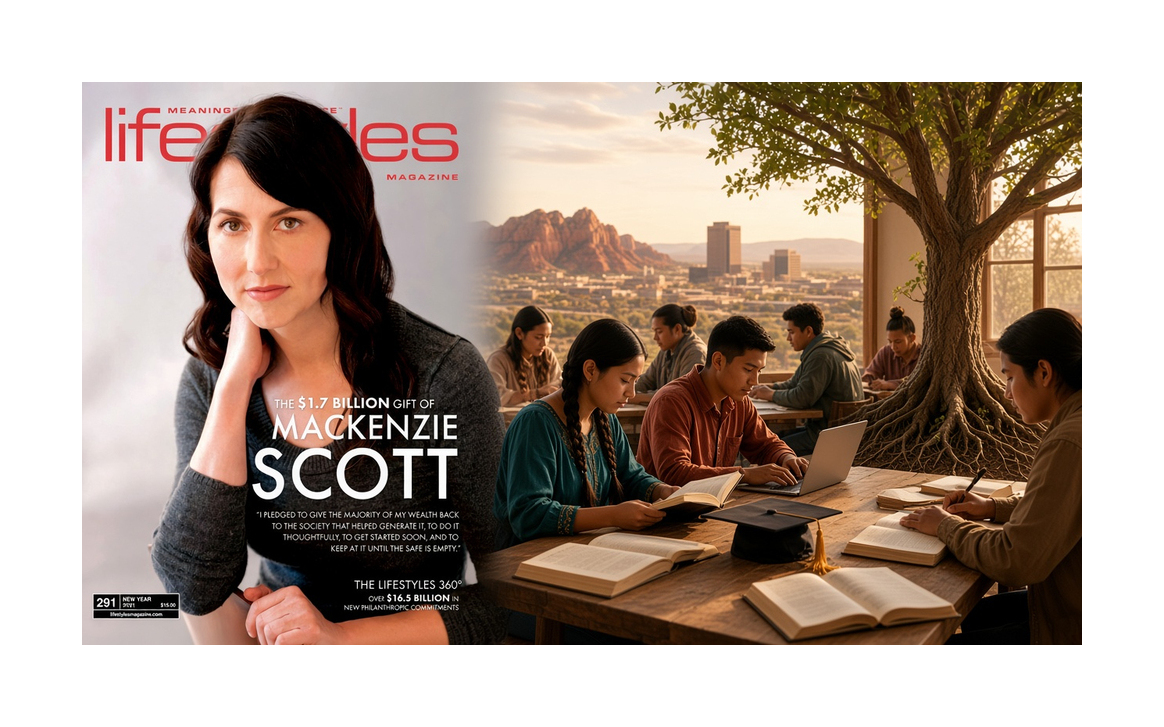
In a modest announcement, the Native Forward Scholars Fund revealed how it intends to spend the largest single gift in its 57-year history: $40 million of a $50 million donation will be locked into a permanent endowment, while the remaining $10 million will be paid out over five years, adding roughly $2 million a year in new scholarships through 2031.
It is the kind of granular, actuarial disclosure — 80 percent banked, 20 percent deployed, a target payout schedule stretching to the edge of the decade — that nonprofits almost never have to make public, because they almost never receive a check this large from a single, still-living donor.
The donor did not attend the announcement, did not issue a quote, and did not put her name on the endowment.
She never does.
She is MacKenzie Scott, and she may be the most consequential person in American philanthropy that almost nobody has ever heard speak.
Scott, 56, is the novelist and early Amazon collaborator who became, upon her 2019 divorce from Jeff Bezos, one of the wealthiest women alive — a $38 billion settlement that left her holding roughly 4 percent of the company she had helped name, finance and staff out of a converted Seattle garage a quarter-century earlier.
Before any of that, she was MacKenzie Tuttle, a scholarship kid’s opposite number — raised in San Francisco by a financial-planner father, educated at Hotchkiss, and mentored at Princeton by Toni Morrison, who would later call her “one of the best students I’ve ever had” in three decades of creative-writing.
She wrote a Nobel laureate’s kind of sentence and, by her own account, nearly dropped out of college anyway; she has said the only reason she stayed enrolled through a rough financial patch was a roommate who quietly loaned her $1,000, and that a dentist once fixed her teeth for free with what amounted to denture glue and goodwill.
She has spent much of the past seven years insisting, in essays and almost nowhere else, that those small, uncelebrated acts of generosity are the real subject of her philanthropy—that the billions are almost incidental to the point.
The billions are, nonetheless, almost incomprehensibly large. Since signing the Giving Pledge in 2019 and vowing to give away her fortune “until the safe is empty,” Scott has distributed more than $26.3 billion to upward of 2,700 organizations through her giving vehicle, Yield Giving — a name she has said reflects “a belief in adding value by giving up control”.
2025 was her single largest year yet: $7.2 billion in new gifts, more than any individual philanthropist has distributed in one year on record, pushing her past the Gates Foundation’s annual grant making pace even as she operates with a fraction of its overhead.
A separate analysis with the Indiana University Lilly Family School of Philanthropy found her 2025 giving alone accounted for a third of all U.S. megagifts that year.
She still has, by most estimates, somewhere between $33 billion and $40 billion left to give away, her fortune buoyed and eroded in roughly equal measure by the swings of Amazon’s stock price.
What sets Scott apart from other megadonors, and what makes her the true animating force behind the Native Forward endowment, is the deliberate absence of her own hand from the process.
Her team conducts what she has called “quiet research,” identifying capable, undercapitalized organizations — community colleges, HBCUs, tribal colleges, minority-serving institutions — and wiring them large, unrestricted sums with no application, no reporting requirements, and no strings
There are no buildings named for her, no plaques, no galas she attends. As Time’s Belinda Luscombe put it in naming her to this year’s Time100 Philanthropy list, “Receiving money from MacKenzie Scott is like winning the lottery, except hardly any recipients bought a ticket”
She has declined to speak to reporters for years, communicating instead through occasional essays on Yield Giving’s site.
In her most recent one, published in December, she wrote that the dollar figure would dominate headlines even though it was “a vanishingly tiny fraction of the personal expressions of care being shared into communities this year,” and mused on what she called the ripple effects of ordinary kindness: “It is these ripple effects that make imagining the power of any of our own acts of kindness impossible”.
Native Forward has now been on the receiving end of that philosophy twice.
The first call came in the summer of 2020, when the organization was still known as the American Indian Graduate Center — a $20 million unrestricted gift, the largest in its history to that point, that let it seed an endowment, launch new scholarship tracks and eventually buy its own headquarters building in Albuquerque, redirecting the rent money straight into student aid.
The second call, this time to CEO Angelique Albert directly from a Scott representative, came five years later and landed with considerably more force. Albert has told multiple outlets that she assumed she was about to be told the gift was $15 million. It was $50 million. “What do you do but cry?” she told Observer.
She later told the Albuquerque Journal it was only the second time in her career she’d wept in a professional setting, and that she went straight to her board with an unusual request: rather than absorb the money into operations, she wanted “100% of it to go to student scholarships”.
Albert’s own biography gives the moment its charge. She grew up on the Flathead Indian Reservation in northwest Montana, the daughter of parents who between them had an eighth-grade and a high-school education, and became a first-generation college graduate at Salish Kootenai College before earning an MBA at Gonzaga.
Her career wound through tribal gaming — she spent two years as vice-chair of S&K Gaming, the Confederated Salish and Kootenai Tribes’ casino corporation — and through philanthropy at the Case Foundation, the Beaumont Foundation of America and the Johnson Scholarship Foundation before she landed, in 2017, in what she calls her dream job leading the nation’s largest direct provider of scholarships to Native students.
In a recent podcast interview, Albert traced her commitment further back still, to her grandfather, who was taken from his family at age five and forced into a Catholic boarding school — the kind of institutionalized rupture that Native Forward’s founders built the organization, in 1969, explicitly to counteract.
That founding, by Robert L. Bennett (Oneida), a former commissioner of the Bureau of Indian Affairs, and John C. Rainer (Taos Pueblo), grew out of a 1967 federal report that found exactly 13 Native students enrolled in graduate programs nationwide
From a trailer office in Albuquerque and a first scholarship transfer of $15,000 from the Donner Foundation, the organization — through several names, from the National Indian Scholarship Program to the American Indian Graduate Center to, since 2022, Native Forward Scholars Fund — has awarded more than $350 million to over 22,000 students from more than 500 Tribal Nations, producing alumni that include Interior Secretary Deb Haaland, the first Native American Cabinet secretary; Pulitzer Prize finalist Tommy Orange; and Cynthia Chavez Lamar, director of the Smithsonian’s National Museum of the American Indian.
Its undergraduates now graduate at a 69 percent rate against a national rate of 41 percent for Native students, and its graduate scholars at 95 percent.
None of that history has slowed the demand. Albert says applications surged 35 percent in the year after the gift was announced, driven in part by DEI rollbacks and disruptive changes to the federal financial-aid form, and that in a typical year Native Forward can fund only about 22 percent of qualified applicants — roughly 1,000 of 7,000.
The average scholar now arrives with $26,000 of unmet financial need.
That tension — a wave of urgent need against a philanthropic instinct to build something permanent — is precisely what the allocation was designed to answer. “For Native students, the path to higher education has never been without barriers — and yet, generation after generation, they persist,” Albert said in announcing the split, framing the endowment decision as an act of intergenerational stewardship rather than caution: “This investment reflects a principle long understood in Native communities: that decisions made today must hold in mind those who are seven generations in the future”.
Board Chair Lillian Sparks Robinson, a citizen of the Rosebud Sioux Tribe and the former head of the National Indian Education Association, called the gift “a statement of trust” that the board intends to honor by directing every dollar to students — and she used the announcement to launch a new, more ambitious target: growing the $40 million endowment to $100 million through additional fundraising.
It is a distinctly Scott-adjacent ambition—using one unrestricted, no-strings gift not as an endpoint but as leverage to attract the next one—and it is being made without any expectation that the woman who made it possible will ever comment on it publicly.
She has said what she is going to say, once a year, in an essay that never once mentions Native Forward, Angelique Albert, or the endowment by name.
The $50 million speaks instead, in the driest possible bureaucratic language, through a press release about basis points of allocation — 80 percent here, 20 percent there — that nonetheless traces back, in a straight line, to a woman who once needed $1,000 from a college roommate to stay enrolled, and has spent every year since trying to be that roommate for someone else, at a scale almost no one in human history has ever attempted.