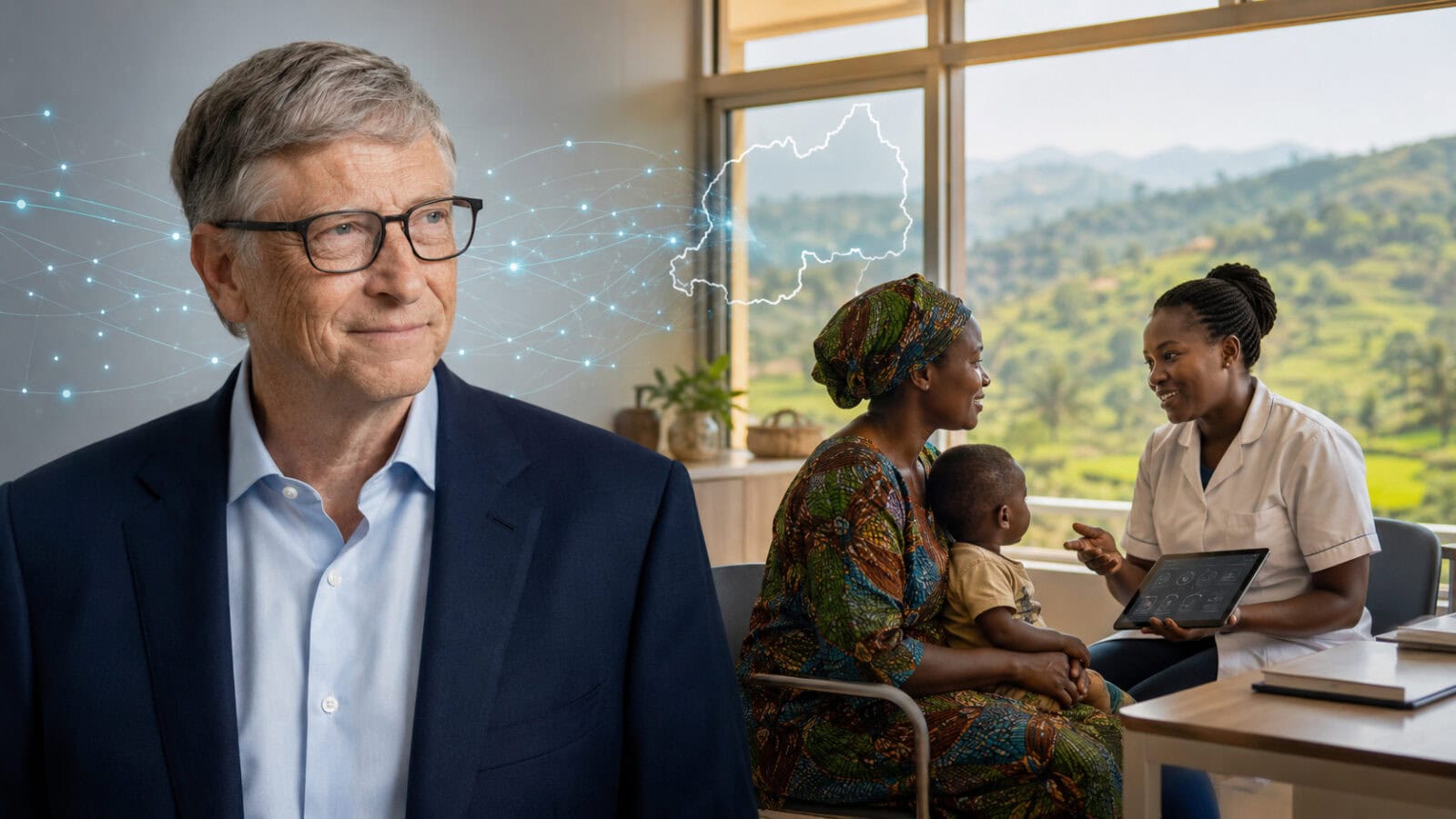
$50 million new Bill Gates initiative developed with OpenAI to bring AI tools into 1,000 primary health clinics across Rwanda by 2028
Bill Gates stood before more than a thousand government officials, philanthropists, scientists, and community leaders in New York last September and made a wager that is being graded, quite literally, the end of July of 2026.
First, the Gates Foundation chair used the stage at his foundation’s annual Goalkeepers event to announce a $912 million pledge to the Global Fund to Fight AIDS, Tuberculosis and Malaria, earmarked for the multilateral agency’s Eighth Replenishment covering 2026 through 2028 — a sum that matched, dollar for dollar, the foundation’s landmark 2022 commitment to the same cause.
As the 26th International AIDS Conference closes in Rio de Janeiro at the end of July 2026, the data being presented there read almost like a scorecard for exactly the crisis Gates warned about ten months ago.
The gift did not arrive as a quiet line item in a foundation ledger.
It arrived as something closer to a personal plea, delivered by a man who has spent more than two decades studying exactly which dollars save the most lives.
“Humanity is at a crossroads. With millions of children’s lives on the line, global leaders have a once-in-a-generation chance to do something extraordinary,” Gates told the Goalkeepers audience.
He was more direct still in an interview ahead of the event, returning to a statistic that has become something of a touchstone in his public appearances: a child born in northern Nigeria today carries a 15 percent chance of dying before age five.
“You can either contribute to improving that situation or ignore its importance,” he said, adding a note of humility rather than triumph—”I cannot compensate for the government cuts, and I do not wish to create a false impression about that.”
That humility has aged into something closer to documented fact.
Research presented at the Rio conference found that 77,163 fewer children with HIV received treatment across the 55 countries supported by the U.S. President’s Emergency Plan for AIDS Relief in 2025 than in 2024 — a 14 percent decline that researchers say cannot be explained by past prevention successes and appears instead to trace directly to funding cuts closing community-based services.
A separate UNAIDS report released for the conference showed donor government funding for HIV fell 18 percent to $7.3 billion in 2025, the lowest level in nearly two decades, even as the United States, despite its own reductions, still accounts for 74 percent of all public funding devoted to fighting HIV worldwide.
New infections rose in 21 countries last year. It is precisely this kind of erosion that Gates’s pledge was built to slow, even as he acknowledged from the start that private philanthropy could never fully replace it.
The instinct behind the gift traces back to an institution the Gates Foundation essentially helped into existence.
The Global Fund was founded in 2002 with seed funding from the foundation, and Gates has called it “one of humanity’s biggest achievements” and “one of the kindest things people have ever done for each other.”
The $912 million pledge pushed the foundation’s cumulative commitment to the Global Fund since 2002 to roughly $4.9 billion.
That money is now visibly moving: Tanzania secured a $538.6 million Global Fund grant this month to carry its HIV, tuberculosis, and malaria programs through 2029, one of many country allocations being finalized from the pool Gates’s pledge helped fill, while the Global Fund’s board approved new measures this week to help the dozens of countries scheduled to transition out of direct support over the coming cycle.
The fund is also entering new leadership, having just named Erna Solberg, the former prime minister of Norway, as its incoming board chair for a term beginning in late October.
The pledge sits inside a far larger financial picture the foundation made public just two days ago in its 2025 Annual Report: $8.47 billion in total charitable support last year, its highest budget yet, including nearly half a billion dollars more in direct cash grants than the year before.
That steady output continues in smaller, less headline-grabbing ways almost daily — this week alone the foundation issued a fresh $3 million grant to Replicate Bioscience to accelerate development of a next-generation tuberculosis vaccine using self-replicating RNA technology, the kind of unglamorous, incremental science that rarely makes news but forms the backbone of what the Global Fund money is ultimately meant to deliver downstream.
Gates spent much of July 2026 not behind a podium but on the ground, visiting Rwanda in a trip he described as a student’s rather than a donor’s.
“I’m excited to be in Rwanda this week to learn more about the country’s progress in health, agriculture, and digital public infrastructure,” he wrote, before meeting President Paul Kagame in Kigali and touring Carnegie Mellon University Africa.
The visit launched Horizon 1000, a $50 million initiative developed with OpenAI to bring AI tools into 1,000 primary health clinics across Rwanda by 2028.
That same restless itinerary has carried into other parts of the foundation’s mission this summer: a new U.S. education strategy aimed at helping 10 million young Americans earn meaningful credentials by 2045, continued investment through Gates’s separate Breakthrough Energy vehicle in cleaner aviation fuel, and reported plans for a visit to South Korea to discuss artificial intelligence and next-generation nuclear power.
Meanwhile, in a quieter but significant shift within his philanthropic circle, longtime friend and foundation benefactor Warren Buffett confirmed late last month that he is redirecting his remaining charitable share gifts to foundations run by his own children rather than to the Gates Foundation, closing out a two-decade partnership that had helped define the foundation’s scale, even as both men have spoken of the change in respectful terms.
What remains constant, as the world’s HIV, tuberculosis, and malaria community packs up from Rio today, is the arithmetic Gates keeps returning to: a foundation with roughly $200 billion left to spend before it closes its doors at the end of 2045, a Global Fund replenishment that still landed well under its $18 billion target, and a funding environment that UNAIDS this week called a “real danger” to decades of hard-won progress.
The $912 million pledge did not fix that equation, and nothing announced this week has either — but the vaccine grants, country allocations, and clinic-level programs it is now quietly financing remain, by most measures, one of the largest single forces still standing between current funding levels and a resurgence of diseases the world had believed it was close to defeating.