
$33 million in gifts to his school by Stephen Schanwald will build a state-of-the-art golf performance center and pump new life into business school program
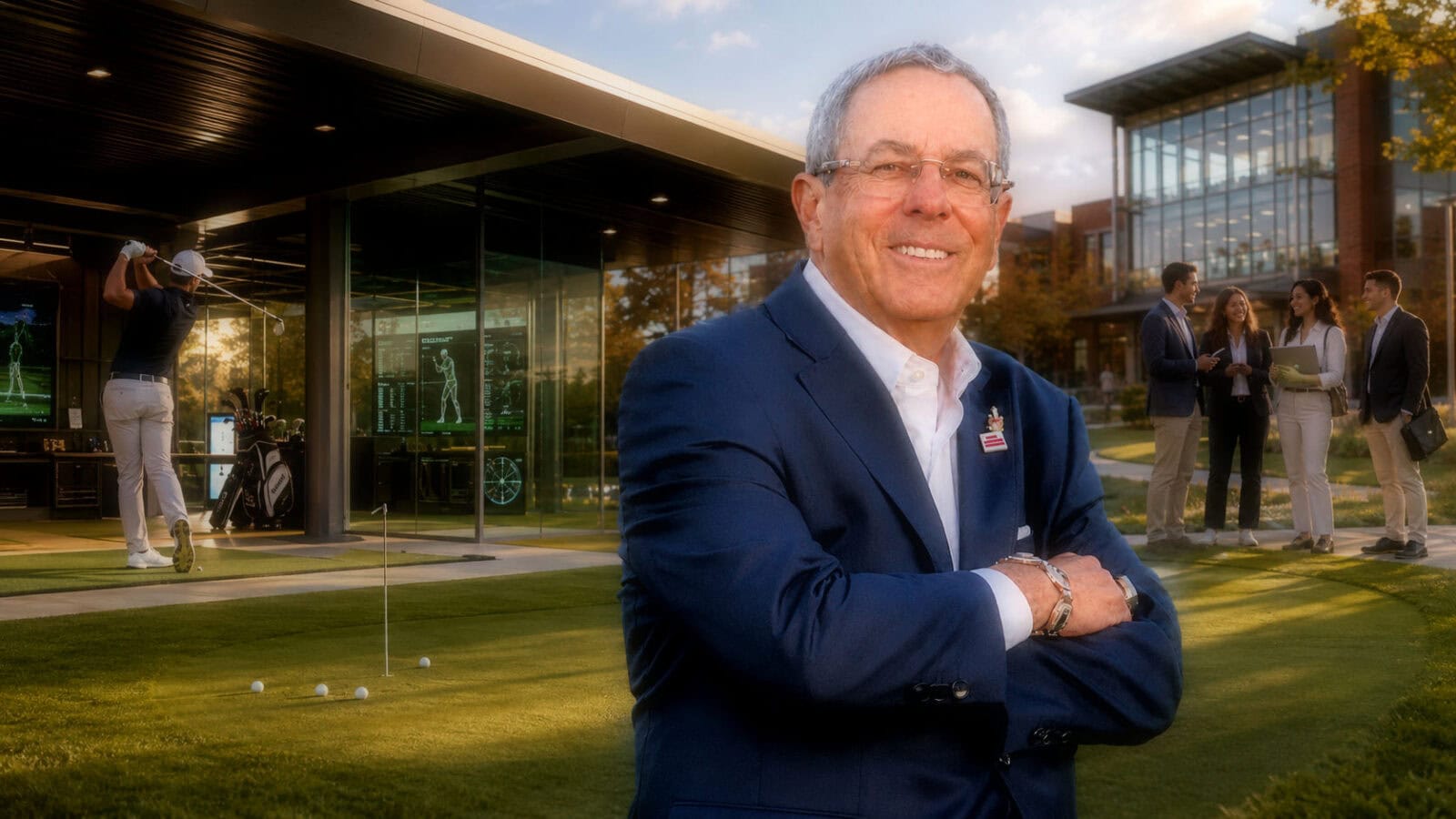
Stephen Schanwald has never stopped chasing a good drive, whether it was down the fairway at Augusta National or through the marketing playbook that turned the Chicago Bulls into a global phenomenon.
Now the 1977 University of Maryland graduate is teeing up his biggest swing yet: a fresh $15 million gift to his alma mater that will build the Terrapins a state-of-the-art golf performance center and pump new life into the business school program that already bears his name, according to a University of Maryland Athletics release.
The roughly 5,000-square-foot facility, which university officials hope to finalize the design for in 2027, will be stitched with the kind of tech normally reserved for PGA Tour pros—indoor and outdoor hitting bays, a dynamic putting lab, high-speed cameras and sensors tracking club speed and angle of contact, Doppler radar, and ball-tracking data on spin rate and distance, all built for the Terps’ men’s and women’s golf squads, per UMD Athletics.
Fittingly, the university will name the building after Schanwald himself, while the Robert H. Smith School of Business will christen a wing of Van Munching Hall the Stephen M. Schanwald Gateway for Smith in his honor, the release notes.
Schanwald calls his relationship with golf “my love affair,” and it is not hard to see why. Since retiring in 2015 after 28 years running business operations for the Bulls, he has played at least four times a week, teeing off at Augusta National, Pebble Beach, and the Old Course at St. Andrews, according to the UMD release.
The sport, he says, eased the stress of a career spent negotiating with owners, sponsors, and superstars, and it doubled as a business tool—he built lasting partnerships on the course and used a round to size up who he could trust in a negotiating room.
His favorite line on the subject doubles as a life lesson for the students he now mentors: “If your opponent moves the ball just to give himself a better lie, that might be a guy that you don’t want to trust that much in business.”
Golf even delivered one of his favorite stories, from the first time he played alongside Michael Jordan, who accidentally clipped him in the nose with a club during a practice swing—Schanwald had forgotten to account for Jordan’s enormous wingspan. He rinsed off the blood in the clubhouse and rejoined the round and cracked, “Bulls play hurt,” the university recounted.
That flair for the dramatic followed him through an entire career built around turning games into spectacles.
Schanwald’s road to the United Center began, improbably, with an unpaid internship in Maryland’s athletics department, where he spent three years learning the craft under Russ Potts, the man widely credited as the first sports marketing director in American collegiate athletics, according to UMD Athletics’ 2024 announcement.
Schanwald has called landing that internship “the greatest decision I ever made.” After graduating with a degree in general studies in 1977, he became the first director of sports promotions at the U.S. Air Force Academy, then moved through marketing jobs with the Pittsburgh Pirates—where he earned a World Series ring—and the Chicago White Sox before joining the Bulls in 1987, per the Chronicle of Philanthropy and UMD’s release.
Over the next 28 years, as executive vice president of business operations, he reimagined what an NBA night could feel like, recalling childhood halftime shows that amounted to little more than a ball cart sitting at center court.
Inspired by Las Vegas-style showmanship, he brought in acrobats, Elvis impersonators, and Blues Brothers acts, stretched 48 minutes of basketball into two-and-a-half-hour spectacles, and helped bankroll construction of the United Center in 1994 through suite sales, naming rights, and signage—all while the Bulls, powered by Jordan, became one of the most recognizable brands in sports.
Tickets stayed a hot commodity even in the lean years after Jordan’s departure. He walked away from the league with seven championship rings and a reputation, in the words of former NBA Commissioner David Stern, as “a trailblazer in every sense of the word.”
This new $15 million commitment is not Schanwald’s first major investment in the university that launched him.
In 2024, he directed $18 million to Maryland—$10 million to athletics department priorities and $8 million to endow what became the Stephen M. Schanwald Sports Management Program at the Smith School, plus scholarships for its students, a gift that ranked as the third-largest in Maryland Athletics history and marked his second straight year of a $10 million commitment to the athletic department, according to UMD’s 2024 release.
That gift put his name on the XFINITY Center Pavilion and the football practice fields at Jones-Hill House and created the Schanwald-Potts External Operations Suite honoring his old mentor.
Combined with the new golf gift, Schanwald’s giving to Maryland now totals at least $33 million, all counted toward the university’s $2.5 billion “Forward: The University of Maryland Campaign for the Fearless.”
The sports management program remains something close to a personal project for him. Beyond the money, Schanwald actively shapes its curriculum, arranges guest lectures from major sports-industry figures, and organizes student trips to the NFL, NBA, and MLB headquarters in New York, the university said.
The new funding will enable the program to add a minor and a major, hire additional faculty and staff, and build its national profile.
“His transformative involvement extends beyond his generous gift,” said Smith School dean Prabhudev Konana. “He offers his time and extensive industry knowledge to ensure students in the program are prepared to become leaders and innovators in the business of sports.”
Maryland’s leadership, unsurprisingly, is thrilled. Athletic director Jim Smith said the gift “will transform the experience for our men’s and women’s golf student-athletes by providing a world-class training environment while strengthening our ability to recruit, develop, and compete at the highest level,” adding that “Steve’s vision and generosity will have a lasting impact on our golf programs and on generations of Terps to come.”
Men’s golf coach John Phillips called the coming facility “a game changer” that will “give us another rallying point to move the program forward, make our student-athletes feel special, and ensure that their hard work is rewarded.”
University president Darryll J. Pines said Schanwald’s background “gives him a unique perspective on how sports connect us to each other and to institutions,” and that the gift “promises to benefit everything we do at the University of Maryland.”
For Schanwald himself, the motivation traces back to that same stress-relieving fairway obsession and to a program he believes teaches life skills disguised as a game: persistence, patience, discipline, and—win or lose—grace.
As he put it of the new center, “The golf performance center will allow us to recruit even greater players, help them reach their full potential, and compete for Big Ten and national championships.”