$30 million seed money from Toby Devan Lewis inspired a constellation of other significant donors to create an architectural masterpiece, celebrated as one of the world’s most important contemporary art museums
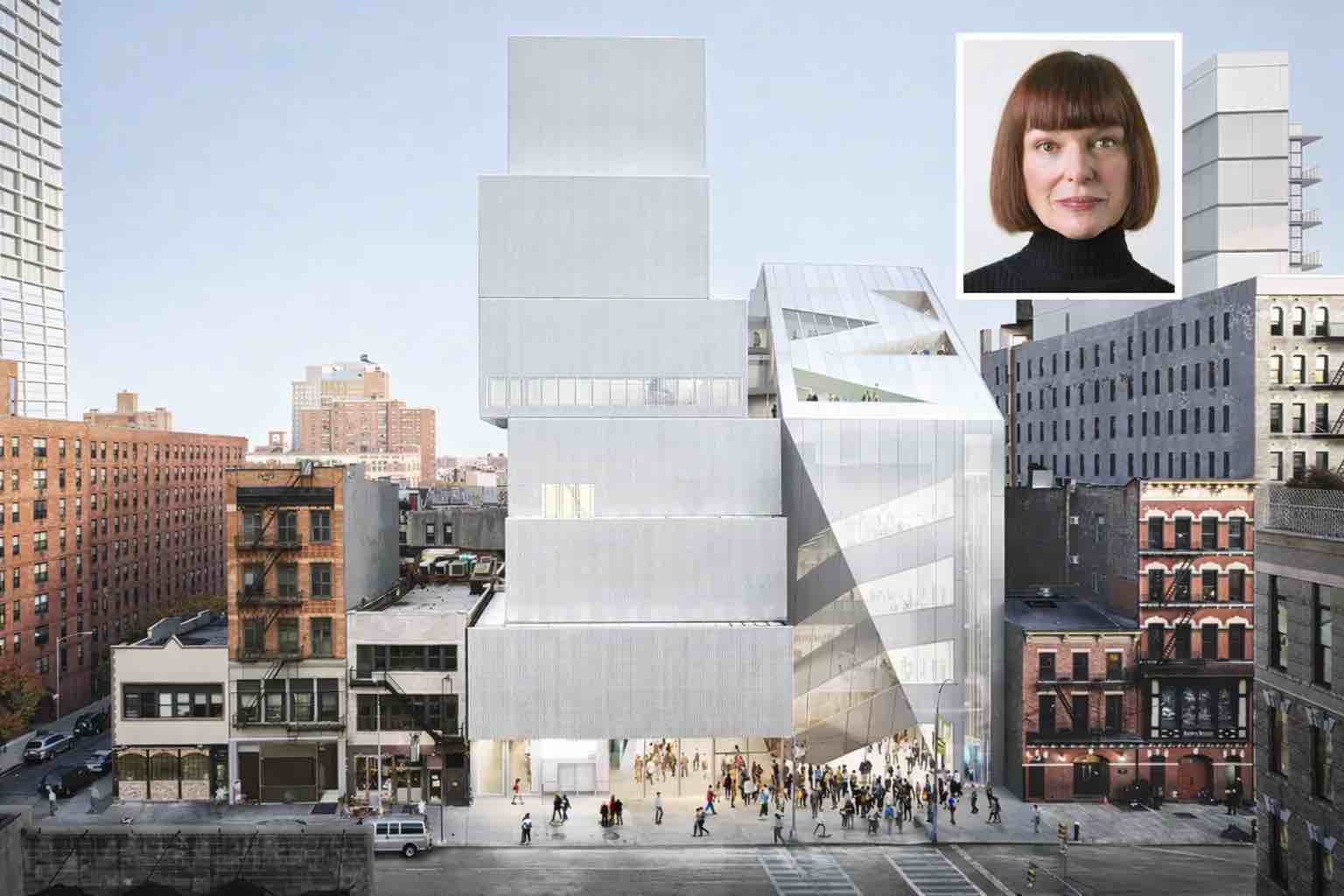
The New Museum’s return to the Bowery in March 2026 reads as both an architectural statement and a declaration of intent and nowhere is that clearer than in the constellation of major donors who have quietly underwritten its striking new silhouette and ambitious reopening exhibition, “New Humans: Memories of the Future.”
The institution, long celebrated as one of the world’s most important contemporary art museums precisely because it does not collect, has doubled its footprint with an OMA‑designed second building that extends SANAA’s 2007 stack of boxes into a 120,000‑square‑foot campus, allowing its international, non-collecting mission to unfold at a new scale.
At the center of that expansion is the late curator, collector and philanthropist Toby Devan Lewis, whose 30-million-dollar commitment stands as the largest gift in the museum’s history and secured naming rights for the new building.
A longtime trustee and early champion of the institution, Lewis effectively turned a bold architectural plan into a buildable project, anchoring the quiet phase of the capital campaign and signaling to peers that this was not a speculative bet but a serious, long-horizon investment in the museum’s future.
Her support is visible in the skyline, where the Toby Devan Lewis Building now joins the original Bowery tower, but colleagues point just as readily to her decades of backing experiment and risk: writing early checks for emerging artists, encouraging curators to push beyond conventional surveys, and insisting that a museum devoted to the “new” had to be structurally nimble.
The expansion translates that philosophy into concrete and glass, giving curators the horizontal galleries, double-height spaces and circulation routes they lacked in the original vertical stack.
Around Lewis’s keystone gift, the Board of Trustees has taken on an unusually prominent role in financing the museum’s next chapter.
Campaign materials describe a goal in the range of roughly 110–125 million dollars, covering construction, fit-out, and an endowment boost, with trustees providing a “majority” of that total through a ladder of seven- and eight-figure commitments that effectively de-risked the project before it went public.
For this circle of board leaders, philanthropy is not a ceremonial obligation but a form of co-authorship: their capital has enabled the museum to imagine a campus that supports not only galleries but also spaces for research, education, residencies, and digital initiatives that do not lend themselves to donor plaques as easily as a named hall.
In conversations around the opening, Director Lisa Phillips has framed these trustee gifts as a vote of confidence in the idea of a non-collecting, internationally oriented museum in a city where the economics of real estate and the attention economy could easily have pushed such an institution to the margins.
Their decision to double down on the Bowery, rather than retreat to safer institutional models, has allowed the New Museum to keep defining itself as a laboratory for contemporary practice rather than a mausoleum of contemporary trophies.
Public capital, from the City and State of New York, adds another layer to this patronage architecture. While smaller in scale than the top private gifts, municipal and state funds have helped close the gap between ambition and affordability, tying the project to broader civic goals around cultural infrastructure, education and neighborhood development.
For the Bowery—once synonymous with flophouses and now a nexus of galleries, hotels, and creative industries—the New Museum’s enlarged presence is both emblem and catalyst.
When SANAA’s original building opened in 2007, it helped redefine the district as a destination; the 2026 iteration, with its expanded public spaces and new plaza, reinforces that transformation and raises the stakes in ongoing debates over gentrification, access, and who benefits from culture-led development. In that context, the involvement of public funders nudges the institution toward an explicitly civic posture, with free opening-week programs, partnerships with schools and community organizations, and a renewed emphasis on the museum as a shared resource rather than an exclusive club.
All of this provides the stage for “New Humans: Memories of the Future,” the reopening exhibition that threads the story of the building’s benefactors into a much larger conversation about technology, power and the definition of the human. Curated by Artistic Director Massimiliano Gioni, the show sprawls across the expanded campus from March 21 through August 23, 2026, bringing together more than 150 artists, architects, filmmakers and thinkers to examine how the idea of “the human” has been redefined by machines, social upheaval, and the unfinished business of decolonization in the 20th and 21st centuries.
The artist list underscores the museum’s international focus, with work by figures from Argentina, Brazil, Martinique, Mexico, Morocco, Nigeria, Peru, Spain and beyond, many of them addressing the ways in which borders, extraction economies and digital systems continue to shape who is granted full personhood.
Gioni’s Italian roots surface in the exhibition’s running dialogue with Italian Futurism, the early 20th-century movement that glorified technology, speed, and war as a cleansing force meant to launch Italy into an industrial modernity. Futurist paintings and manifestos appear not as heroic origin stories but as cautionary touchstones, visually seductive yet ideologically fraught, their “fast and sexy” images countered by the historical record of violence and authoritarianism they helped romanticize.
The show draws a pointed parallel between that moment and the present, when some of the most advanced technologies are again concentrated in military, surveillance, and extractive applications, and when the unfinished project of decolonization feeds culture wars over identity, historical curricula, and public monuments. In one sense, the museum’s new architecture, sleek, luminous, unmistakably of the global-creative-city playbook, is funded by wealth generated in the same interconnected systems that the exhibition scrutinizes, a tension that the institution does not resolve so much as stage.
For the New Museum’s top donors, this framing offers both a challenge and an opportunity.
Their names are inscribed in a building that houses an exhibition explicitly concerned with who controls the tools and narratives of the future, and how technology amplifies existing inequalities.
Rather than steering clear of those questions, the museum invites them in: AI-generated imagery, surveillance aesthetics, and speculative bodies share space with archival material from earlier technological revolutions, suggesting that cultural institutions—and the philanthropists who sustain them—are implicated in these histories whether they acknowledge it or not.
In this light, Lewis’s bequest, the trustees’ pooled capital, and the city’s investment read less as acts of neutral beneficence and more as wagers on the value of a public space where such entanglements can be examined openly by a broad and diverse audience.
On the Bowery today, the New Museum’s two interlocking structures glow above a neighborhood that has already lived through several cycles of reinvention.
Inside, “New Humans: Memories of the Future” maps a century of attempts to imagine new kinds of people, from Futurist machine worship to postcolonial cyborgs and networked identities, while outside, the building itself stands as a testament to another, quieter sort of speculation: that a small group of committed donors and public partners can, together, build an institution agile enough to keep pace with the art—and the questions—that the future will bring.