
$28 million gift from Dick and Cornelia Corbett built Tampa’s Egypt moment
When the Tampa Museum of Art threw open its doors for Mysteries of the Nile: Ancient Egypt, the mummies, sculptures and gold jewelry filling its redesigned galleries were the headline.
But the real story of how a mid-sized Florida museum came to mount its first full-scale Egyptian exhibition, borrowing more than a third of its 117 objects from the Royal Ontario Museum’s 25,000-piece trove, starts decades earlier and traces back to one man: Tampa real estate developer Dick Corbett, whose $28 million lead gift anchors the Centennial Campaign that made the show’s redesigned galleries possible in the first place.
Richard A. “Dick” Corbett is not a newcomer to Tampa philanthropy, and he is not a passive checkbook donor.
Born in Rochester, New York, and a 1956 graduate of Aquinas, Corbett went on to Notre Dame and then Harvard Business School before landing, almost improbably, in the Kennedy White House as an aide to President John F. Kennedy. He later moved into the Kennedy business office and became national treasurer of Robert F. Kennedy’s 1968 presidential campaign, an origin story he chronicled decades later in his own book, Ringside Stories: From the Kennedy White House to Real Estate Everest.
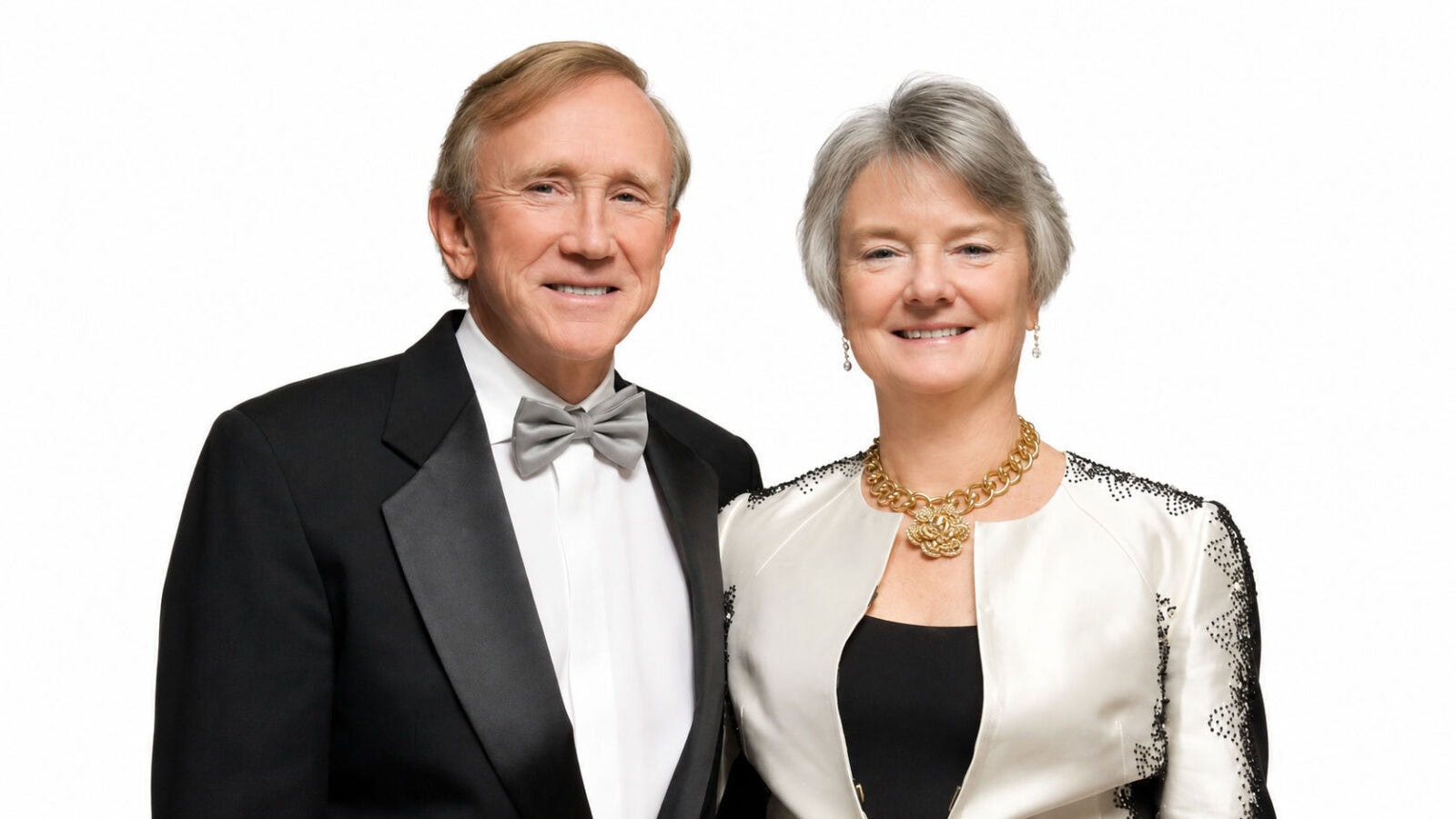
That same year, 1968, he married Cornelia “Cornie” Corbett, a descendant of a Founding Fathers-era family, and the two have built a philanthropic partnership ever since that now touches nearly every major cultural, educational and conservation institution in the Tampa Bay region.
The fortune behind that philanthropy came from real estate.
After starting out as an investor and developer in New York City, Corbett relocated to Tampa, where he built Concorde Companies into a firm responsible for more than $1 billion in complex development.
His signature project, Tampa International Plaza and the adjoining Bay Street, is a three-million-square-foot mixed-use retail, office and hotel complex beside Tampa International Airport that has drawn more than 20 million visitors a year since opening in 2001, generating thousands of permanent jobs and hundreds of millions of dollars annually for the regional economy.
Along the way he also owned the NASL’s Tampa Bay Rowdies, cementing his place as one of the city’s more colorful civic builders.
It is that fortune, and a genuine, decades-long devotion to the Tampa Museum of Art specifically, that set up this summer’s Egypt exhibition.
Corbett’s relationship with the museum did not begin with the Centennial Campaign; in 2010 he made a $5 million gift in his wife’s name that put her name on the museum’s riverfront home, the Cornelia Corbett Center, and Cornie Corbett has since served as a longtime museum board leader and now chairs the Centennial Campaign itself.
When the museum launched its Centennial Campaign for Renovation and Expansion during its 100th-anniversary year, Corbett stepped in again as the lead donor, a gift the museum now describes as anchoring more than $100 million raised from individuals, families, corporations, the City of Tampa, Hillsborough County and the State of Florida, and the single largest private donation ever made to a public art museum in Florida history.
“The Tampa Museum of Art strengthens arts and culture in our vibrant city and opens the eyes of schoolchildren to the power of beauty and imagination,” Corbett has said of the gift, framing it explicitly around access for children rather than prestige for himself.
That gift is now visibly at work.
It funded the renovation that expanded the museum’s exhibition and collections space from 14,800 to more than 43,000 square feet and opened the 8,000-square-foot Vinik Family Education Center, the redesigned galleries in which Mysteries of the Nile now sits.
It is also underwriting the museum’s $110 million Centennial Expansion, a more than 51,000-square-foot addition along the Tampa Riverwalk designed by WEISS/MANFREDI, for which construction manager The Beck Group began preliminary site work in August 2025, starting with relocating the Curtis Hixon Waterfront Park dog runs to make way for a structure that will extend toward the Hillsborough River.
Interim executive director Tom Hochhausler, a longtime board member and Deloitte accountant who took over administrative leadership in April as the museum manages its leadership transition mid-campaign, put the mission in plain terms: “Making world-class collections accessible to everyone is at the heart of what we do at the Tampa Museum of Art.”
The Egypt show itself carries Corbett’s fingerprints even in its curatorial logic.
Curator Branko van Oppen specifically chose the Royal Ontario Museum as a partner because its early 20th-century Egyptian holdings were legally excavated under official archaeological campaigns, a provenance question that has become central to any serious antiquities exhibition today, and that clean history shaped how the 117-object show, more than a third of it on loan from Toronto, came together.
Standouts include a 1933 plaster replica of the bust of Nefertiti from the ROM, a Late Period wood Bust of a Man and a basalt Ovoid Head of Aged Man both from the Sorvats-Trebor Collection, a Ptolemaic-era Collar with Falcon Heads from a private collection, and the museum’s own bronze Feline Goddess Bastet from its Joseph Veach Noble Collection, itself a legacy of a foundational 1986 acquisition of roughly 175 ancient Greek and South Italian ceramics that first put Tampa on the map for classical scholarship.
The U.S. Department of State underscored the stakes in March, publishing a Federal Register notice declaring the show’s foreign-loaned artifacts culturally significant and immune from judicial seizure while on display.
Presented by Fifth Third Bank and expected to welcome roughly 15,000 elementary school students and teachers over its two-year run through June 2028, the exhibition is precisely the kind of children-focused access Corbett has said motivates his giving.
The museum’s Egyptian collection had already made headlines on its own before this exhibition existed. A 2024 analysis by University of South Florida researchers working with van Oppen found trace residues of a fermented, hallucinogenic liquid inside a 2nd-century BCE Bes mug long held in the museum’s permanent collection, rare chemical evidence of ancient ritual practice that hinted at the depth of scholarship an institution like Tampa’s could bring to a show of this scale once it had the gallery space to do it justice.
Art and education are only one front of Corbett’s philanthropy, and Mysteries of the Nile fits a pattern that runs through his giving generally: build the infrastructure, then open it to children.
He and Cornelia designed, financed and helped construct Corbett Preparatory School of IDS in Tampa, where they sent all four of their children, and put up $1.5 million toward the University of South Florida’s Corbett Stadium, one of the nation’s premier collegiate soccer venues, followed by a later $500,000 gift for a digital information wall in USF’s Muma College of Business.
In 2015 the couple sent $35 million to Corbett’s alma mater, Notre Dame, split between a $25 million gift underwriting the 280,000-square-foot Corbett Family Hall, now home to the anthropology and psychology departments, and a $10 million endowment for the university’s head football coaching position.
Outside the classroom, Corbett’s second great passion has been conservation, pursued with the same hands-on intensity he brings to real estate and museum-building.
He and Cornelia co-own Pinckney Hill Plantation, a roughly 16,000-acre farm and wildlife preserve in Florida’s Red Hills near Monticello, managed for native species and known for traditional horseback quail hunting.
Since 2003 he has served as a governor-appointed commissioner on the Florida Fish and Wildlife Conservation Commission, rising to chair, and he is a Diamond Legacy sponsor of Ducks Unlimited, having committed $1.575 million to the organization’s youth recruitment, education and habitat programs and serving as a trustee of the Wetlands America Trust.
Taken together, the résumé, JFK aide, RFK campaign treasurer, billion-dollar developer, museum patron, Notre Dame benefactor, wildlife commissioner and published author, reads like several careers stitched into one.
But in Tampa, Corbett’s name is now inseparable from a single riverfront institution he has spent decades and tens of millions of dollars building toward this exact moment: two years of ancient Egypt, on loan from Toronto, under legal protection from the federal government, in galleries that would not exist without him.