
$25 million: Rich and Nancy Kinder open a year at Oxford for Mizzou’s students of democracy — part of over $900 million committed through their foundation
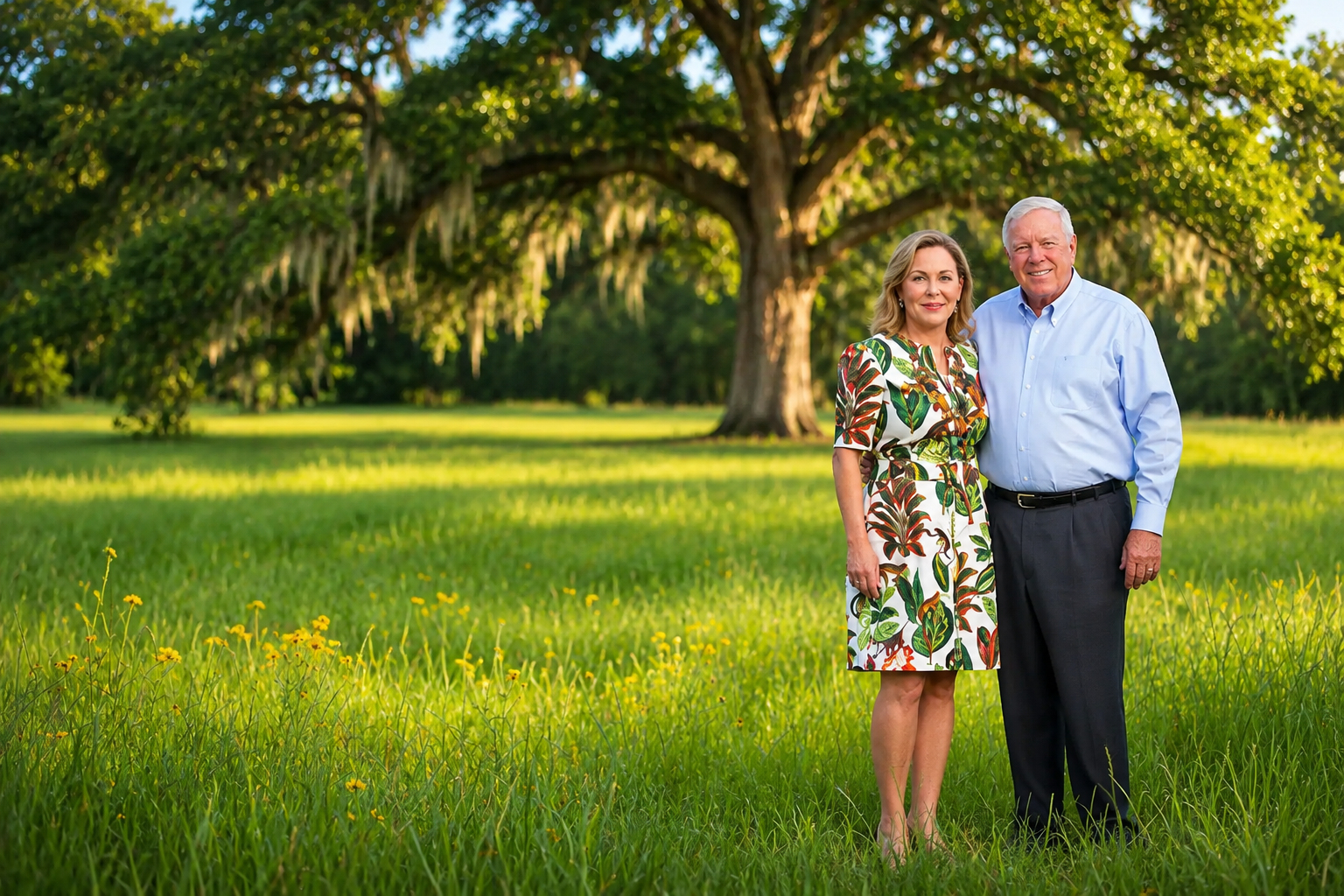
Rich Kinder came home to Columbia recently, as he has many times over the past decade, with his wife, Nancy, beside him and a plan for students who are now younger than his grandchildren.
Under the high dome of Jesse Hall, the building that houses the institute bearing their name, the Houston philanthropists announced a $25 million, five-year grant from the Kinder Foundation to the University of Missouri’s Kinder Institute on Constitutional Democracy.
Their granddaughter, Kendall Howes, stood with them for the photographs.
The gift goes into the institute’s endowment, which is now the largest at Mizzou.
It also brings the Kinders’ support for the institute to more than $85 million, built over eleven years and four major commitments: a founding $25 million in 2015, $10 million in 2019 to create new degrees, another $25 million in 2022 to add faculty and expand student programs, and now this.
The centerpiece is a deeper partnership with the Rothermere American Institute at the University of Oxford.
Beginning in the fall of 2028, Mizzou’s master’s program in Atlantic history and politics will become a two-year experience shared by both universities, with American and British students spending one year in Columbia and one year in Oxford.
Today the program includes four weeks in England. Students will also be able to earn credit through internships in London, modeled on the Kinder Scholars program that already places Mizzou undergraduates in jobs across Washington each summer.
The grant also funds new faculty positions, broader research, international research opportunities for every faculty member, and added support for graduate and doctoral students.
For Rich Kinder, the connection is personal and long. He grew up in Cape Girardeau, on the banks of the Mississippi in southeast Missouri, and earned both his undergraduate degree and his law degree at Mizzou, in 1966 and 1968.
He went on to build Kinder Morgan into one of North America’s largest energy infrastructure companies, with tens of thousands of miles of pipeline.
Yet those who know him often return to a smaller detail from his boyhood: as sports editor of his high school newspaper, he was fired for questioning the judgment of the basketball coach.
A taste for argument, and for the freedom to make it, seems to have stayed with him.
“We’ve long believed that understanding our nation’s founding principles is essential to preparing future generations to lead,” he said.
“We’re pleased to support the students and faculty who are carrying that work forward.”
At the ceremony, he put it more simply: “Everybody has the desire to leave the world a little better place than we found it.”
And when he talked about why he keeps coming back, he spoke of the students themselves.
“It just means a lot when you get to see the individual students and you get to see the opportunities that are now possible for them.”
Nancy Kinder is the other half of this partnership, and in many ways its daily engine.
A native of New Iberia, Louisiana, who studied at the University of Louisiana at Lafayette, she is president and chief executive of the Kinder Foundation, which the couple founded in 1997, the same year they married.
In Houston she is known for a hands-on style of giving, sitting down with city officials, civic groups, and young leaders to see projects through from first sketch to opening day.
Her name is tied to the city’s transformation: Discovery Green downtown, where she was founding chair of the conservancy; Buffalo Bayou Park; the Bayou Greenways trail network; the renewal of Memorial Park; and, most recently, an $18.5 million expansion of Emancipation Park in the historic Third Ward.
She also leads the advisory board of Rice University’s Kinder Institute for Urban Research, a sister institution of sorts that studies the life of cities the way the Missouri Institute studies the life of the republic.
Together the Kinders have committed more than $850 million in grants through their foundation, most of it in Houston, focused on urban green space, education, and quality of life.
In 2011 they were among the earliest signers of the Giving Pledge, and they went well past its minimum, promising to give away 95 percent of their wealth, now estimated at about $11 billion, during their lifetimes and through the foundation after they are gone.
Rich Kinder once summed up the decision with a wry aside to the next generation: “We’re giving 90 to 95 percent — sorry, grandchildren — back to our foundation.” The couple has said they want their grandchildren to be proud of what that money does.
At Mizzou, it is already doing a great deal.
What began in 2014 as a modest forum on constitutional democracy has grown into one of the country’s leading centers for the study of American political history and the ideas behind it.
Today about 150 students are pursuing the institute’s bachelor’s degree in constitutional democracy, 130 are in programs off campus in North America, Europe, and Africa, and 40 first-year students live and learn together in its democracy lab.
The institute is run jointly by Mizzou’s history and political science faculty, and it has drawn students from well beyond those departments.
That breadth is deliberate.
“We don’t just want to educate lawyers,” Rich Kinder has said.
“We need doctors, engineers, journalists and architects to understand the founding. They’ll all go out there and be leaders in their community in a different discipline.”
The institute’s founders have also been careful about what it is not.
Its mission is not to steer students toward a party or ideology but to give them context and the habits of critical thinking.
Rich Kinder has admitted that he did not foresee how much that would matter.
“I thought it would be important,” he said last year, “but I didn’t realize we were heading into a time where we would have such divisive politics at the state and federal level, where we’d have camps that just think whatever the other side says is a lie, and there’s no civil discourse anymore.
Over the 10 years since we founded it, I think it’s become much more important than I ever dreamed it would become.”
Jay Sexton, the institute’s director, who taught at Oxford before coming to Missouri and brought the Rothermere connection with him, frames the new grant as both a history lesson and a renewal.
“American constitutional democracy has always been part of a wider Atlantic story,” he said.
“Through our partnership with Oxford’s Rothermere American Institute, our students and faculty not only study that shared history but help renew the traditions of transatlantic cooperation that will be as important to the future as it has been to the past.”
His own summary of the institute’s purpose was plainer: “We’re doing what public institutions of higher education should do, which is give smart kids opportunities.”
University of Missouri System President Mun Choi called the day a celebration of “remarkable leaders whose vision, generosity and commitment to education have transformed our university.”
The Kinders, he said, “understand that the strength of our nation depends on an informed citizenry, one that understands our founding principles as a constitutional democracy.”
The grant counts toward Power the Roar, Mizzou’s $2 billion campaign, the largest in the university’s history, and vice chancellor for advancement Chris Smith said the couple “epitomize” its spirit.
For a young person from a small Missouri town, the change is easy to picture.
A student who might once have seen Oxford for a month can now live there for a year, read in its libraries, argue in its seminars, and come home with a London internship on a résumé and a wider sense of where the American experiment came from.
Rich Kinder made that journey in his own way, from Cape Girardeau to Columbia to the heights of American business.
Now, with Nancy, he is making sure the road runs a little farther for the students who follow.
“We know, as the old saying goes,” he told the crowd in Jesse Hall, “the best is yet to come.”