
$200 million gift to university from Mark and Mary Stevens aims to accelerate discovery across health sciences, national security, business innovation, and the creative arts—fields that increasingly converge through the power of advanced computing
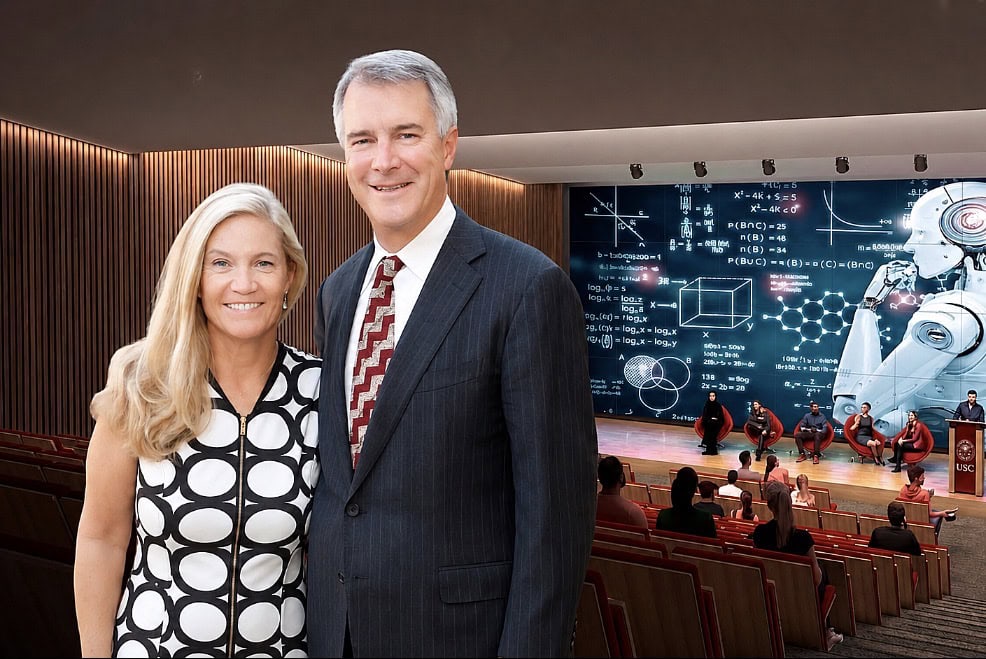
The University of Southern California has entered a defining new chapter in its history with a $200 million gift from venture capitalist Mark Stevens and his wife, Mary, a contribution that stands among the largest ever made to the institution and signals a profound vote of confidence in the university’s future at the forefront of artificial intelligence.
The gift launches a university-wide initiative to accelerate discovery across disciplines—from health sciences and national security to business innovation and the creative arts—fields that increasingly converge through advanced computing.
At the center of this moment is not only the scale of the investment, but the arc of the donors’ own story. Mark Stevens, a USC alumnus who earned both his undergraduate and master’s degrees from the university in the early 1980s, has long embodied the entrepreneurial and intellectual ethos that USC seeks to cultivate.
As a partner at Sequoia Capital, Stevens helped shape the modern technology landscape through early investments in companies that have become foundational to daily life—Google, NVIDIA, Yahoo, and YouTube among them. His presence on Forbes’ Midas List reflects decades of identifying transformative ideas before they enter the mainstream, but those who know his career best often point to a deeper throughline: a belief in the catalytic power of institutions and individuals when given the right tools at the right moment.
That philosophy is evident in the Stevenses’ philanthropic trajectory. Their giving has consistently been centered on enabling innovation at scale, particularly where technology intersects with human outcomes.
At USC, their prior support helped establish the Mark and Mary Stevens Neuroimaging and Informatics Institute, where researchers are harnessing AI to analyze vast datasets of brain scans, unlocking earlier and more precise diagnoses for neurodegenerative diseases such as Alzheimer’s and Parkinson’s.
The couple’s investments have also reflected a nuanced understanding that breakthroughs rarely occur in isolation; rather, they emerge from ecosystems where disciplines collide—where engineering meets medicine, where data science informs ethics, and where computation expands the boundaries of human creativity.
Their latest gift builds on that philosophy with uncommon ambition. In recognition of their generosity, the USC School of Advanced Computing will now be named the USC Mark and Mary Stevens School of Computing and Artificial Intelligence, serving as the intellectual and physical hub for AI research and education across the university.
Yet the renaming is less a capstone than a catalyst. The Stevens gift is explicitly designed to recruit leading AI researchers, support interdisciplinary collaboration, and position USC as a global destination for talent eager to push the boundaries of what artificial intelligence can achieve responsibly.
For Mark Stevens, the timing is deliberate.
He has long argued that moments of technological inflection demand decisive institutional investment, and he sees AI as precisely such a moment. His career has been defined by recognizing when emerging technologies transition from promise to inevitability, and his confidence in USC reflects both personal loyalty and a clear-eyed assessment of its trajectory.
The university already ranks among the nation’s leaders in federally funded computer science research and produces a remarkable share of graduates who go on to shape Silicon Valley and beyond. In Stevens’ view, the next era will belong to universities that not only teach computing but also integrate it deeply into every domain of inquiry.
Mary Stevens, though less publicly profiled, has been an equally important partner in shaping the couple’s philanthropic vision. Together, they have approached giving with a long-term perspective, emphasizing initiatives that will endure and evolve rather than deliver immediate but limited impact.
Their support for USC reflects a belief in education as a multiplier—an investment that extends far beyond campus boundaries through the students, researchers, and ideas it empowers. Colleagues and collaborators often describe their philanthropy as both strategic and deeply personal, rooted in a shared conviction that access to knowledge and innovation can meaningfully improve lives.
The initiative their gift supports is broad in scope and ambition. At USC, artificial intelligence is already being deployed to tackle some of society’s most pressing challenges: improving early detection of neurological disease, developing tools to prevent suicide among students and active-duty military personnel, enhancing immersive training environments for defense applications, and redefining storytelling through virtual production in film and gaming.
The Stevens investment amplifies these efforts, providing the resources to scale them while fostering new collaborations across disciplines that have not traditionally worked in tandem.
Their emphasis on ethics and human-centered design, an area where the Stevenses’ influence is particularly resonant. As AI’s capabilities grow, so too do questions about its responsible use. USC’s Institute on Ethics and Trust in Computing and its Center for AI in Society exemplify an approach that balances technological advancement with moral and societal considerations—one that closely aligns with the donors’ belief that innovation must be guided by purpose.
Their support ensures that USC’s leadership in AI will not be measured solely by technical achievement but by its contribution to human well-being and agency.
The ripple effects of this gift are expected to extend well beyond Los Angeles. With a global alumni network of more than 500,000 and a longstanding reputation for interdisciplinary excellence, USC is uniquely positioned to translate academic breakthroughs into real-world applications.
By strengthening its AI capacity, the university strengthens its role as a bridge between research and impact institutions, where ideas are not only conceived but also deployed to address complex global challenges.
For the Stevenses, this moment represents both a continuation and an evolution of their lifelong engagement with innovation. Their journey from USC students to influential figures in the technology and investment worlds has come full circle, culminating in a gift that seeks to empower the next generation of thinkers, builders, and leaders.
It is a gesture that reflects gratitude, certainly, but also a forward-looking vision—one that recognizes that the most meaningful legacies are not measured in dollars alone but in the opportunities created and the futures shaped.
As artificial intelligence reshapes industries and societies, the Stevens gift positions USC to help define that transformation.
More importantly, it underscores the enduring role of philanthropy in accelerating progress at critical junctures.
In Mark and Mary Stevens, USC has found not only benefactors, but partners in imagining what comes next—and in ensuring that the benefits of that future are as واسع and inclusive as the technology itself promises to be.