
$15 million and $10.45 million: Robert and Stefanie Skinner and Elisabeth C. DeLuca give university two different visions of a winning future as campaign tops $900 million
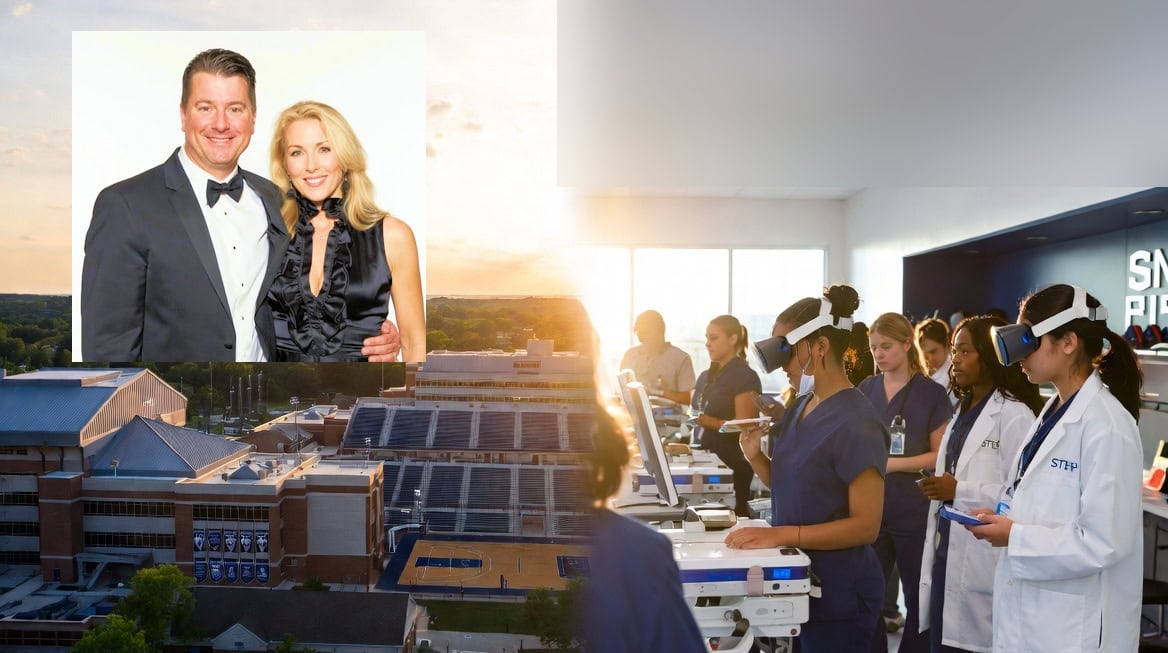
Storrs, Connecticut, is having a landmark philanthropic summer, and two gifts sitting side by side on the University of Connecticut’s ledger tell a story about how different kinds of loyalty can build the same institution.
As the UConn Foundation closed out its 2026 fiscal year, officials announced the “Because of UConn” campaign had blown past the $900 million mark, its most successful fundraising year in the university’s history, with $171 million raised in twelve months alone, a figure 143 percent higher than the pre-campaign baseline of fiscal year 2019.
Among the headline gifts propelling the campaign from its $800 million mark in November to $900 million by June: a $15 million commitment from alumnus Robert Skinner and his wife Stefanie aimed squarely at UConn Athletics, and a $10.45 million pledge from the Elisabeth C. DeLuca Foundation designed to open new doors for nursing and STEM students in Waterbury, a struggling mill city about 20 minutes from the flagship Storrs campus.
The Skinner gift reads almost like an insurance policy for a dynasty.
Robert Skinner, a 1993 graduate of the College of Liberal Arts and Sciences, structured $10 million of his commitment as a planned gift that will permanently endow the head coaching positions of both UConn basketball programs, one fund built in the name of the legendary Geno Auriemma, the other honoring the lineage that runs from Jim Calhoun to current coach Dan Hurley.
The Skinners seeded each fund with $5 million, with UConn openly hoping fellow Huskies fans will double each endowment to $10 million over time.
It’s not hard to see why the family felt moved to protect the program’s future: between them, the men’s and women’s teams have combined for 18 national championships, 33 Final Four trips, and a level of sustained dominance that has become the defining brand asset of the entire athletic department.
“For over four decades, the standard at UConn has been shaped by leadership, discipline, and a commitment to excellence,” Skinner said in the announcement, framing the gift as being made “with deep gratitude for those who established that standard, and with a shared responsibility to ensure it endures.”
Athletic Director David Benedict called it one of the most significant commitments in the program’s history, one that will “strengthen the foundation of everything we do.”
The remaining $5 million of the Skinner gift was carved into smaller, still meaningful pieces: $1.5 million in flexible funding for the athletic director’s office, $1 million toward a planned 22-acre golf training facility roughly a mile and a half south of campus, and $2.5 million spread across football, baseball, men’s soccer, and men’s ice hockey, programs officials say have built real momentum under a new generation of coaches.
If the Skinner money is about locking in a winning culture, the DeLuca money is about building one from scratch in a city that needs it.
The Elisabeth C. DeLuca Foundation is no stranger to UConn; its namesake, a 1969 nursing alumna and the widow of Subway sandwich empire cofounder Fred DeLuca, has become arguably the single most transformative donor in university history, having already committed $50 million to construct the gleaming new DeLuca Hall for the nursing school that now bears her name.
The latest $10.45 million tranche takes a very different shape.
Rather than bricks and mortar in Storrs, it is aimed at Waterbury, where only 49 percent of students currently go on to college and STEM retention lags well behind state averages.
Roughly $5.45 million funds a new Husky Prep Academy and an “Ideas to Action” lab where high schoolers as young as ninth grade get hands-on time with virtual reality, augmented reality, and real medical equipment, banking up to 30 UConn credits, about a year of college, before they ever formally enroll.
The foundation sweetened that piece further with a $1.65 million matching-fund pledge, meaning every dollar the community raises for the lab unlocks foundation money behind it.
The remaining $5 million launches what UConn is calling the first program of its kind: a four-year nursing pathway that lets Waterbury students start their coursework locally before transitioning in their junior and senior years to DeLuca Hall itself, complete with a new simulation center, added faculty, and an enrollment target of 300 nursing students by 2028.
“Waterbury students are talented and ambitious. What’s too often missing is a clear, supported pathway,” said Fumiko Hoeft, dean of the UConn Waterbury campus, describing the initiative as a “cradle-to-career pipeline.”
Victoria Vaughan Dickson, dean of the nursing school, called it a way to reach “talented individuals who might otherwise face barriers to entering the profession.”
Together, the two gifts anchor a campaign that university leaders are treating as a referendum on philanthropy’s role in public higher education.
UConn Foundation CEO Amy Yancey said the DeLuca match “means more students will have access to life-changing opportunities,” while Foundation president and campaign co-chair Richard Eldh noted the broader haul, more than 276,000 individual gifts from nearly 70,000 donors, with 89 percent of them under $1,000, shows the campaign is “a powerful reflection of what UConn means to our alumni, donors, parents, faculty, staff, and friends.”
University President Radenka Maric tied the momentum directly to strategic goals of pushing the six-year graduation rate to 90 percent and growing the endowment, now at $715.26 million, toward the $1 billion mark.
With the “Because of UConn” campaign sitting at 60 percent of its own $1.5 billion target and climbing toward its next round-number milestone, the Skinner and DeLuca commitments serve as a reminder that a single university campaign can hold both a coaching dynasty’s insurance policy and a struggling city’s college pipeline, funded by two very different donors chasing, in their own ways, the same idea of Husky pride.