
$10 million gift from Leah Wightman reimagines university’s historic round barns for a new era of innovation and learning
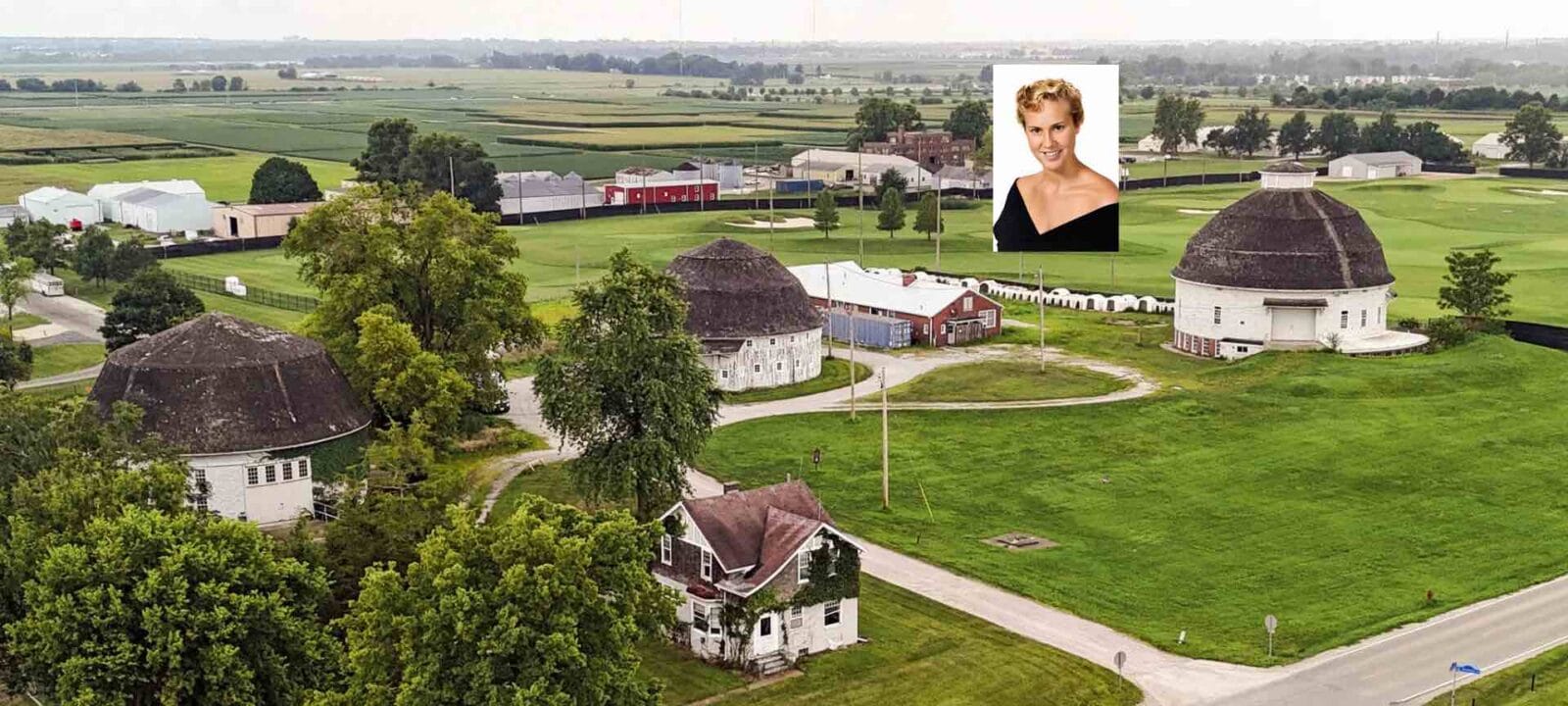
On a warm afternoon in Urbana, a quiet stretch of historic farmland just west of the University of Illinois campus became the setting for a moment that bridged past innovation with future possibility.
Approximately 130 guests gathered among three distinctive round barns—structures that have stood for more than a century—to mark a new chapter in their life cycle, one defined by preservation, purpose, and renewed relevance.
The occasion formally dedicated the barns to Leah Wightman, whose $10 million philanthropic commitment has made their restoration and continued use not only feasible, but transformative.
Long regarded as architectural and agricultural curiosities, the barns are, to those within the university community, something far more enduring. Their circular design—rare even in their own era—was rooted in efficiency and experimentation.
The earliest of the trio, constructed in 1908, emerged at a time when the dairy industry faced economic strain and required bold thinking. Its design demonstrated how smaller farms could operate with remarkable efficiency, using spatial ingenuity to streamline labor and maximize output.
Two subsequent barns followed in 1910 and 1912, each advancing the concept, including one built specifically for equine use and another that embodied what was then considered modern agricultural design.
Over the decades, these barns became woven into the lived experience of students and faculty alike. For Jim Lowe, associate dean of the College of Veterinary Medicine, their significance is both professional and deeply personal.
Having first encountered the barns as an undergraduate in the 1980s—when they were still actively housing cattle—Lowe recalls their functionality as striking even then.
“It was 70 or 80 years old at that point and was fantastically efficient,” he reflected in remarks shared with RFD Radio Network. Today, he describes them as “iconic” and “amazing,” emblematic of a university ethos grounded in innovation and knowledge-sharing.
Their historical importance was formally recognized in 1994, when the barns were added to the National Register of Historic Places as part of the Illinois Experimental Dairy Farm Historic District. Yet designation alone could not shield them from the wear of time. Without significant intervention, their structural integrity—and with it, their legacy—faced an uncertain future.
The current restoration effort, now well underway, focuses on stabilizing and renewing the barns’ roofs and exteriors, alongside the adjacent manager’s house.
Completion is anticipated by spring 2027, at which point the site will stand not merely as a preserved relic but as a revitalized asset integrated into the university’s academic mission.
Plans are already forming to incorporate the barns into the College of Veterinary Medicine’s programming, ensuring they remain active contributors to research, education, and community engagement.
For Dean Peter Constable, the scale of what is now possible marks a decisive shift. Prior to this philanthropic investment, restoration efforts had been limited in scope, with work progressing incrementally on a single structure.
“We weren’t going to be able to do that by ourselves,” he noted.
“This gift is transformational.”
With sufficient resources now secured, all three barns can be restored to their intended condition, while a portion of the funding will establish an endowment dedicated to their long-term maintenance—covering essential upkeep such as painting and repairs to safeguard their future.
Beyond the technical and financial dimensions, the project carries a more intangible weight: the stewardship of legacy.
Lowe, who had spoken with Wightman about her affinity for barns and her desire to see them preserved, has taken on the role of translating that vision into action.
“This is important to her; we have to live with that legacy,” he said, a sentiment that resonates across the teams now tasked with bringing the project to fruition.
In an era where institutional expansion often prioritizes the new, the restoration of the University of Illinois’ round barns stands as a compelling counterpoint—one that recognizes the enduring value of heritage when paired with forward-thinking investment.
As scaffolding rises and timber is reinforced, these century-old structures are once again becoming sites of experimentation, learning, and shared purpose, reaffirming that innovation is not only about what comes next but also about what is preserved and reimagined along the way.