
$42 million gift from Roland G. Parrish puts his name on university’s new home for business
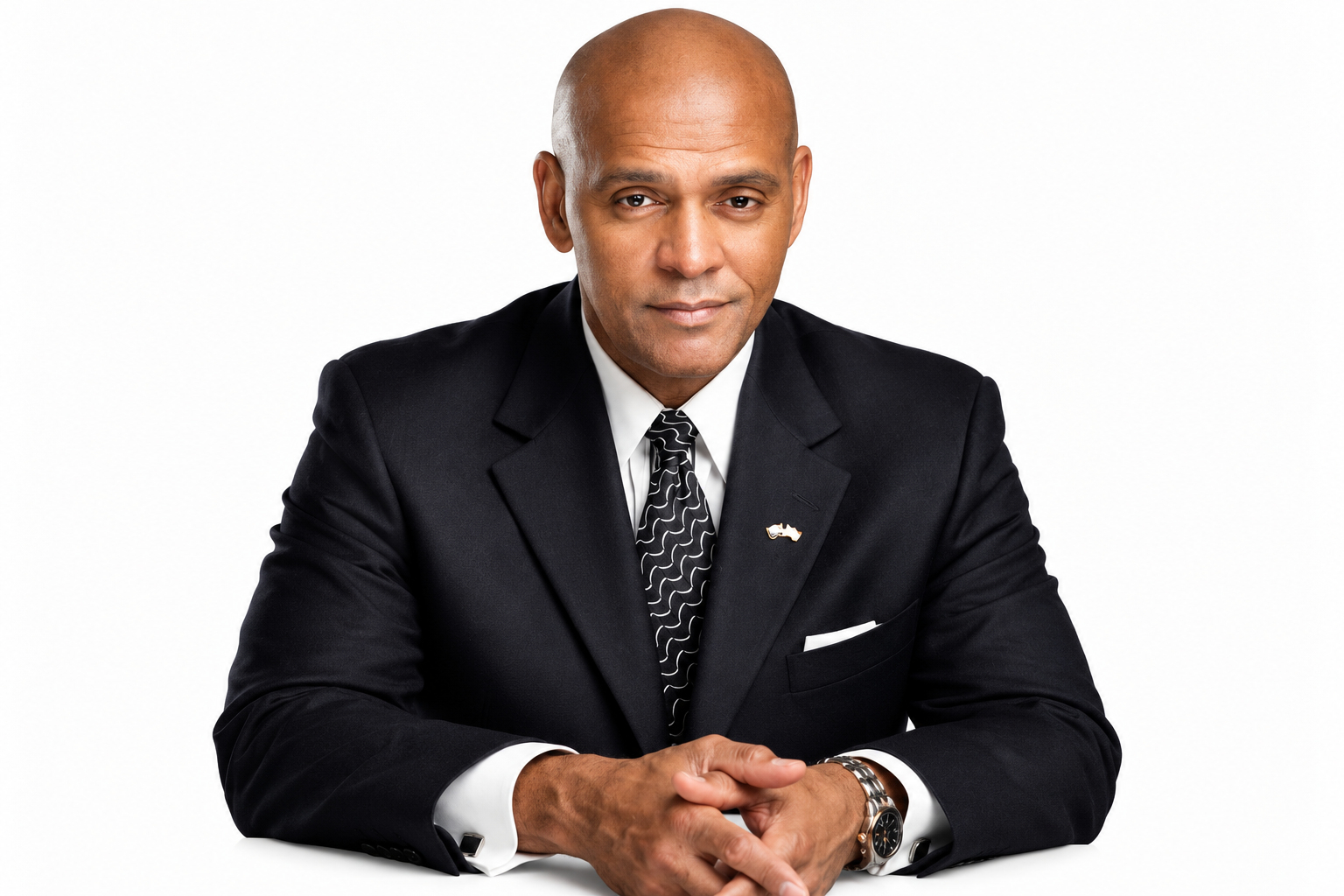
Roland G. Parrish keeps a rejection letter framed on the wall of his office high in Dallas’s Oak Cliff Tower.
It came from McDonald’s in the 1980s, when the company turned down his first application to become a franchisee.
Recently, the man who wouldn’t take no for an answer gave his alma mater the largest gift any individual has ever made to a building at Purdue University.
Purdue announced on October 9 that Parrish has committed $42 million to name the new flagship building of the Mitch Daniels School of Business.
When it opens in fall 2027, the building will be called the Roland G. Parrish Hall of Business. At 164,000 square feet, it will be the second-largest classroom building on the West Lafayette campus, behind only the Wilmeth Active Learning Center.
Beyond its classrooms and conference space, it will hold teaching and research labs for financial trading, data visualization, behavioral research, and hands-on learning.
“Everything I have accomplished professionally began with the foundation I received at Purdue,” Parrish said.
“Supporting Purdue has always been deeply personal because I know firsthand the difference this institution can make in a student’s life.”
The scale of the gift stands out even against the money already behind the project.
Purdue’s trustees approved the building in 2023 at an estimated total cost of $168 million, all from gifts, and the Lilly Endowment contributed $50 million to construction in early 2024.
Parrish’s commitment is now the gift that gives the building its name and its identity: a business school’s front door bearing the name of an alumnus who built his fortune one restaurant at a time.
The story begins in Hammond, Indiana, where Parrish grew up as the son of a Baptist preacher.
He often talks about his grandfather, Will Leander Parrish, an Arkansas sharecropper who moved to Memphis during the Depression.
Will Parrish woke before dawn and walked half an hour along the Wolf River to be first in line at a gravel pit, where the foreman set out only as many shovels as he needed that day. His boots had no soles, so he lined them with wire mesh.
He had no shoelaces, so he tied his boots shut with wire and a pair of pliers. Eventually he bought books and taught himself carpentry.
“I stand on his shoulders,” Parrish has said.
“He didn’t have to make that walk every day, but he did.”
Parrish went to Purdue on athletic and academic scholarships.
He ran the 880 and relays for the track team, earned four varsity letters and two MVP awards, and was elected captain as a senior.
He made the dean’s list, worked as a residence hall counselor, and served as a teaching assistant while earning his master’s degree.
He finished a bachelor’s in industrial management in 1975 and a master’s in management in 1976.
He might have become an engineer if not for Dr. Cornell A. Bell.
Bell led the Business Opportunity Program, founded by business faculty the day after Dr. Martin Luther King Jr.’s assassination in 1968 to open top management education to underrepresented students.
Parrish was Bell’s first recruit, and Bell talked him into switching from engineering to industrial management.
The two stayed close long after graduation. Parrish later served as executor of Bell’s estate, gave his mentor’s papers to the Purdue archives and funded a scholarship in his memory.
Today he also funds the program’s summer session, an eight-week course that lets incoming freshmen start their business classes and settle into campus before their first fall.
“Krannert and the Business Opportunity Program became the cornerstone of my success,” he once said.
The program’s current director, Darren Henry, stood beside him at this week’s announcement.
After Purdue, Parrish spent 13 years at Exxon.
When McDonald’s rejected his franchise application, he called the company’s Houston office every Monday, Wednesday, and Friday until it let him into a nine-month application process and then a two-year unpaid training program.
For about two years, he worked 50 hours a week at Exxon and another 25 at McDonald’s.
He opened his first restaurant in Dallas’s Pleasant Grove neighborhood on Juneteenth in 1989.
Today, Parrish Restaurants runs more than two dozen McDonald’s locations across North Texas, employs more than 1,000 people, and ranks as the second-largest minority-owned franchise organization in the McDonald’s system.
He started giving on that first day.
As a condition of opening, McDonald’s asked him to donate $500 to charity.
He kept going from there, setting aside $50 at a time so he could say yes when a church group, a football team, or a cheerleading squad came through the door.
“I put $50 aside. I put a lot more aside now,” he has said. “If someone comes to me and I think it’s a good idea, and we can afford it, that’s what I do.”
What he has done adds up to a long record of generosity.
In 2010, he made a $2 million leadership gift toward the $4.2 million renovation of Purdue’s management and economics library.
When it was rededicated in 2012 as the Roland G. Parrish Library of Management and Economics, it became the first major facility on campus named for an African American alumnus.
At Fisk University, the historically Black university in Nashville, his $3 million gift built the Roland Parrish Career Planning and Development Center, which opened in 2023.
In Fort Portal, Uganda, he funded the Rev. John and Marie Parrish Medical Clinic, named for his parents. It opened in 2016 and serves about 6,000 orphans a year.
Most of his giving, though, has happened close to home in Dallas, and it is aimed mostly at young people.
For roughly two decades, his McMiracle on Highway 67 Christmas giveaway has handed out more than 4,500 bicycles to fifth graders.
He has paid for state championship rings for DeSoto and Duncanville high school football players, bought marching band equipment, and sponsored band, debate, and poetry competitions.
He has endowed scholarships at South Oak Cliff, Spruce, DeSoto, Duncanville, Skyline, and St. Philip’s School.
He has also funded a four-year, $250,000 fellowship tied to a Texas Rangers internship program.
In May, at a University of North Texas at Dallas commencement, he surprised the graduates with a $50,000 endowed scholarship for first-generation and underserved students and promised to add to it every year.
He had given the same school $5,000 when he spoke at its graduation in 2017.
Since 2016, Parrish has run much of this work through the Parrish Charitable Foundation, which he leads with his children, Jade and Ro.
The foundation raises little money beyond an annual celebrity golf tournament.
Restaurants fund it mostly, and it gave away more than $370,000 in 2023 alone.
Parrish and his wife, Jewel, are also the second-largest investors in the redevelopment of Dallas’s RedBird Mall, a project that is bringing a hotel, jobs, and medical care from Parkland and UT Southwestern to southern Dallas.
Dallas has thanked him in return.
In 2023, the city’s park board named a 23-acre park in Cadillac Heights the Roland G. Parrish Park.
In 2024, he received the Linz Award, one of the city’s highest civic honors, after the late Congresswoman Eddie Bernice Johnson nominated him.
Purdue gave him the Krannert Business Leadership Award in 2011 and named him an Old Master in 2012. He has served on advisory councils for the business school, Purdue Libraries, and the Black Cultural Center, and he has supported each.
Parrish explains why he gives with a line from the Gospel of Luke: “From everyone who has been given much, much will be demanded.”
Terry Flowers, who leads St. Philip’s School and Community Center in South Dallas, sees it another way.
“You turned success into significance,” Flowers told him.
“That differs from a lot of people who turn their success into an exit out of the community.”
That is the lesson Parrish hopes the new building will teach.
When asked once what legacy he wanted to leave, he named a library at Purdue, a center at Fisk, a clinic in Uganda, and a park in Dallas.
“I hope people would look at those things and say he did some good things,” he said.
“He made a difference.”
Next fall, a new generation of Purdue business students will add a building to that list.
Parrish already knows what he wants them to take away from it.
“I hope this investment inspires students to pursue their goals with confidence, resilience, and integrity,” he said, “and to recognize that success carries with it a responsibility to create opportunities for others.”