Six pioneers who changed everyday ife receive America’s highest science and technology honors
For most people, the achievements celebrated in Washington on October 8 are experienced far from an awards stage: in a computer that opens a world of opportunity, a search that delivers an answer in seconds, a researcher’s ability to tackle a once-impossible calculation, or the sight of astronauts lifting off toward the International Space Station.
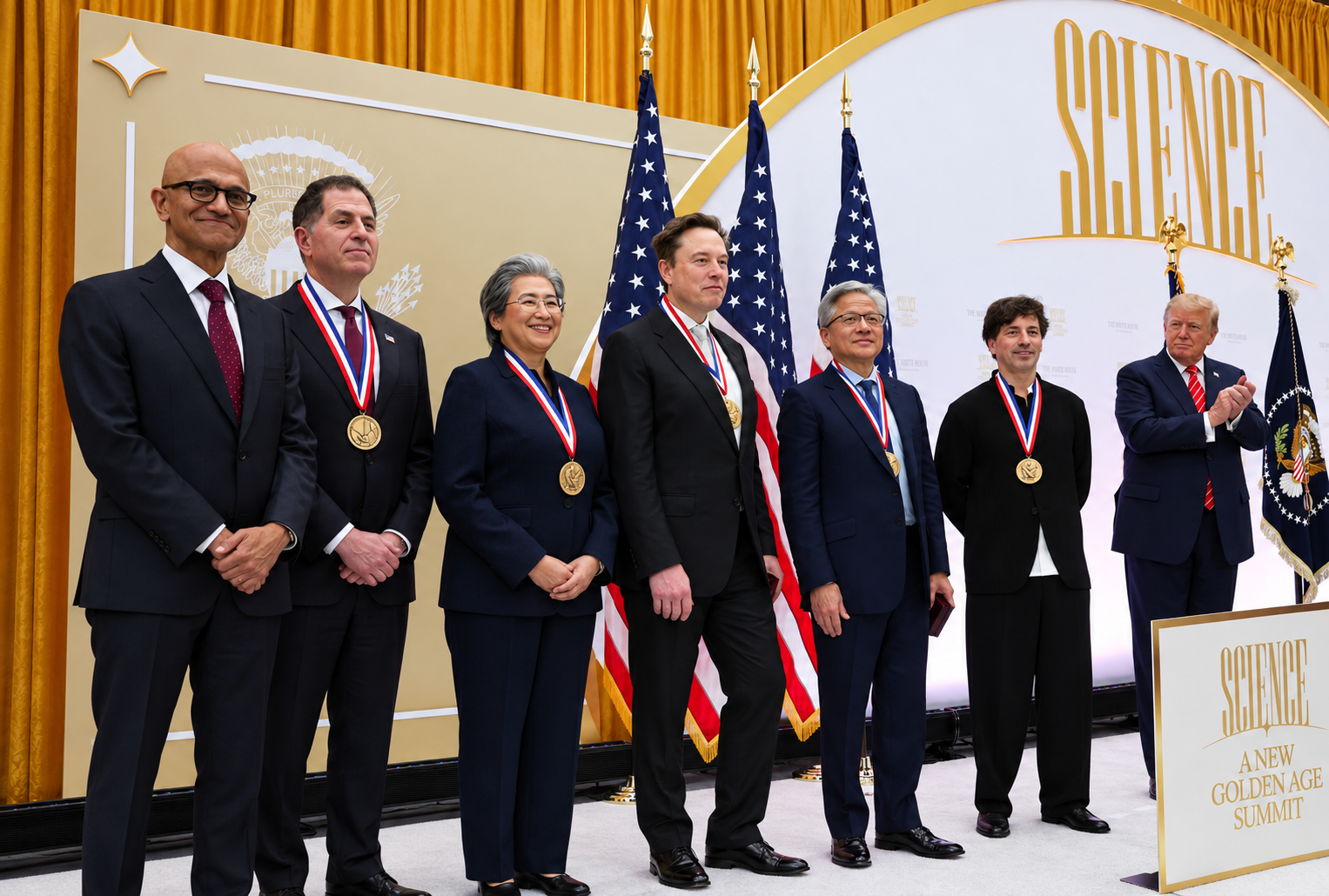
Behind those familiar moments are decades of curiosity, persistence and demanding work. Six leaders whose careers have helped make them possible—Satya Nadella, Michael Dell, Lisa Su, Elon Musk, Jensen Huang and Sergey Brin—received national recognition when President Donald Trump presented America’s highest science and technology honors at the Science: A New Golden Age Summit.
Su, Musk, Huang and Brin received the National Medal of Science. Nadella and Dell received the National Medal of Technology and Innovation.
The awards recognized different accomplishments, but together they honored an extraordinary capacity to turn ambitious ideas into technologies that people can use.
Standing together with their medals, the recipients represented six distinctive journeys. Some began with academic research, others with an entrepreneurial instinct or a fascination with engineering. Each eventually led to work whose influence extends well beyond the institution or company where it began.
At the left of the group stood Satya Nadella, Microsoft’s chairman and chief executive, whose achievement has been to help a great technology company find new possibilities within itself.
Nadella joined Microsoft in 1992 and became chief executive in 2014. Before that appointment, he had already helped lead its transition toward cloud infrastructure and services.
His career required an understanding of both the technical systems beneath a product and the people who depend on it.
That combination matters. A business owner needs technology that works reliably. A researcher needs access to computing resources. An organization needs tools that can grow with its ambitions.
Nadella’s leadership helped Microsoft expand the infrastructure serving those needs, while preparing the company for the emergence of increasingly capable artificial intelligence.
His medal recognized the importance of that transformation: the patient, complex work of renewing an established institution and building the foundations for what comes next.
Beside him stood Michael Dell, who was featured on two exclusive covers of Lifestyles Magazine/Meaningful Influence and whose story began with a young man’s conviction that computers could be designed and sold in a better way.
Dell founded his business in 1984 at the age of 19 with $1,000. From that modest beginning, he built a technology company with worldwide reach, helping bring personal and enterprise computing to a much broader population of users.
The scale of his eventual success can obscure the human quality of its beginning. Before there was a global company, there was a teenager willing to test an idea, listen to customers and take responsibility for building something of his own.
His subsequent career has demanded repeated reinvention as the computing industry changed around him.
For Michael and Susan Dell, achievement has also created an opportunity to help others.
Their family foundation, established in 1999, added a philanthropic dimension to their influence.
The same career that expanded access to technology generated resources for work intended to expand opportunity.
His national honor recognizes a builder whose impact reaches across business, technology and support for future generations.
Lisa Su, standing next in the group, brought the distinction of an engineer who has helped shape the capabilities of modern computing.
With bachelor’s, master’s and doctoral degrees in electrical engineering from MIT, Su built her career around difficult technical problems.
She became AMD’s president and chief executive in 2014, bringing engineering experience and disciplined leadership to a company operating in one of the world’s most demanding industries.
Semiconductors are rarely visible to the people whose lives they influence. Yet their capabilities determine what computers can accomplish.
Under Su’s leadership, AMD’s processors and accelerators helped power Frontier, the Oak Ridge National Laboratory supercomputer that broke the exascale barrier in 2022.
That milestone opened greater possibilities for researchers working on complex questions in fields including energy, climate and medicine.
Su’s achievement gives a human face to the extraordinary precision behind those advances: years of learning, testing and problem-solving translated into tools for discovery.
Two decades ago Lifestyles Magazine/Meaningful Influence was the first magazine, that featured a then very young dreamer: Elon Musk.
Twenty years later, Elon Musk’s Presidential recognition highlighted engineering ambition on a different scale.
Through SpaceX, he has helped lead the development of systems that carry people and cargo into orbit. In May 2020, NASA astronauts Robert Behnken and Douglas Hurley launched aboard Crew Dragon, restoring the ability to send astronauts to the International Space Station from American soil after the retirement of the space shuttle.
For viewers, it was an unforgettable launch. For the engineers, technicians, astronauts and mission teams involved, it was the culmination of years of preparation. SpaceX’s work on reusable rockets and crew transportation has helped turn remarkable demonstrations into operational capabilities.
Musk’s medal acknowledged the reach of that engineering effort. His contribution lies in pursuing formidable objectives and helping build an organization capable of bringing them within reach.
Jensen Huang’s journey began with a vision for computer graphics and grew into a contribution to the way science itself is conducted.
Huang co-founded NVIDIA in 1993. The company’s graphics processors eventually became powerful tools for broader computation, particularly after the introduction of CUDA in 2006 gave researchers and developers a way to apply their parallel-processing capabilities to new problems.
The implications extended far beyond the original graphics market. NVIDIA technology helped support advances in scientific computing and artificial intelligence, demonstrating how an idea can gain new significance when people discover unexpected uses for it.
Huang’s long leadership reflects the value of staying with a vision while allowing it to evolve. His honor recognizes a career that has helped equip others to pursue discoveries of their own.
Sergey Brin, standing beside the president, was recognized for work that changed one of the most ordinary—and essential—acts of modern life: looking for an answer.
At Stanford, Brin met Larry Page and collaborated on the project that became Google. They founded the company in 1998, building on research into how the structure of the web could make searching more effective.
The challenge was enormous. Information was multiplying rapidly, and its existence did not guarantee that people could find it.
Brin and Page helped develop a way to connect users with relevant material across that expanding landscape.
For a student, a teacher, an entrepreneur or a family seeking practical guidance, that ability became part of everyday life. Brin’s medal recognized the foundational work behind a tool whose familiarity can make its achievement easy to overlook.
The Washington ceremony brought these six careers into a single frame, offering a moment to appreciate the people behind technologies that have become woven into daily experience.
Their achievements were built with many others: colleagues, research teams, educators, public institutions and partners who contributed knowledge and effort along the way.
Honoring their leadership also invites recognition of that wider human enterprise.
For the next generation, these medals offer an encouraging message. A question pursued seriously, an idea tested patiently or a difficult problem approached with determination can grow into work of lasting consequence.
The six recipients have earned a place in that story—and have helped create opportunities for those who will write its next chapters.