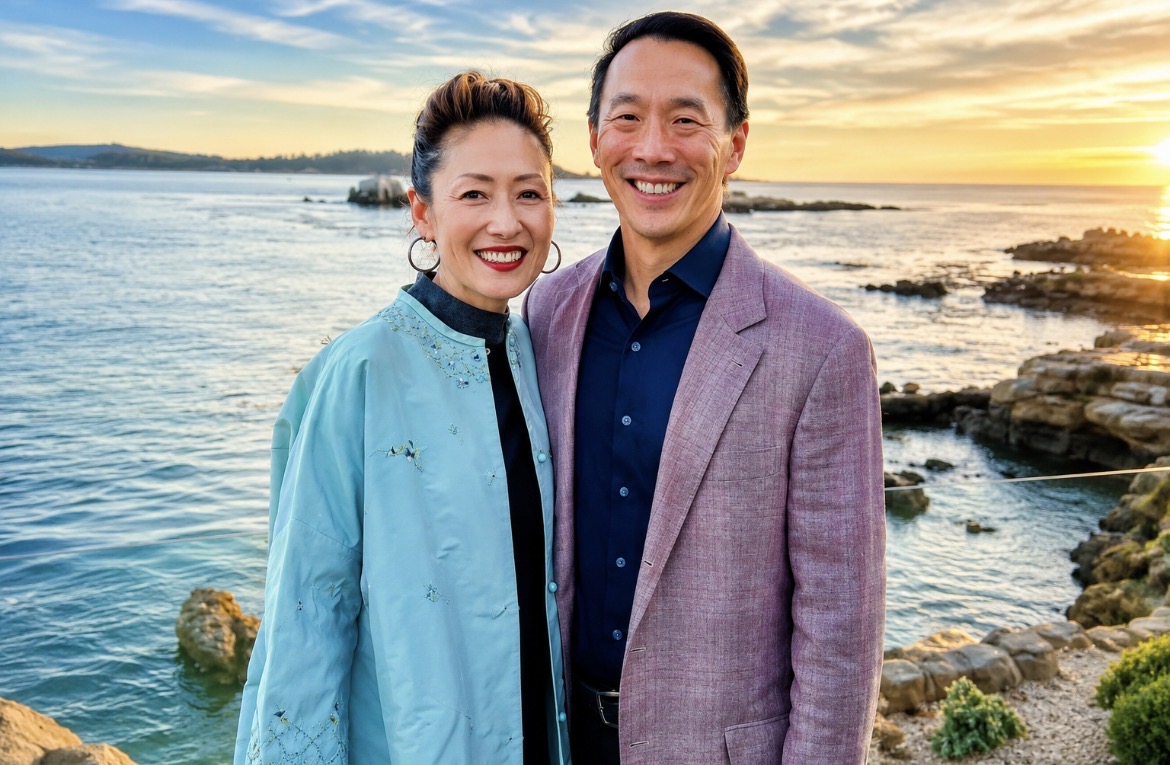
$100 million latest gift to university raises philanthropists Kathy Chiao and Ken Hao’s giving to approaching $200 million
On May 7, 2026, one of the most significant philanthropic announcements in the recent history of the University of California, San Francisco, arrived not with fanfare but with a letter—a direct message from UCSF Chancellor Sam Hawgood to his university community sharing extraordinary news.
San Francisco philanthropists Kathy Chiao and Ken Hao had committed $100 million to UCSF, delivering flexible, wide-ranging resources at what Hawgood described as “a pivotal moment” for the institution.
The gift, which touches everything from aging hospital infrastructure to cutting-edge cancer science and artificial intelligence platforms, is among the largest individual commitments in UCSF’s recent history and reflects a couple whose generosity toward the UC system has nowreached a breathtaking scale in just a few weeks.
The gift’s scope is deliberately broad and strategically timed. A meaningful portion is directed toward capital improvements at UCSF’s Parnassus Heights and Oakland campuses — facilities that serve tens of thousands of patients and researchers each year but face the pressures of aging infrastructure and expanding clinical demand.
These investments, as Chancellor Hawgood explained, are “essential to ensuring that our facilities are able to meet the growing needs of our clinical, research, and educational programs.”
In a healthcare landscape where physical environment directly shapes patient outcomes and the quality of research conducted within its walls, this component of the gift is foundational, enabling UCSF to modernize the very places where medicine’s future is being forged.
The cancer research dimension of the gift carries particular momentum. Chiao and Hao have made a matching commitment to the Weill Cancer Hub West, an ambitious collaborative initiative launched in 2025 through a $100 million matching grant from Joan and Sanford Weill’s Weill Family Foundation.
The Hub unites two of the nation’s premier cancer centers—the UCSF Helen Diller Family Comprehensive Cancer Center and the Stanford Cancer Institute—in a structured, decade-long partnership designed to advance cross-specialty science that neither institution could pursue alone.
UCSF and Stanford each committed to raising $50 million in matching gifts to bring the total initiative to $200 million over ten years, and the Chiao-Hao commitment now meaningfully accelerates UCSF’s ability to meet that challenge.
The Hub’s initial research portfolio is daring by design, bringing together expertise in cellular engineering, CRISPR technologies, and artificial intelligence to develop therapies that can detect cancer at its earliest stages and treat tumors that have long resisted medicine’s best efforts.
The third pillar of the gift — innovation and artificial intelligence — is where Ken Hao’s personal passions most visibly converge with UCSF’s institutional ambitions.
Hao, who built his career at the intersection of technology and capital as Chairman and Managing Partner of Silver Lake, the global private equity firm whose portfolio includes some of the most transformative technology companies of the past two decades, has long believed that AI is not simply a tool for medicine but a fundamental reimagining of how healthcare is delivered, monitored, and improved.
As early as 2024, Chiao and Hao gave a $5 million gift to UCSF’s Division of Clinical Informatics and Digital Transformation to build IMPACC—the Impact Monitoring Platform for AI in Clinical Care — the first real-time, continuous, and automated AI monitoring system ever developed for clinical use in the United States.
Where traditional healthcare systems relied on periodic, manual checks of AI tool performance, IMPACC shifts to a continuous surveillance model that can flag safety concerns, health disparities, or declining tool efficacy in real time, giving clinicians and health system leaders the actionable intelligence they need to refine or remove AI applications before they cause harm.
That earlier gift laid the conceptual and technical groundwork for the broader AI and innovation investment embedded in the new $100 million commitment—a signal that Chiao and Hao are not making one-time bets but building a sustained portfolio of impact at UCSF.
To fully appreciate the weight of the May 7 announcement, it helps to understand who Ken Hao and Kathy Chiao are and how they arrived at this moment. Hao is a Harvard economics graduate who joined Silver Lake in 2000 and, by 2008, was leading the firm’s expansion into Asia, where he helped direct landmark investments in Alibaba Group and Ant Financial.
Today, he serves as Silver Lake’s chairman and managing partner, overseeing a portfolio that has made the firm one of the defining forces in global technology investing.
He sits on the boards of Broadcom and Altera and has previously served on the boards of Symantec, Splunk, SolarWinds, and several other major technology companies.
His civic engagement is equally remarkable: he has served as co-chairman of the UCSF Health Executive Council and vice chairman of the UCSF Foundation Board for years, making him not merely a check-writer to UCSF but an active architect of the institution’s direction during some of its most complex chapters.
Kathy Chiao has been his equal partner in every dimension of this philanthropic journey, with her name appearing alongside his on every major gift their family has made to medicine, education, and the arts.
Together, the couple has become one of the most consequential philanthropic forces in California higher education and medicine in a remarkably compressed period. Just two weeks before the UCSF announcement, on April 22, 2026, the University of California, Davis, celebrated a $75 million gift from Chiao and Hao to the UC Davis Weill School of Veterinary Medicine—the second-largest individual gift in that school’s history.
The gift is the naming of the school’s new small-animal hospital, a state-of-the-art facility scheduled to open in 2030 that will be capable of caring for up to 25,000 additional animals per year across specialties, including oncology, cardiology, neurology, and orthopedic surgery.
It also funds scholarships, animal-human translational medicine research, and programs that help families facing financial hardship provide veterinary care for their pets.
In announcing that gift, Chiao and Hao offered a window into their vision: “We deeply value the advancement of healthcare for every type of animal. We also believe research in veterinary medicine and human life sciences will be increasingly interconnected and mutually reinforcing.” That philosophy — the belief that knowledge flows across species, disciplines, and institutions — now clearly extends to their work with UCSF as well.
Their philanthropy is not limited to California’s UC campuses. Chiao and Hao are significant donors to the Metropolitan Museum of Art in New York, where, in May 2025, Ken Hao was elected as an elective trustee of the Met’s board.
The family has been a major supporter of the forthcoming Oscar L. Tang and H.M. Agnes Hsu-Tang Wing for Modern and Contemporary Art — a $550 million renovation that is transforming the Met’s iconic 1870 wing — and has also donated to the museum’s social media initiatives, Asian art programming, and acquisitions.
Closer to home, Chiao and Hao supported a cohort of UC Berkeley Public Health students earlier in 2026, providing $100,000 in impact funding to 10 researchers whose work addresses public health challenges at the community level.
The Hao Family Foundation, through which much of their structured giving flows, has grown substantially in recent years, with charitable disbursements spanning multiple institutions and causes.
Taken together, the combined value of Chiao and Hao’s confirmed philanthropic commitments in 2025 and 2026 alone—$100 million to UCSF; $75 million to UC Davis’s Weill School of Veterinary Medicine; the earlier $5 million IMPACC gift; contributions to the Metropolitan Museum; the Weill Cancer Hub West matching commitment; and their UC Berkeley gift—places them in an elite circle of American philanthropists whose giving is both extraordinarily generous and unusually coherent in its vision.
They are not spreading resources thin across unrelated causes but investing deliberately across a network of interconnected institutions where medicine, science, technology, and human well-being converge. As of May 8, 2026, their total known public philanthropy comfortably exceeds $180 million and is almost certainly larger when private and unannounced gifts are accounted for.
For UCSF — an institution that depends more heavily on private philanthropy than perhaps any other public university in the country — the Chiao-Hao gift arrives at a defining moment. Federal research funding faces growing uncertainty, capital needs across UCSF’s campuses are significant, and the race to integrate artificial intelligence responsibly into clinical care demands investment that no government grant cycle can fully underwrite. In this context, the flexibility embedded in the $100 million gift is as important as its size.
Chancellor Hawgood’s letter to the UCSF community was careful to describe the resources as “significant, flexible”—language that signals a level of donor trust rarely extended at this scale. It is the kind of gift that allows a great institution not simply to execute a predetermined plan but to respond to the unexpected opportunities and emergencies that define the frontier of medicine.
What Kathy Chiao and Ken Hao have built through their philanthropy is something that money alone cannot buy: a reputation as partners — people who show up not just with a gift but with their time, their networks, their judgment, and their sustained belief in the institutions they support.
As Ken Hao has demonstrated through his years of service on the UCSF Foundation Board and the UCSF Health Executive Council, the best philanthropists don’t just write checks—they help institutions become the versions of themselves they aspire to be. On May 7, 2026, that partnership grew by $100 million, and UCSF’s future grew with it.