$80 million bet on urban renewal: Wellman family gift sparks new site readiness fund for creating good jobs
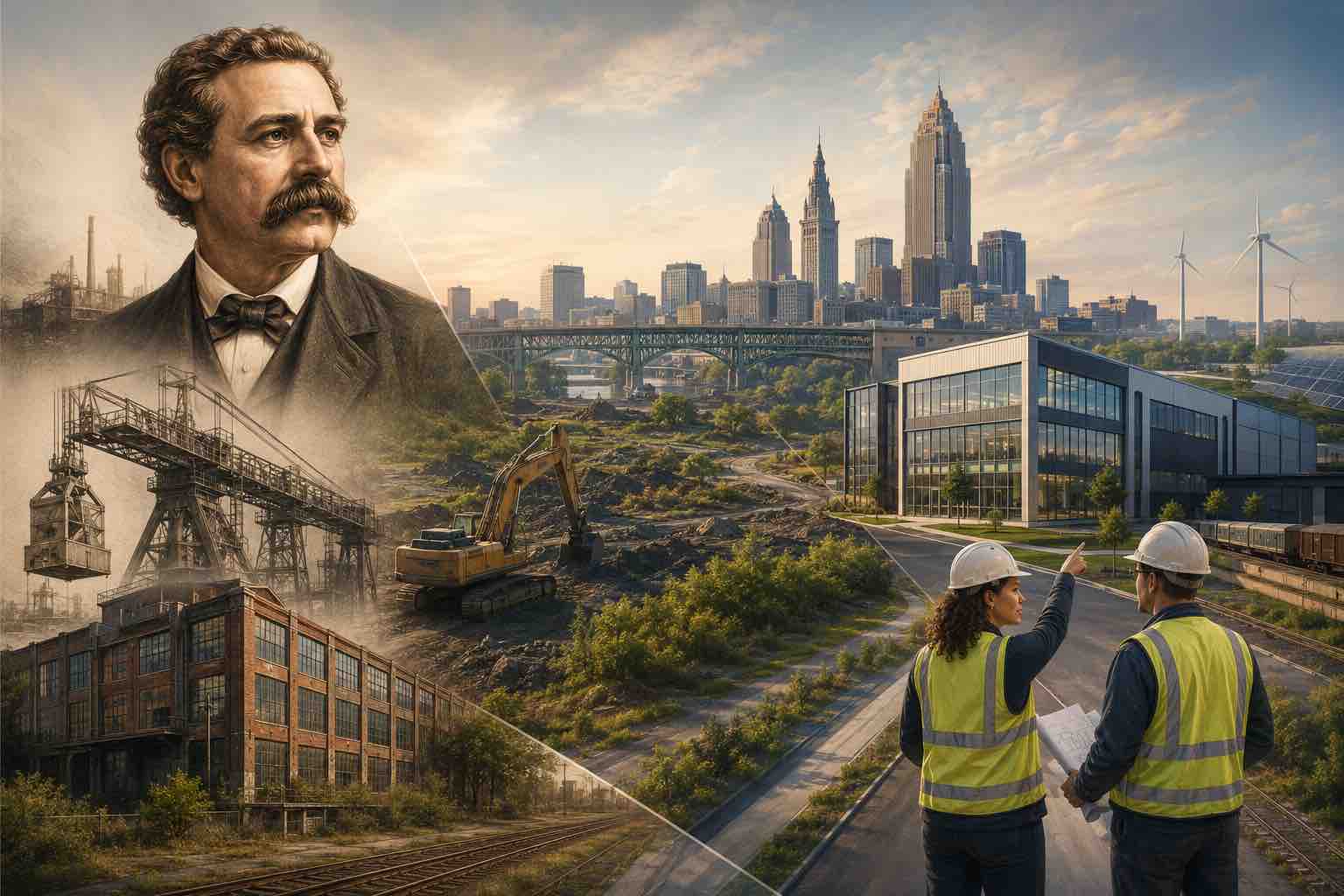
Cleveland’s latest bid to turn rust-belt acreage into a jobs engine now carries the name of a 19th‑century steel pioneer—and a 21st‑century bet by his descendants that place-based industrial philanthropy can still remake a city’s future.
Civic leaders announced that the Site Readiness for Good Jobs Fund has grown to $80 million, bolstered by a $10 million commitment from the Wellman family, $2 million from the KeyBank Foundation, and $1 million from the Rockefeller Foundation.
In recognition of the lead gift, the Cleveland Foundation’s permanent endowment for the effort will bear the historic name of the Samuel T. Wellman Site Readiness Fund, linking a new wave of land reclamation and job creation to one of the architects of America’s steel age.
The fund itself is barely three years old but already central to Cleveland’s attempt to convert 1,000 acres of long-vacant or underused industrial property into “shovel‑ready” sites for advanced manufacturing, logistics, and other employment-heavy uses.
Seeded in 2023 with a $50 million allocation of American Rescue Plan Act dollars from Mayor Justin Bibb’s administration and Cleveland City Council, the Site Readiness for Good Jobs Fund was created as an independent nonprofit with a simple, capital‑intensive mandate: buy distressed industrial parcels, remediate contamination, assemble fragmented lots, and bring them to market in a form that private employers can actually use.
Local partners estimate the initiative could ultimately support 25,000 on-site jobs and catalyze more than 65,000 positions across the region over the next decade, if the land can be prepared fast enough and marketed effectively.
That is the backdrop against which the Wellman family’s 10-million-dollar gift landed—an infusion that does more than round up a fundraising total. It shifts the center of gravity from a one‑time federal rescue to a long‑horizon civic endowment, signaling that local private capital is now willing to co‑underwrite the transformation of some of Cleveland’s most challenging real estate.
Philanthropically, it is the sort of move more often associated with marquee cultural institutions or elite universities; here, the object is not a concert hall or research lab but the invisible, expensive work of cleaning soil, replacing sewers and stitching together parcels left behind by a bygone industrial era.
For the Wellmans, it is also a generational homecoming. Samuel Thomas Wellman, born in 1847, was a pioneering steel industrialist and prolific inventor whose work helped define the very landscape the fund now seeks to retool.
Often described as a “father of the open-hearth process” in the United States, he developed furnaces and heavy equipment that allowed American steelmakers to scale production, and he played a key role in the creation of the Hulett ore unloader that revolutionized iron-ore handling on the Great Lakes.
From Cleveland, he founded the Wellman‑Seaver‑Morgan Engineering Company—an enterprise that grew alongside the city’s mills and docks and, in different corporate form, still traces its lineage back to his designs.
In that sense, naming the endowment for Samuel T. Wellman does more than honor a local industrial celebrity; it closes a narrative loop.
A family whose ancestor helped build the infrastructure of heavy industry is now underwriting the reclamation of its physical afterlife—those hulking buildings, rail‑adjacent lots and fenced‑off brownfields that once powered Cleveland’s economy and now stand as obstacles to its reinvention.
In a city where the scars of deindustrialization remain visible on the East Side and in neighborhoods like Central and Fairfax, the gesture reads as both restitution and reinvestment.
The philanthropic bet is already being tested on the ground. In April 2024, the Site Readiness for Good Jobs Fund acquired an abandoned industrial complex and roughly 10 acres at Central Avenue and East 71st Street, a graffiti‑covered relic in Cleveland’s Central neighborhood that once housed major material‑handling projects.
The building, historically tied to the large‑scale equipment work that defined the Wellman era, is now slated for a job‑creating redevelopment, with environmental cleanup and modernization underwritten by the same fund that will now carry the Wellman name in perpetuity. City officials frame the project as a proof‑of‑concept: if they can turn this site into a functioning employment hub, the model can be replicated across dozens of similar properties scattered along rail corridors and aging industrial districts.
The larger canvas is The Midline, a 350‑plus acre redevelopment zone stretching along the Norfolk Southern rail corridor near the city’s east side, where the Site Readiness for Good Jobs Fund is the central land‑assembly and remediation engine.
Envisioned as a connected district rather than a single mega‑factory, The Midline is planned to host advanced manufacturing, research and development, office space, parks and new transit‑linked infrastructure, with at least 1.5 million square feet of new industrial and commercial buildings and more than 2,500 direct jobs at full build‑out.
By absorbing the upfront costs that typically scare off private developers—everything from brownfield remediation to complex title work—the fund positions itself as a quiet co‑author of whatever corporate success stories eventually occupy those sites.
Into that machinery, the Wellman family’s 10 million dollars functions as much as leverage as it does largesse. As a permanent endowment housed at the Cleveland Foundation, the Samuel T. Wellman Site Readiness Fund is designed to spin off income year after year, underwriting future acquisitions and cleanups even after the initial federal allocation is spent down.
In philanthropic terms, that structure signals a shift from project‑based charity to an infrastructure endowment—a vehicle meant to endure through multiple mayoral administrations and economic cycles, much as cultural or educational endowments buffer museums and universities against volatility.
The choice of partners reinforces that framing. KeyBank, a legacy Cleveland financial institution, added $2 million through its foundation, and the Rockefeller Foundation, whose own history is entangled with the rise of American heavy industry, contributed $1 million.
Their dollars arrive alongside the Wellman gift but play a different role: signaling to national and regional capital markets that this is not a one‑family tribute but a crowding‑in of institutional philanthropy around a shared thesis that land and infrastructure are, in fact, investable public‑interest assets.
For a fund tasked with raising additional private money over time, having both a local industrial family and a global philanthropic brand on the masthead is an asset in its own right.
Yet the symbolic weight of the Wellman name is unique. Samuel T. Wellman’s innovations—open‑hearth furnaces, hydraulic cranes, and ore‑unloading technology—allowed steel plants to operate at a scale that defined America’s industrial century.
In Cleveland, that meant jobs and tax base, but it also meant environmental damage, fragmented rail‑side parcels, and heavy‑industry layouts ill‑suited to today’s diversified, tech‑inflected manufacturing.
By attaching that name to a fund explicitly focused on cleanup, land assembly, and future-oriented job creation, the family is effectively reframing an industrial legacy from extraction to repair.
There is a broader philanthropic pattern here. Across the country, family fortunes rooted in earlier industrial eras—from steel to chemicals to consumer manufacturing—have increasingly shifted toward place‑based grantmaking that focuses on brownfield reclamation, community wealth building, and workforce development.
Many began with classic “checkbook charity,” backing hospitals and educational institutions, then evolved into more strategic, systems‑level interventions that treat land, zoning, and infrastructure as levers for equity and opportunity. The Wellman family’s decision to anchor an endowment in site readiness and industrial land reactivation places them firmly in that lineage, but with a distinctly local, Cleveland‑centered focus.
For Cleveland’s civic leadership, the timing matters. Federal pandemic‑recovery cash that initially underwrote the Site Readiness for Good Jobs Fund was always finite, and the pace of industrial redevelopment depends on long lead times, complex environmental work, and cyclical capital markets.
An endowed fund named for a local industrial icon offers not just money but also a narrative tool: a way to tell potential employers, community groups, and outside investors that the city is committed, over decades, to turning its industrial past into future paychecks.
Whether the fund ultimately hits its targets—1,000 acres activated, tens of thousands of jobs and a new generation of clean, connected industrial districts—will hinge on execution as much as philanthropy.
For now, the Wellman gift has done something rare in the world of industrial land policy: it has given a sprawling, technical, often invisible piece of civic infrastructure a human story and a family face.
In a city defined by both the grandeur and the aftermath of its manufacturing history, the decision to engrave Samuel T. Wellman’s name on a fund devoted to reclaiming that history’s physical footprint suggests a new kind of industrial philanthropy—one that measures impact not only in dollars granted but also in acres cleared, sites reactivated, and jobs that carry the legacy forward.