$60 million gift to library and one unprompted question for Roberta Pereira
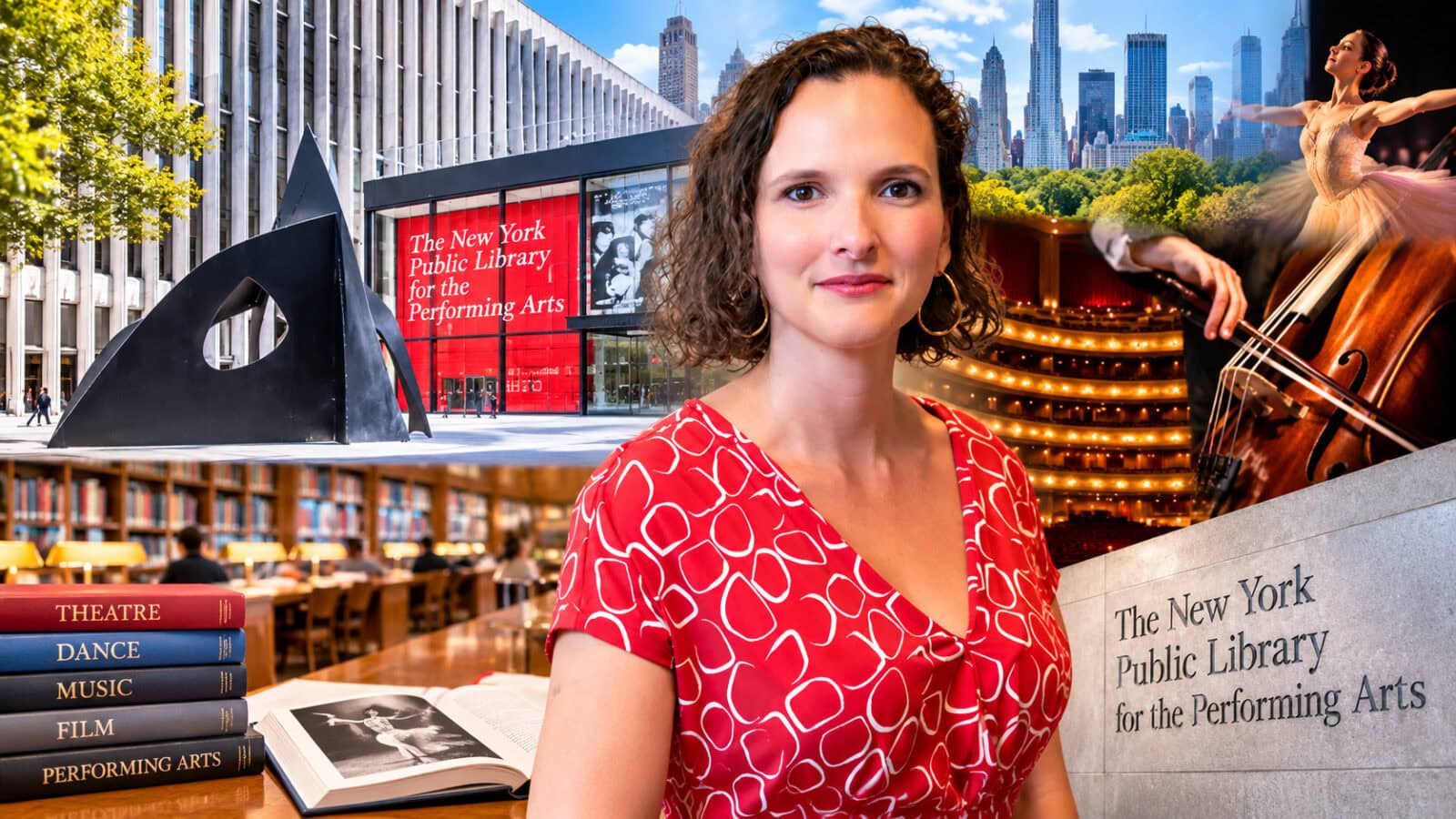
Roberta Pereira was not asking for money.
It was a June afternoon, and she was doing what she does most days at 40 Lincoln Center Plaza—walking a visitor through the building she runs.
The woman had come to see the collection, and Pereira showed her the things people tend to stop in front of: photographs of performances that closed decades ago, a choreographer’s handwriting, and recordings that exist in exactly one place on earth.
And she said what she always says, because it genuinely bothers her: almost nobody can get to any of this. Fifteen million items in the vaults. A sliver of it online.
“I wasn’t even making a pitch,” Pereira said.
The visitor left.
Then she came back with a question people in her job spend whole careers waiting to hear.
“What would it take?”
The answer, announced this week, is $60 million—the largest gift in the library’s history and one of the largest ever made anywhere—to preserve the record of American performance.
It will pay to digitize, conserve, and catalog a collection that reaches back centuries across theater, dance, and music and to build the far duller machinery that lets someone in São Paulo or Sioux Falls actually find what they came looking for.
The number is almost too tidy: $60 million for a library that turned 60 in 2025, the same year its collection picked up a Tony Honor for Excellence in the Theater.
What the donor said she cared about was cultural preservation—which sounds like the sort of phrase that shows up in press releases until you understand what is quietly falling apart inside the building at Lincoln Center.
Performing arts archives die in ways books don’t.
A first edition can sit on a shelf for two hundred years and still be a first edition. Magnetic tape can’t. Acetate can’t.
An oral history recorded in 1974 on a reel that has since gone sticky and brittle isn’t a document patiently waiting for a scholar to arrive; it’s a clock running down.
Theater and dance are the most fragile of the arts—the performance happens, and then it’s gone—and the archive is the only thing standing between that and total erasure. When the tape goes, the thing disappears a second time.
Pereira has been making this argument since she started in January 2024, and she makes it in a particular direction.
She grew up in Brazil, came to the library from The Playwrights Realm with a Tony nomination and an Olivier to her name, and is the first Latina to run the place.
She has spent her whole career on the same conviction: that the arts belong to whoever wants them, not only to the people who already know how to get in the door.
So preservation, for her, has never meant sealing things away in cold storage where they’ll survive another century unseen. It means letting people wander, the way she walks visitors through the stacks, one thing leading to the next.
Digitizing helps. It isn’t enough on its own.
A scanned photograph nobody can search is just obscurity in a sturdier format.
Which is why a real share of this money will disappear into work no one will ever photograph: cataloging systems, metadata, and search.
The library has already put pieces of the collection online—production photographs from Martha Swope, who for decades photographed Broadway and Balanchine’s New York City Ballet, and from White Studio, whose prints preserve a theatrical world that has otherwise vanished entirely.
Those projects showed the approach worked. They were just small. Pereira says the $60 million gets the library “a big part of the way there,” which is a careful thing to say when you know exactly how big the real number is.
One collection stays where it is, for now. The Theatre on Film and Tape Archive—TOFT, to anyone who has used it—holds thousands of professionally filmed Broadway and Off Broadway performances, recorded on the promise that they’d only ever be watched on the third floor, by appointment, by researchers and people working in the field. It’s the closest thing the American theater has to a memory of itself in motion, and it isn’t part of the digitization plan.
Changing that would mean reopening agreements with unions, estates, designers, playwrights, and performers—everyone who consented to be filmed under one set of terms and would now be asked to accept another. The library hasn’t ruled it out. It just isn’t promising it.
That’s worth noticing, because gifts this size usually arrive wrapped in language about total transformation and the whole archive at your fingertips.
This one doesn’t.
What it promises is years of patient, technical, mostly invisible labor—conservators stabilizing paper, engineers coaxing sound off failing tape, catalogers writing the plain descriptions that make a search box work at all. None of it produces a ribbon-cutting. None of it gets a name on a wall.
Which may be the most interesting thing about it. Plenty of philanthropy shows up for buildings, and you can understand why: a wing carries your family’s name for a hundred years. Far less of it shows up for upkeep.
Paying for upkeep means believing the value of something lies in its being useful to people you will never meet—a researcher in a country you’ve never visited, a young choreographer trying to see how Graham actually moved, a director in a small city who could never afford the trip to Lincoln Center and now won’t have to.
Pereira likes telling people they can spend an entire day in her building—an exhibition, something in the archive, a concert in the Bruno Walter Auditorium—and pay nothing, which in New York borders on the impossible. What $60 million buys is a version of that day you can have from anywhere.
And it arrived because of an ordinary walk through the stacks and one question nobody prompted. Sixty million dollars, and she never made the ask.