
$350 million from Lori and Jensen Huang’s foundation gives open science the power of supercomputing, with a Nobel Laureate leading the way
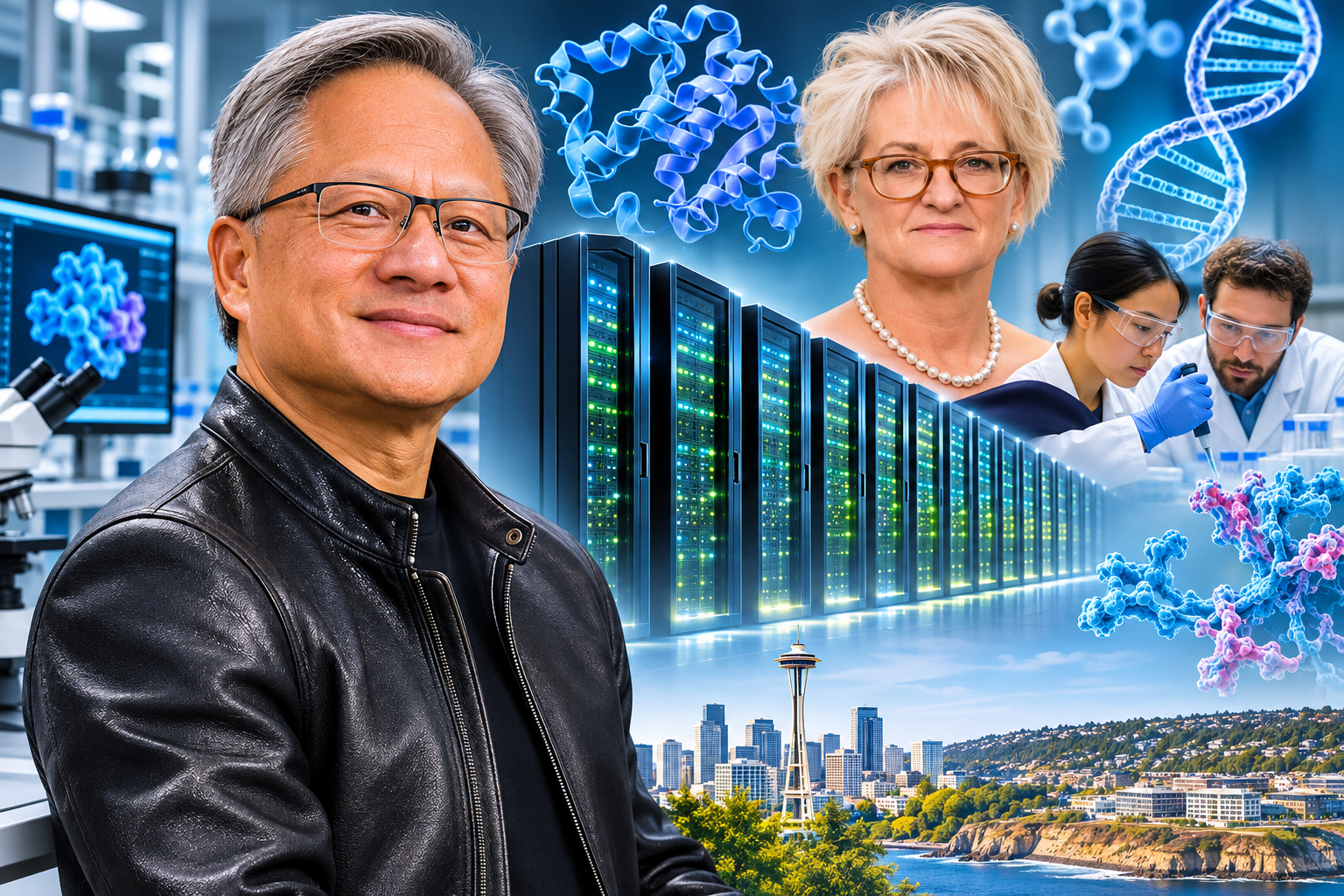
While much recent media coverage has focused on the Huangs’ personal lives, a quieter, consequential story has gone largely unnoticed, even by outlets that usually look past the headlines.
Through the Jen-Hsun & Lori Huang Foundation, Nvidia co-founder Jensen Huang and his wife, Lori, have committed $350 million to one of modern science’s most stubborn obstacles: access to the immense computing power discovery now depends on.
The commitment funds the foundation’s Computing Initiative for Open Science, which secures time on vast clusters of Nvidia graphics processors, the same technology behind today’s most advanced artificial intelligence, through the cloud provider CoreWeave.
That time is then given, free of charge, to researchers at universities and nonprofit institutes. In the foundation’s own words, the initiative is meant to unlock “one of the most significant barriers to modern scientific discovery: access to large-scale GPU-computing power.”
Nvidia has also said it plans to offer some recipients engineering support at no cost.
For many scientists, that barrier is painfully familiar.
At the frontiers of biology and medicine, a promising idea increasingly needs staggering amounts of computation to become a result.
Training an AI model on millions of molecular structures, or simulating how a single protein twists and folds inside the body, can consume more computing power than most academic institutions can afford.
That capacity is costly, scarce, and largely held by commercial players with far deeper pockets than any university lab.
Brilliant researchers have often had to ration their ambitions, testing a handful of ideas when they might have tested thousands.
The Huangs’ gift is designed to lift that ceiling.
The scale of their generosity is striking.
The commitment was by far the foundation’s largest gift of the year, accounting for nearly all of its roughly $373 million in total giving, about three times what it gave the year before.
It builds on a conviction the Huangs have held for some time.
At Oregon State University, their $50 million gift helped launch a research complex whose centerpiece is one of the most powerful university supercomputers in the nation.
“AI is the most transformative technology of our time,” they said then.
“To harness this force, engineering students need access to a supercomputer, a time machine, to accelerate their research.”
With the new initiative, that idea reaches far beyond a single campus.
The work is already well underway.
Researchers have begun drawing on the initiative, with more than $100 million of the commitment deployed so far, and early results read like a preview of medicine’s future.
In Seattle, the UW Medicine Institute for Protein Design, led by Nobel laureate David Baker, received nearly 7 million GPU hours, enough to power about a year of work.
Proteins are life’s molecular machines, and Baker’s team uses AI to design entirely new ones that have never existed in nature.
Their targets include precision cancer therapies, longer-lasting vaccines, treatments for diseases that currently have none, and enzymes capable of breaking down plastics and persistent toxic chemicals.
Until now, the institute relied on its own computer cluster, capable but limited, and couldn’t afford cloud computing at this scale.
The new computing power can shrink the time it takes to train and test its AI models from months to days.
Baker has been almost giddy about the change.
“We have made more rapid progress on methods development than any time in my career,” he said.
“I mean, it’s just been totally mind-boggling.” Abundant computing, he explained, “spawns more ideas because you know you can test them. So it just creates this incredibly fertile, creative environment.”
The institute has already released its first open-source protein design model built with Nvidia, and it plans to share its AI models, software, and data freely with scientists worldwide so other researchers can adapt the tools to their own fields.
Jensen Huang, the foundation’s co-president, described the possibilities in vivid terms: researchers training AI “on tens of millions of molecular structures, learning from virtual experiments, and finding novel protein designs that have eluded nature.”
In La Jolla, Scripps Research received more than 14 million hours of computing time to bring artificial intelligence into the heart of biomedicine.
One team, led by Professor Bryan Briney, is building what it calls a “Virtual Germinal Center,” an AI model of how the human immune system learns to fight a threat. In the body, immune cells repeatedly mutate their antibodies and keep only those that bind their target best, a process that normally takes scientists weeks of educated guesswork to study.
Trained on millions of real antibody sequences and structures, the model could let researchers test vaccine ideas and search for antibody treatments on a computer before they ever enter the lab.
Another Scripps team, led by Professor Stefano Forli, is exploring the “dark” proteome: thousands of human proteins that constantly flex and change shape, resisting the static snapshots of traditional structural biology.
Hidden within that motion are fleeting pockets where a medicine might attach.
By simulating these proteins as they move under conditions like those inside the body, the team hopes to catch those openings and turn so-called undruggable proteins into new targets for treatment.
Both efforts draw on experimental data from several Scripps laboratories, pairing computation with the hard evidence of the lab bench.
Andrew Ward, whose lab leads the Scripps effort, put the change simply: “To go from an idea to a molecule would normally take years. Now we’ve compressed that timeline down, and we can at least have candidates for testing in a matter of weeks or months.”
What makes the Huangs’ philanthropy distinctive is its shape.
There is no building to name and no endowed chair.
Instead, they fund capacity: millions of hours of computation that flow wherever the most promising science happens to be.
It is philanthropy fit for the age of AI, built on the recognition that, for a growing number of researchers, the scarcest resource is no longer ideas or talent, but the power to pursue them.
Because the models and tools this work produces are meant to be shared openly, every hour a laboratory spends on it can benefit researchers everywhere.
At its heart lies a simple conviction: the tools reshaping the world should also belong to those working to understand and heal it.
In laboratories from Seattle to La Jolla, that conviction is already at work, and the most important chapters of this story are still being written, long after the headlines have moved on.