
$40 million from Dudley and Harriet Mecum creates a new college and raises faculty pay at school
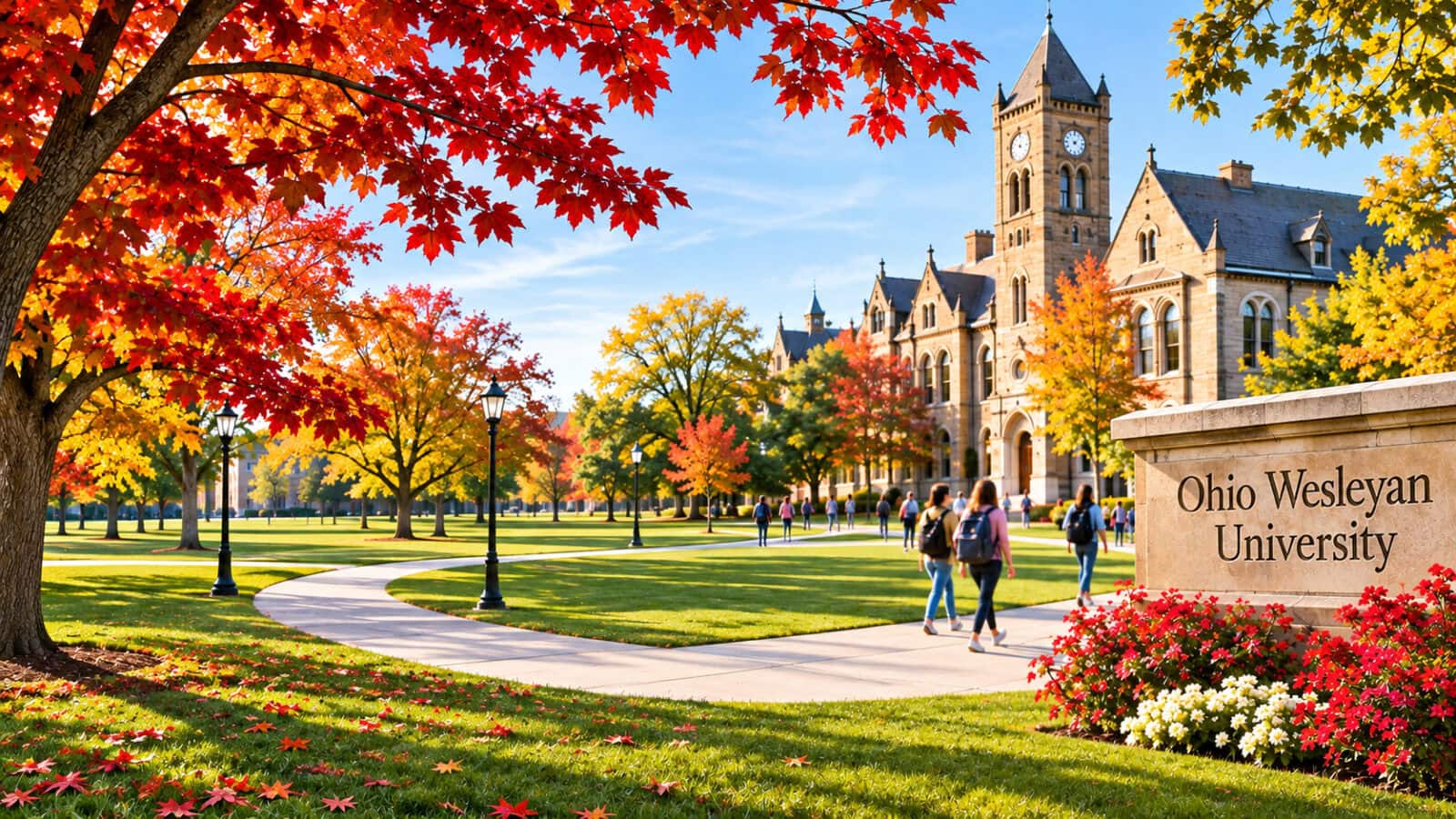
Long before Dudley Mecum II sat on the boards of Citigroup and Travelers or helped run one of the country’s largest accounting firms, he was a boy in Hamilton, Ohio, with two newspaper routes.
He took on both so he could pay for tennis lessons, and tennis stayed with him for the rest of his life.
He worked his way through Ohio Wesleyan University and graduated in 1956.
On the Delaware campus he gave up his plan to study medicine and turned to business.
Seventy years later, the university says that choice has returned to it as the largest gift in its history.
Recently, before students, faculty and alumni gathered on Rock Quad, Ohio Wesleyan President Matt vandenBerg announced a $40 million commitment from Dudley Mecum II and his wife, Harriet Zahn Mecum.
It ranks among the largest gifts ever made to an Ohio liberal arts institution.
Through three charitable trusts, the gift creates a permanent endowment for faculty pay across the university.
It also raises the arts and humanities division to the Mecum College of Arts and Humanities, named in Harriet’s honor.
It is the first of Ohio Wesleyan’s three academic divisions to become a college.
Two of the Mecums’ three children, Dudley Mecum III and Lynne Mecum, were there for the announcement.
For the family, the moment was about their mother.
Dudley III said he believes his father would be deeply touched that he chose to honor her in such a meaningful and lasting way.
“She would be so proud to have her name associated with a school that so closely reflects her interests and passions,” he said.
He described a campus that changed the direction of his father’s life.
“We are thrilled to see our parents’ vision and legacy become a reality,” he said, adding that it meant a great deal to the family that future students would have the chance to explore their passions, pursue careers in the arts and humanities, and build futures they might not otherwise have imagined.
The Mecums’ own story began in Ohio.
Dudley and Harriet met in Columbus and married in 1959, while he was working as a senior account representative for IBM.
They moved to Boston, where he earned his MBA at Harvard Business School and where they started their family.
His career then took them to Potomac, Maryland, then Los Angeles, then Greenwich, Connecticut, and finally to retirement in Stuart, Florida.
He helped found an aerospace and defense consulting firm that Peat Marwick Mitchell & Co. later bought.
In 1969, he became one of the youngest partners elected to that firm’s senior management group.
Over the next two decades, he chaired its Far West region, served as managing partner of its New York office, and sat on its board.
He spent two years as Assistant Secretary of the Army for Installations and Logistics, served in the Office of Management and Budget, and was part of President Reagan’s 1980 transition team.
He later became a partner at G.L. Ohrstrom and a managing director at Capricorn Holdings.
Among the many boards he joined, one was always closest to him: Ohio Wesleyan’s.
Outside the boardroom, those who knew him describe a man of wide curiosity.
He built model airplanes, traveled widely, read deeply about World War II, and especially loved the performing arts.
It suits him that his largest act of generosity puts the arts and humanities on stronger footing and that he named the result for the woman he married in Columbus more than six decades earlier.
The gift’s central goal is practical: paying the people who teach. VandenBerg has promised to improve faculty pay since his 2024 inauguration, and the university has already doubled merit awards on top of cost-of-living increases.
Its median full-time faculty base salary for a nine-month year now stands at $82,820. The aim is to move into the top tier of Central Ohio institutions for faculty pay. VandenBerg admitted that, for a school of Ohio Wesleyan’s size, that would take resources far beyond any normal operating budget.
“This is one of the largest investments ever committed to faculty compensation at an American liberal arts college,” he said.
“Ask our alumni what set them on their path, and they almost always name a professor. Our faculty are how we deliver on every promise we make to students, and that’s why this gift goes straight into faculty pay.”
Other donors are already building on the Mecums’ gift.
Several families have pledged about $4 million in additional endowed support so that raises can start before the Mecum funds arrive, and the university is still raising money to grow the total.
The Mecum commitment also completes a record fundraising run.
Ohio Wesleyan raised $69.4 million in fiscal 2025, then $94 million in fiscal 2026, the two largest totals in its history.
The new Mecum College includes six departments: English, fine arts, history, performing arts, philosophy and religion, and world languages and cultures.
It also offers programs in creative writing, film studies, and ancient, medieval, and Renaissance studies.
VandenBerg presented the decision as a deliberate move against the trend in higher education.
“At a time when many institutions are cutting the arts and humanities, we want to stand out as the place running back to them,” he said.
He argued that employers and communities need the skills the arts, humanities, and social sciences are especially good at building.
That belief is also behind the new identity the university announced the same afternoon: America’s University for Ambitious Self-Discovery.
The idea is simple.
Seventeen- and eighteen-year-olds shouldn’t be pressed to choose a major, and with it a career, before they’ve had the chance to find out what interests them.
About 80 percent of college students change majors at least once, and vandenBerg calls them the “exploratory majority.” At Ohio Wesleyan, first-year students don’t declare a major.
They spend two semesters building core skills in reasoning, writing, speaking, and creative thinking.
Every student also completes a hands-on experience outside the classroom, such as an internship, research, study abroad, a service project or a startup.
“More and more students need the space, the time, the grace, and the support to be able to figure out who they are,” vandenBerg said.
The university now has strong momentum.
It has enrolled two first-year classes in a row at levels not seen in about 15 years, and total enrollment is at a ten-year high.
Its strategy rests on that kind of course change.
One senior, a theater and communications student, came to campus planning to become a high school theater teacher and now sees possibilities well beyond that.
“My dreams do not have to compete with each other,” she said.
Dudley Mecum II understood that.
He arrived in Delaware planning to become a doctor, but he left on another path.
Now, through the gift he and Harriet made, the faculty who help students find their own paths will be better paid, and the college that carries Harriet’s name will be there for students still working out who they want to be.