
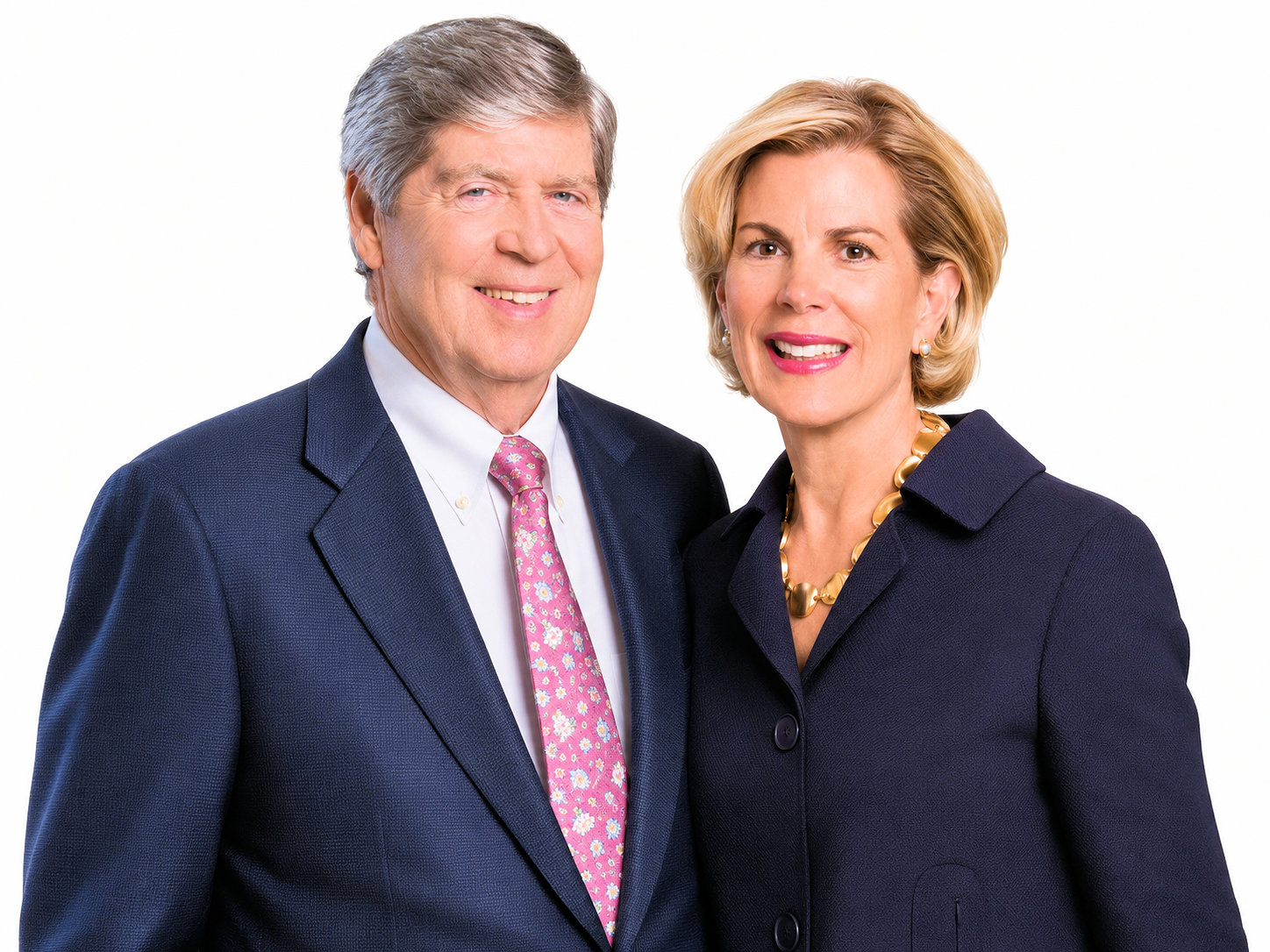
$30 million latest gift from Dwight and Martha Schar launches two new institutes at university and lifts the Schars’ philanthropic gifts above $238 million
Mason Square, George Mason University’s Arlington campus, has a plaza at its center.
On most days it’s an ordinary place: students crossing between classes, faculty stopping to talk, neighbors coming in for a public lecture.
It will soon carry the name of a man who began his working life teaching junior high in Ohio and spent more than a decade quietly building the school next to it.
Dwight Schar, the founder of homebuilder NVR Inc., has given $30 million to George Mason’s Schar School of Policy and Government.
The gift will create two new institutes focused on some of the country’s hardest problems, and in recognition of his longstanding support, the university will name the space the Dwight Schar Plaza at Mason Square.
You can trace the gift back to a farm-country childhood.
Schar grew up in rural northeast Ohio, one of six children raised by a single mother.
Health care was hard for the family to reach, and his mother died of cancer young.
He graduated from Norwayne High School in 1960 and went to nearby Ashland College to study education.
He loved teaching.
But on weekends he picked up a side job selling houses, and he turned out to be good at it.
He soon left the classroom, joined Ryan Homes in 1968, and went on to run its land acquisition across Ohio, Kentucky, and Indiana.
He then moved east to lead the company’s Washington operations.
In 1980 he founded NVR, which grew into a Fortune 500 company building homes in 15 states under the Ryan Homes, NVHomes, and Heartland Homes names.
He led it as chief executive and then as chairman until he retired at 80.
The road wasn’t always smooth, and Schar is the first to say so.
When interest rates spiked and the housing market collapsed in the early 1990s, NVR went through a painful restructuring.
That’s when he made his first major gift to the Inova health system.
“At that point in my career, I was really broke,” he has said, “but I was drawn to help Inova.”
That instinct, giving when it costs something and doubling down when the stakes are high, has defined his philanthropy ever since.
The name on the policy school is not new either.
In 2016, Schar gave $10 million to what was then called the School of Policy, Government, and International Affairs, and the university renamed it in his honor.
Since then, his support has helped create the Washington Post-Schar School polls, bring in leading academics and policy experts, and grow the school’s research and programs.
It helped turn a regional public policy school into one with a national profile.
Schar, who once taught teenagers for a living, has been blunt about why public universities matter to him: “The cost of higher education is ridiculous now; only the affluent can afford to make that kind of an investment. We have to figure out alternative ways to provide quality, affordable education.”
“I have believed for a long time in what this school can become,” he said of this new gift.
“My hope is that these institutes will help prepare the next generation to take on the difficult questions facing our country and give students the judgment, experience, and perspective to do that work well. I’m proud to continue supporting the Schar School as it builds for the future.”
The first of the two new centers, the Institute for Security, Intelligence, and Defense, builds on an area where the Schar School already has real strength.
It will focus on security challenges in the Indo-Pacific; nuclear, biological, and chemical threats; emerging technologies; and the growing role major technology companies play in national security.
At its core will be the school’s Michael V. Hayden Center for Intelligence, Policy, and International Security, whose public programs will expand under the new institute.
For retired Air Force Gen. Michael V. Hayden, who founded the center after leading both the CIA and the National Security Agency, the goal is openness.
“People should have the opportunity to understand how national security decisions are made, who makes them, and the responsibilities those public servants carry,” he said.
“Bringing these conversations into the open can help people ask better questions, understand the work more fully, and perhaps even see a place for themselves in public service.”
The second center, the Institute for Economic Statecraft, takes on a subject that has moved from specialist journals into front-page news.
It will study how governments use economic tools to pursue foreign policy and national security goals: export controls, financial sanctions, tariffs, and limits on critical technologies.
It will also look at what those choices cost businesses, markets, and international relationships.
The gift will let the school recruit faculty with senior government experience, start a research initiative on illicit financial flows, hold an annual summit, and produce new research in the field.
The topic suits a builder who saw his own company nearly undone by forces far beyond any single job site.
He knows that decisions made in Washington reach all the way down to payrolls and kitchen tables.
Whatever Schar builds, he builds with his wife, Martha, and the couple’s giving has always followed what matters to their family.
Health care comes first.
“Health care is No. 1 in my books; there’s nothing more important you can offer the community,” he has said.
“The metropolitan Washington area has been very good to me and my business, so this is where I feel I can do the greatest good for the greatest number of people.”
Together they have given more than $126 million to Inova since that first gift.
That includes $50 million to create the Inova Schar Cancer Institute, a cause rooted in his mother’s illness.
It also includes a $75 million challenge gift for heart and vascular care that more than 10,000 donors rushed to match.
That gift came around the time Martha had heart valve surgery herself.
Dwight called it a coincidence, but hardly a surprising one, since heart disease touches nearly every family.
He doesn’t micromanage the gifts, but he notices the small things.
What he talks about most at Inova isn’t the technology.
It’s the free valet parking, so no one facing chemotherapy has to walk four blocks from a garage, and the greeters who meet patients at the door with a smile.
“The treatment is obviously the most important thing,” he has said, “but all these other little things make the experience that much more positive for patients.”
Education is the couple’s second calling, and it runs through their family story too.
They gave $12 million to Elon University, where their sons Spencer and Stuart studied, the largest gift in its history at the time.
At Ashland, the college where a farm kid once trained to be a teacher, their name is now on the College of Education, the College of Nursing and Health Sciences, the athletic complex, and, as of just weeks ago, a plaza outside newly renovated residence halls.
That brings their support for the school to $60 million. Schar has long credited the late Northern Virginia developer Milt Peterson and his family as his “idols in philanthropy.”
He and Martha have clearly taken that example to heart.
With this new gift, their documented philanthropy now tops $238 million.
At George Mason, the people closest to the work describe this gift as the moment a plan becomes real.
“This gift allows us to put our vision for the next chapter of the school into practice,” said Mark J. Rozell, dean of the Schar School.
“By establishing these two institutes focused on critical, global issues and bringing in additional academic and practitioner expertise, we can expand the research we undertake and the opportunities we offer students. Just as important, we can bring those ideas and conversations to a broader public at a time when they are needed most.”
George Mason President Gregory Washington put it in terms of region and legacy.
“Dwight Schar has long understood that investing in George Mason University students and faculty is investing in the future prosperity and thought leadership of our region and the Commonwealth of Virginia,” he said.
“Dwight’s support of these new institutes deepens the Schar legacy of impact and opportunity at the university that he so proudly and generously supports.”
Trishana E. Bowden, the university’s vice president for advancement and alumni relations and president of the George Mason University Foundation, said the gift shows what philanthropy makes possible.
“Dwight Schar’s investment reflects a belief in the Schar School’s potential and in George Mason’s ability to contribute to the public good,” she said.
The gift is part of Mason Now: Power the Possible, the university’s $1 billion comprehensive campaign.
Both institutes are expected to open in fall 2027, with research, public events, and ways to get involved taking shape in the months before then.
When they open, the plaza outside will carry the name of a former schoolteacher who never really stopped believing in classrooms.
It will keep doing what it already does: hosting public events and drawing students, faculty, and the Arlington community together.
The ideas he’s paying for are meant to be shared in public, and the plaza is where that happens.