
$27 million new commitment for public schools: Marc and Lynne Benioff extend a billion-dollar Bay Area legacy of giving
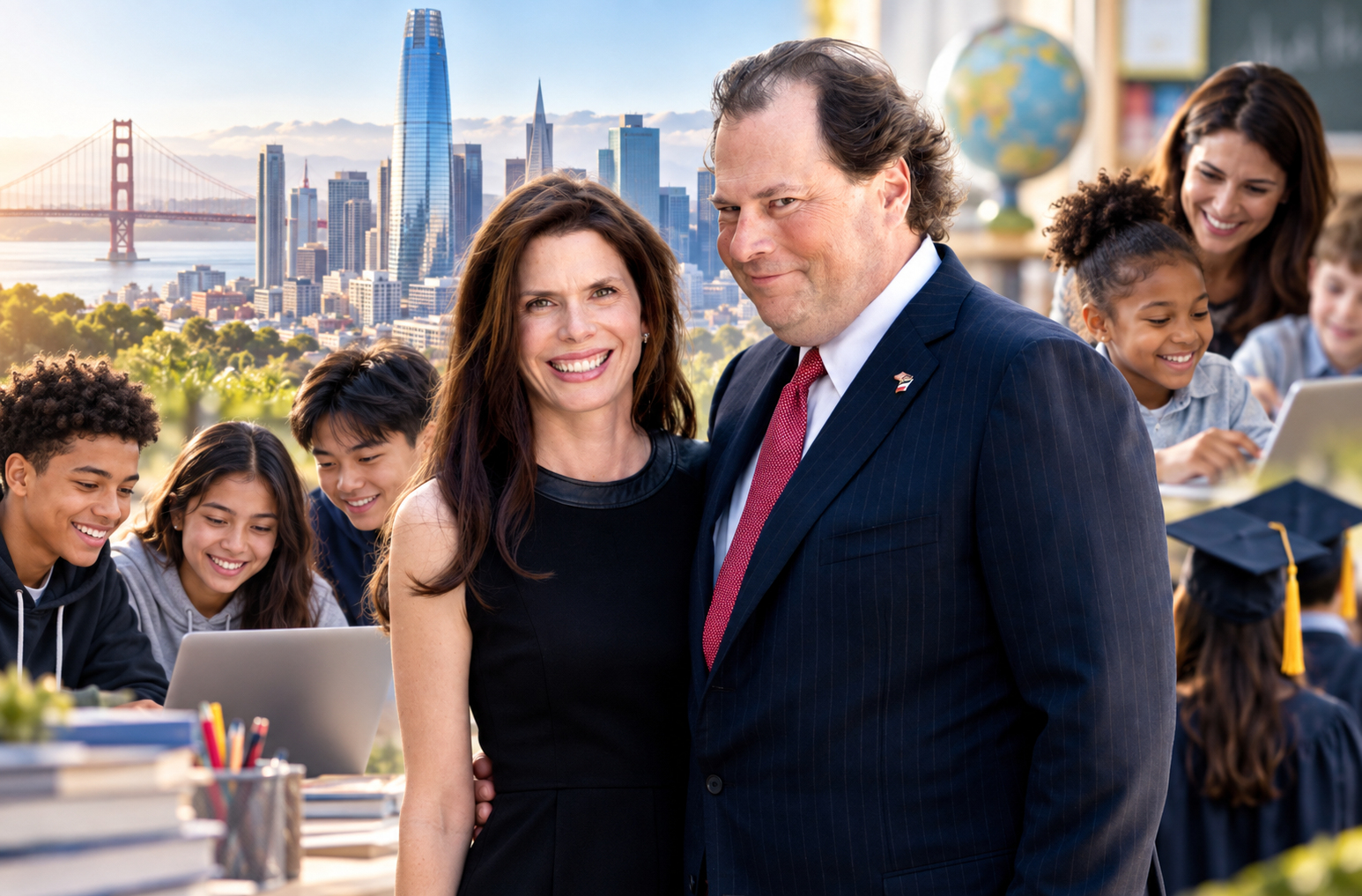
Marc Benioff is once again placing public education at the center of Salesforce’s civic mission, with the company announcing $27 million in new education grants nationwide—an investment that reflects both the urgency of the AI era and the long-running philanthropic identity of the Salesforce founder.
The new commitment includes $18 million for public-school districts in San Francisco, Oakland, New York City, Chicago, and Indianapolis, while another $9 million will support organizations working with educators, school leaders, and students on professional development, career preparation, and technology skills.
The grants build on Salesforce’s 14-year partnership with public schools and bring its total investment in public education to more than $180 million nationwide, including $156 million in the Bay Area.
For Benioff, Salesforce’s chair and chief executive, the announcement is part of a much broader effort to tie the success of a major technology company to the well-being of the community around it. Salesforce has long promoted its 1-1-1 model, through which the company commits 1% of its equity, technology, and employee time to giving back.
Since its founding, Salesforce says it has provided $970 million in grants, logged nearly 11 million employee volunteer hours, and made its technology available free or at a discount to more than 65,000 nonprofits and educational institutions.
The education grants arrive at a moment when artificial intelligence is changing the nature of work, creating new opportunities but also intensifying concerns about who will have the skills, confidence, and access to benefit.
Salesforce’s funding is intended to help schools respond to that shift in practical ways: strengthening STEM and computer-science instruction, preparing students for careers, supporting principals, and helping teachers understand how to use AI responsibly in their classrooms.
“Business is the greatest platform for change,” Benioff said in announcing the initiative.
“As AI transforms our world, we have an even greater responsibility to support schools and teachers and help make sure every young person has the opportunity to thrive.”
The company points to early signs of progress from its existing education work. In Oakland, Salesforce-funded math teacher coaches helped contribute to an eight-point increase in standardized math assessment scores, according to the company.
In San Francisco, a broader middle-school math initiative supported by Salesforce has coincided with an almost 8% increase in proficiency rates since 2022. Across San Francisco and Oakland, Salesforce says its investments have helped bring computer-science education to more than 130,000 Bay Area students.
The grants also emphasize the adults at the center of public education. Funding will go to organizations including New Teacher Center, Leading Educators, TNTP, aiEDU, and Partners in School Innovation, supporting teacher coaching, professional learning, leadership development, and AI readiness. Salesforce cited survey findings from aiEDU showing that 91% of participating teachers reported considerable or significant growth in their AI literacy.
For students, the company is backing CodePath, Genesys Works, and Eat. Learn. Play. Foundation, and Jobs for the Future are organizations focused on expanding hands-on learning, career-connected opportunities, and pathways into fields where technical and workplace skills are increasingly in demand.
The strategy suggests that Salesforce sees education not simply as a philanthropic cause but as a central infrastructure investment in the country’s future workforce.
Benioff’s approach also extends beyond grantmaking. Ahead of Dreamforce, Salesforce’s annual conference, the company has relaunched its Adopt-a-School program, pairing employees and senior executives with more than 25 public schools nationwide, including 15 middle schools in the Bay Area.
Employees will be encouraged to build ongoing relationships with schools through mentoring, workshops, classroom preparation, and other forms of direct support shaped by local needs. About 100 students are also expected to attend Dreamforce for mentoring and hands-on workshops.
The program reflects an important distinction in the Benioff model of philanthropy: the belief that corporate giving should not be limited to capital. It should also involve access to technology, the skills and time of employees, and a sustained presence in the institutions being supported. “Being part of a community means showing up again and again,” Salesforce President and Chief Operating and Financial Officer Robin Washington said, describing her involvement with Elmhurst United Middle School in Oakland.
The announcement is especially resonant in the Bay Area, where the Salesforce tower has become one of the defining symbols of San Francisco’s technology-driven economy—and where Benioff has made a point of arguing that prosperity comes with a responsibility to reinvest locally.
Salesforce has contributed more than $285 million to Bay Area public schools and UCSF Benioff Children’s Hospitals.
Those investments form part of more than $1 billion in combined contributions to the Bay Area by Salesforce and Marc and Lynne Benioff over more than 27 years.
That record includes significant support for pediatric health care and education.
In 2025, Marc and Lynne Benioff announced a $100 million gift to UCSF Benioff Children’s Hospitals, further cementing their role among the Bay Area’s most consequential philanthropic donors.
The latest education commitment will not solve every challenge confronting public schools, from funding pressures and teacher shortages to learning gaps and the unsettled role of AI in the classroom.
But it does represent a substantial, sustained wager on the public systems that shape opportunity for millions of families.
As the technology industry pushes forward into an AI-powered future, Benioff’s message is increasingly clear: the companies helping to define that future should also help equip young people—and the teachers guiding them—to take part in it.