
$258 million to start over: Chris Coble and Lilly Endowment bet on America’s newest Churches
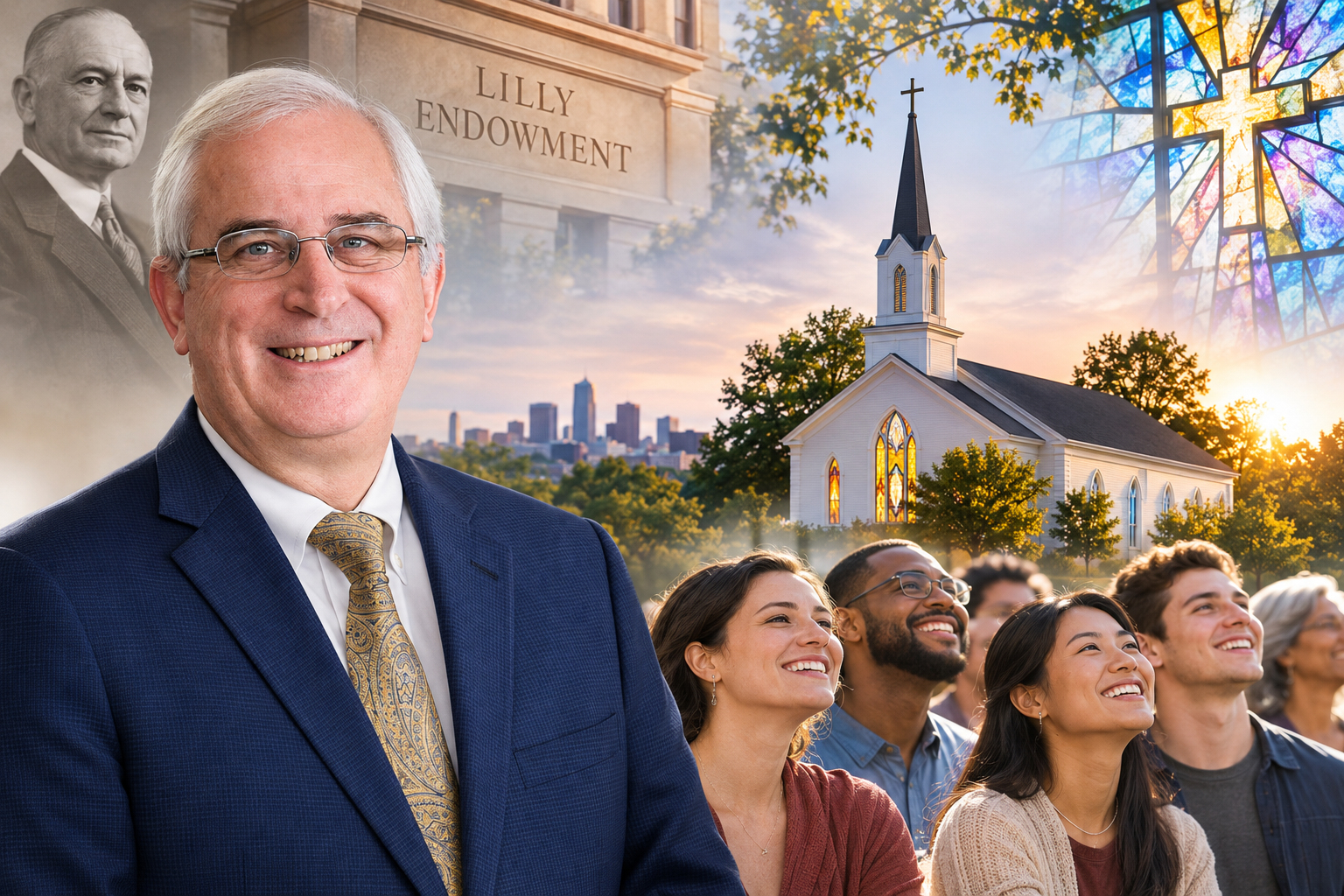
Chris Coble has spent most of his life in church pews, behind pulpits and inside the archives of American faith.
Before becoming one of the most influential figures in American religious philanthropy, he majored in religion at Wabash College in Indiana, then studied divinity at Duke, then pursued a doctorate at Harvard, where he trained as a historian of American religion.
His scholarly question was quiet but enduring: how faith is formed and how it passes from one generation to the next.
Along the way, he was ordained in the Christian Church (Disciples of Christ) and served congregations in Indiana, North Carolina, Iowa and Massachusetts, learning firsthand what it takes to keep a community of believers alive.
Today, as vice president for religion at Lilly Endowment, the Indianapolis foundation where he has worked for three decades, Coble is helping to answer that question at national scale.
The Endowment has approved more than $258 million in grants through its New Churches Initiative, a five-year effort to help denominations, church networks and faith-based organizations do something that sounds simple and is anything but: start new congregations, and help them last.
The money is spread across 52 organizations, with most receiving $5 million and none less than $4 million.
The roster reads like a map of American Christianity.
Catholic dioceses include Phoenix, Nashville, Charlotte, Seattle, Atlanta, Las Vegas, and Galveston-Houston.
The roster also includes the Greek Orthodox Archdiocese, the Orthodox Church in America, and the Coptic Orthodox Diocese of Los Angeles.
Historic Black denominations include the African Methodist Episcopal and AME Zion churches, the Church of God in Christ, the National Baptist Convention, and the Progressive National Baptist Convention.
Mainline bodies include the Episcopal Church and the Presbyterian Church (U.S.A.), the Evangelical Lutheran Church in America, and the United Church of Christ, alongside the Southern Baptists’ North American Mission Board, the Assemblies of God, the Seventh-day Adventists, the Lutheran Church-Missouri Synod, and the Global Methodist Church.
And there are entrepreneurial networks that have made church planting their life’s work, including Acts 29, Exponential, Vineyard USA, and Redeemer City to City, the New York-based network born of Manhattan’s Redeemer Presbyterian Church.
Duke University, where Coble earned his divinity degree, will run a separate coordination program so that these very different organizations can share what they learn.
The breadth is deliberate.
Before designing the initiative, the Endowment spent months talking with leaders from mainline Protestant, evangelical, Catholic, Black Church, Orthodox, and Peace Church traditions, as well as Hispanic and Asian American Christian communities.
Their message surprised many outside the church world.
While headlines tend to focus on sanctuaries closing their doors, the most recent U.S. Religion Census found that over the past decade, nearly as many congregations opened each year as closed.
Leaders described a steady stream of people, many of them unaffiliated or estranged from organized religion, who hesitate to walk into an established church but feel drawn to a new one.
That observation sits at the heart of Coble’s career.
When he was elevated to lead the Endowment’s religion division, the foundation’s chairman, N. Clay Robbins, singled out his special interest in how the church can better engage younger generations.
The Endowment found that new congregations do exactly that.
They tend to attract more young people, are often led by younger pastors, adapt more readily to their surroundings, and are more likely to serve growing immigrant communities.
“Leaders from many Christian denominations, parachurch organizations, and church networks shared encouraging accounts about the growth and vitality of new congregations they are starting,” Coble said.
“We hope these grants will help to build their capacities to strengthen and extend these important efforts.”
The hope is grounded in hard-won realism.
The same leaders who spoke of momentum also described a field in a critical transition. Finding and preparing the right pastors is difficult.
Supporting them through the lonely early years is harder still. And money, perhaps the most daunting challenge of all, rarely arrives in the shape a young congregation needs.
Many denominations have acknowledged that the financial models they once relied on to launch churches no longer work, especially in less-resourced communities.
So the grants are built in three parts.
Each organization will design and test new approaches to starting congregations and parishes, strengthen its own ability to support them, and build up a pool of funds that flows directly to new churches as they work toward standing on their own.
Some are experimenting with revolving funds, where startup support is gradually repaid as a congregation matures and then lent to the next.
Others are pairing established churches with new ones to share resources.
To encourage new giving, the Endowment is matching a portion of these church-starting funds dollar for dollar, inviting other donors to join the effort rather than simply relying on a single foundation.
On the ground, the work will look like discernment retreats for people wondering whether they are called to plant a church, conferences for seminarians, mentoring and spiritual care for pastors who are building something from nothing, and new congregations led largely by laypeople or rooted inside community organizations that already serve their neighbors.
A long line of continuity runs through this.
J.K. Lilly Sr. and his sons, Eli and J.K. Jr., created Lilly Endowment in 1937 through gifts of stock in their family pharmaceutical company, and religion has been one of its founding causes ever since, alongside education and community development.
Nearly nine decades later, the founders ask those gifts to do what they would surely recognize: help ordinary people find a place to belong, ask their deepest questions, and grow in faith together.
For Coble, the historian who once studied how belief is handed down, the initiative is a wager on the future rather than a lament for the past.
It suggests the next generation of American churches may not look like the ones their grandparents attended.
Some will meet in storefronts and community centers, some will worship in languages new to their neighborhoods, and many will be led by pastors who have never done this before.
With patient money and a five-year runway, Lilly Endowment is betting that they will find their footing and that the faith Coble has spent a lifetime studying will keep finding new homes.