
$22.5 million new gift from Gabriel and Stephanie Gilinski brings their family’s education habit home to university
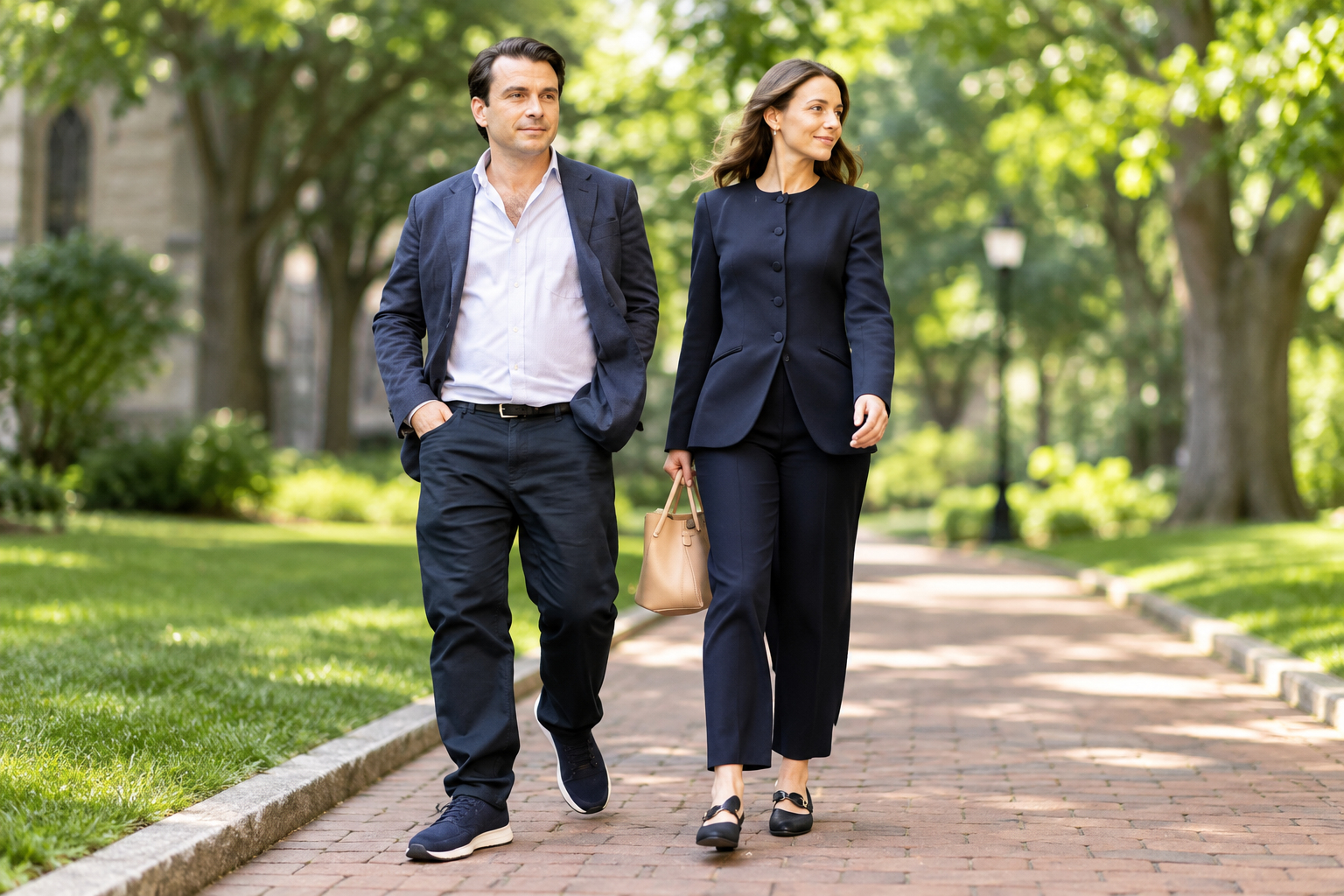
Gabriel Gilinski came to the University of Pennsylvania as the son of one of Latin America’s most formidable dealmakers.
He studied political science, minored in economics, and graduated from the College of Arts and Sciences in 2008.
Eighteen years later he is back, this time as a benefactor. On Tuesday, September 22, Penn announced that Gilinski and his wife, Stephanie, have committed $22.5 million to the School of Arts and Sciences.
The gift endows an undergraduate scholarship and creates two professorships and a visiting professorship across history, political science and economics, the disciplines that shaped his own time on campus.
The announcement photo shows the Gilinskis standing with Penn President J. Larry Jameson and Arts and Sciences Dean Mark Trodden.
It looks like a routine campus ceremony. Behind it is a family story nearly a century long, one that began with Lithuanian Jewish immigrants in Barranquilla and runs through plastic chairs, snack foods, rescued banks, luxury hotels, a national newsmagazine, and a hostile takeover of Colombia’s largest food company.
The gift has two parts. Scholarship money will help undergraduates afford Penn, with specific support for students educated in Latin America. The faculty money works at the top of the academic ladder.
An endowed chair is the highest honor Penn gives a faculty member, and each one in the college requires at least $3 million. The college has about 200. The visiting professorship adds something the Gilinskis clearly value: a steady flow of scholars from elsewhere who bring different views into Penn classrooms.
Gilinski framed the gift in personal and regional terms.
“Across Latin America, access to education creates lasting change for families, and I’ve seen the ripple effect it can have, shaping not just one life but an entire community,” he said.
“Penn gives international scholars a place to bring their own perspectives and experiences, and they leave shaped by everything they’ve learned from the classmates around them. That’s part of what makes a Penn education so special to me.”
He credited Penn’s liberal arts training with teaching him the value of critical thinking. On the professorships, he said: “Exceptional faculty are at the heart of Penn’s mission, and we are proud to support the recruitment and retention of scholars who bring complex problems to life in the classroom.”
Jameson called the gift a partnership.
“Penn is at its best when we bring talented students together with outstanding faculty and give them the opportunity to learn from one another,” he said. “Gabriel and Stephanie’s generous commitment expands access to a Penn education while investing in the scholars whose outstanding teaching and research enrich our academic community.”
The timing adds weight. It is the largest gift Penn has announced this year, ahead of a $20 million commitment for middle-income financial aid in May. It lands as the university’s Quaker Commitment offers full-tuition scholarships to families earning up to $200,000 with typical assets, and as tuition has risen again.
It also comes at a hard moment for international students, some of whom face new uncertainty from shifting federal immigration rules. A scholarship aimed at Latin American students, from a donor who talks openly about the value of international classmates, sends a clear message at such a time.
The donor himself is a rare mix. Gabriel Gilinski Kardonski was born in Miami in 1987.
He is the second of four children of Jaime Gilinski Bacal, a Colombian banker whom Forbes now ranks as the country’s richest person, worth about $16.9 billion, and Raquel Kardonski, who comes from a prominent Panamanian family.
An article has reported that Gabriel first heard about the family business when he was seven.
People close to the family say that whenever Jaime pursues a major deal, he calls Gabriel to come along and learn. Friends describe Gabriel as someone who makes friends easily and as “a gomoso de la tecnología,” a Colombian expression for a tech enthusiast.
His career started in the usual way for ambitious graduates. He worked in consulting at Boston Consulting Group, which sent him to Santiago, Chile, for a tourism project that first sparked his interest in hotels. He joined the family business in 2008, just as the American banking crisis hit, starting at a Miami bank the family owned.
He then helped run the GNB Sudameris banking network in Peru and later Colombia. Over the next decade, he sat on the boards of family banks in Colombia, Peru, and Paraguay. He also joined the board of Grupo Sura, the financial conglomerate at the center of his father’s biggest corporate battle.
His own deals have had flair. In 2015, he talked his father into hotels. The Gilinskis paid about $100 million for three historic properties, the Charleston and Casa Medina in Bogotá and the Santa Teresa in Cartagena, buying them from French businessman Pierre Falcone, who had been caught up in a notorious Angolan arms-trafficking scandal.
They renovated the Bogotá hotels and brought in Four Seasons to run them. Gabriel then invited his friend, the celebrity chef Harry Sasson, to open a Harry’s Bar inside the Santa Teresa. Not every bid succeeded. The family also went after Madrid’s grand Villa Magna and lost it to a Turkish group.
His most public move was in media. In 2019, the Gilinskis bought half of Publicaciones Semana, publisher of Colombia’s most influential newsweekly, for a reported $18 million. Gabriel proposed the deal to his father and closed it with the magazine’s founding family.
His plan was ambitious. He wanted to combine Semana’s business titles with a financial news site and build something like a Latin American Bloomberg. In November 2020, the family bought the rest of the company, and Gabriel became its controlling shareholder.
He pushed Semana hard toward digital, backing a new online TV channel. The overhaul drove out some of the country’s best-known journalists and sharply cut staff. Critics said the magazine had shifted to the right. When asked about the departures, Gabriel replied, “Nadie los sacó,” meaning “No one pushed them out.”
Today Gabriel sits at the top of the family’s largest prize. In January 2025, he became chairman of the board of Grupo Nutresa, the Medellín-based maker of chocolates, coffee, and cold cuts, with more than 50,000 employees and 45 factories in 17 countries. His father serves as chief executive.
Winning Nutresa took years. The Gilinskis launched a tender offer in late 2021, fought an 18-month battle with the Grupo Empresarial Antioqueño, the Medellín business alliance that had controlled the company for almost half a century, and partnered with Abu Dhabi’s royal family. By 2025, the family held about 84.5 percent of the company. In March 2026, Gabriel also joined the board of GeoPark, the Latin American oil and gas producer, where he chairs the nomination and compensation committee.
The family’s history begins with a narrow escape.
In the 1920s, Gabriel’s great-grandparents left Lithuania, spent time in pre-state Israel, and then settled in Barranquilla, on Colombia’s Caribbean coast. The relatives who stayed behind died in the Holocaust. Their son Isaac, born in 1934, studied chemical engineering in Indiana and married Perla Bacal, a chemist he had met when they were both 13.
In 1953 Isaac and his brother Lazar founded Rimax, whose plastic chairs became a fixture in Colombian homes. Isaac later founded the snack company Yupi, moved into banking, and served as Colombia’s ambassador to Israel, presenting his credentials to Shimon Peres, before a posting at the United Nations.
Perla started three businesses of her own. In her seventies she earned a master’s degree in social work from Barry University in Miami, where she was the only student her age. This August, Gabriel’s aunt Tania Gilinski was named Colombia’s ambassador to Israel, the same post her father and uncle held before her.
Jaime, Gabriel’s father, gave the family its reputation for boldness. He left Cali for Georgia Tech at 16, arriving in 1974 with what he called “a suitcase and a dream.” He went on to Harvard Business School and Morgan Stanley. His early legend involves Procter & Gamble.
After his letters went unanswered, he flew to Cincinnati uninvited and left a note at headquarters. The partnership that followed took four years and 42 trips to Medellín. In 1991 he persuaded his father to buy the Colombian arm of the collapsed Bank of Credit and Commerce International.
In 1994, according to news reports, George Soros agreed on the back of a napkin to put $50 million into Jaime’s bid to take over Colombia’s largest bank. “There is a moment in life when you have to take all of the risk,” Jaime has said, “just put all of the cards on the table.”
Gabriel’s gift continues a family habit of giving to education and medicine, often at the schools where family members studied. In the 1990s the family gave about $8 million to the Fundación Santa Fe de Bogotá, which supports one of Colombia’s leading hospitals.
In 2003 Jaime and Raquel, together with George Rohr and his wife, paid for the purchase of Chabad’s $1.5 million student center on Banks Street in Cambridge. Jaime continues to chair capital projects for Harvard Chabad.
The couple’s endowment supports Harvard’s David Rockefeller Center for Latin American Studies, and their fellowship at Harvard Business School sends Colombian and Panamanian students to earn MBAs. In 2013 Jaime endowed a chair in entrepreneurship at Tel Aviv University in his father’s name.
Isaac and Perla funded scholarships at Israel’s Reichman University, including for students of Ethiopian origin and in memory of Lazar. In 2022 Mount Sinai announced a multimillion-dollar gift from Jaime and Raquel that named its department of obstetrics, gynecology and reproductive science in New York.
In Miami, they created a merit scholarship program for middle and high school students at the Jewish day school now called Scheck Hillel, where Stephanie Gilinski is listed on the board of governors.
This spring, Georgia Tech gave Jaime an honorary degree, recognizing in part his support for undergraduate scholarships.
The family’s most recent gift before Penn came during a disaster. After a magnitude 7.4 earthquake hit Colombia on August 10, Jaime and Raquel pledged 150 billion pesos, about $48 million, to rebuild hospitals and schools in Cali, his hometown.
President Abelardo de la Espriella announced the pledge after a phone call with the couple. Speaking to Georgia Tech students this month, Jaime put the family philosophy plainly: “I think that the future of a company and the future of a country is to have educated human beings.”
Seen against that history, the Penn commitment is Gabriel and Stephanie stepping forward in their own names.
The pattern is familiar: an endowed gift, a focus on students from Latin America, and a debt repaid to the school that shaped a family member. Isaac studied in Indiana, and Jaime at Georgia Tech and Harvard.
Gabriel chose Penn, and now the college where he studied politics and economics will have Gilinski-funded professors teaching there and Gilinski-funded scholarships for students who, like him, came to Philadelphia from somewhere else.