$150 million latest gift from Harold Hamm renames OU’s Health Campus and caps two decades of giving back to his community
Harold Hamm has never been comfortable with ceremony.
Recently, standing before a crowd on the University of Oklahoma’s health campus east of downtown Oklahoma City, the philanthropist heard the university announce that the entire campus would now carry his name.
Then he told the audience, in his flat, unhurried Oklahoma cadence, that it was “not a big deal to me, one way or the other. I wasn’t crazy about that.”
The room laughed. It was probably the most honest line of the day.
What Hamm did want to talk about was the gift.
His $150 million commitment is the largest single gift in the University of Oklahoma’s history, and it brings his lifetime giving to the university close to $250 million, making him OU’s largest individual donor.
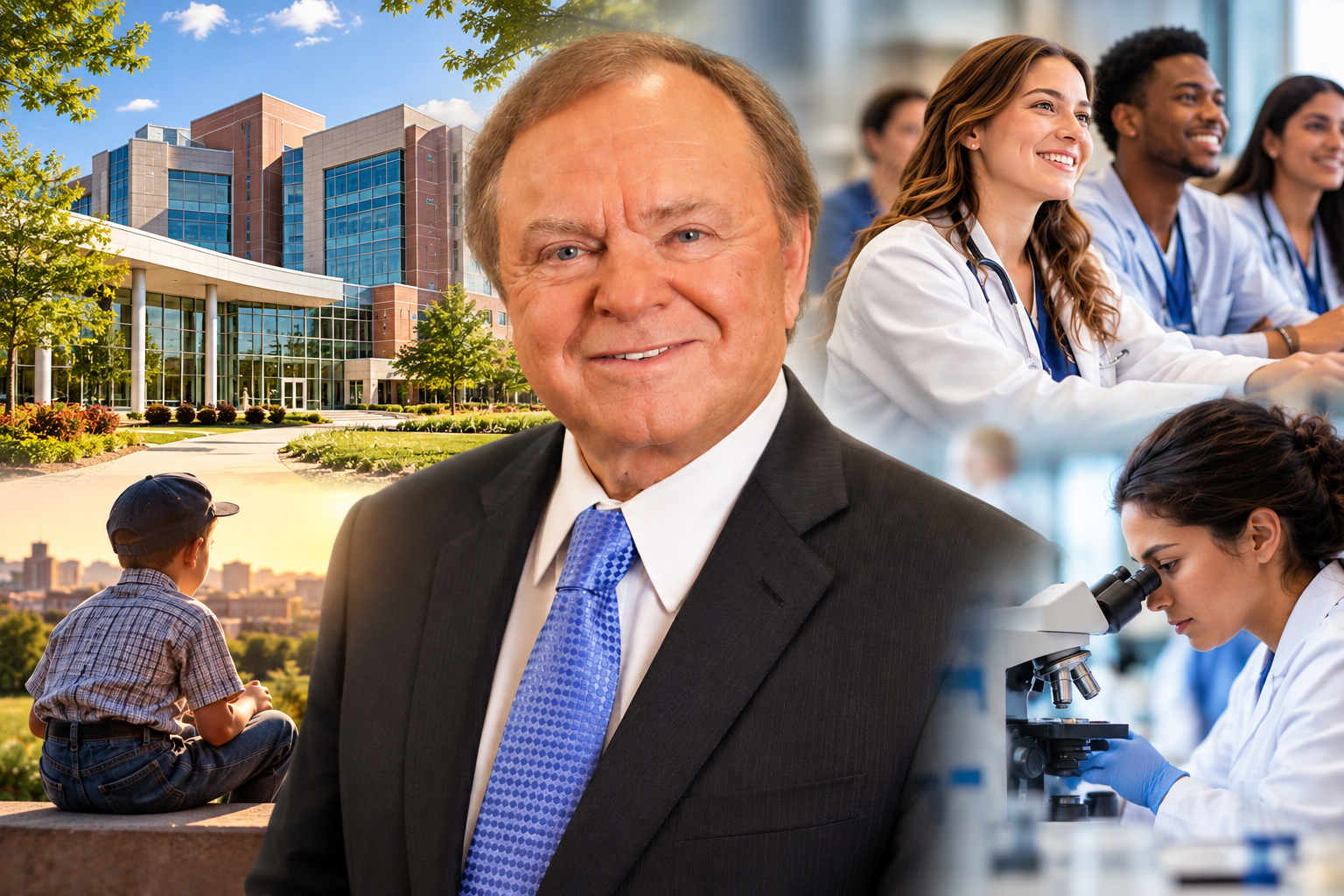
In recognition, the university’s colleges, hospital, and research facilities in Oklahoma City are now the Harold Hamm Health Campus at the University of Oklahoma. It is home to six health professions colleges and the Graduate College, more than 4,100 students, and the classrooms that train roughly 80 percent of Oklahoma’s health care workforce.
The money is divided with an engineer’s precision.
Fifty million dollars goes to the Harold Hamm Diabetes Center, the institution Hamm helped create nearly two decades ago. Of that, $30 million will back the priorities of John P. Kirwan, the internationally known translational scientist who arrived this month from Pennington Biomedical Research Center in Louisiana to lead the center, and $20 million will pay for capital improvements and research infrastructure.
The remaining $100 million will support the broader campus: educating the doctors, nurses, and allied health professionals Oklahoma needs, and recruiting researchers through Project 200, OU’s push to bring more than 200 world-class scientists to the state. About 150 of those hires are planned for the health campus, with diabetes and metabolic disease, cancer, and neuroscience among the priorities.
University President Joseph Harroz Jr. said conversations about the gift began about five years ago. He described Hamm as “a global visionary who has spent his life seeing what is possible and having the courage to act on it” and called the donation “an invitation to all of us to seize this moment.”
He was blunt about the stakes. Oklahoma ranked 47th in the nation for health outcomes in both 2023 and 2024, according to the United Health Foundation, and more than 14 percent of the state’s adults have been diagnosed with diabetes, above the national average. “It’s an absolute crisis,” Harroz said.
“We have fought this for a very long time in our state.”
Few people understand that fight as personally as Hamm does. He was born in 1945 outside Lexington, Oklahoma, the 13th and youngest child of cotton sharecroppers. He picked cotton as a boy and has said he remembers wondering whether he would have shoes to start school.
At 16 he was pumping gas in Enid; by 17 he had written a high school paper simply titled “Oil,” and by the time he finished it, he later said, “I was a believer.” He cleaned sludge out of storage tanks, hauled fuel to drilling rigs, bought a used tank truck with borrowed money, and in 1967 founded Shelly Dean Oil, named for his two oldest daughters, and ran from a makeshift office off his bedroom.
It became Continental Resources, the company that helped unlock North Dakota’s Bakken formation and turned horizontal drilling and hydraulic fracturing into an American energy story. Only after striking oil did he go back to Phillips University in Enid to study geology. “I made my fortune first, then went back to school,” he once joked. “I wouldn’t necessarily recommend that order.”
Then, in his 50s, came the diagnosis: Type 2 diabetes. “I was shocked,” he told Sooner Magazine years ago. He had the means to seek treatment anywhere in the world and discovered there was nowhere obvious to go.
“There is no major center for diabetes like there is for cancer or heart disease,” he said. “Diabetes has been under the radar.”
He came to believe his mother, who died at 62, and at least two of his siblings had lived with the disease undiagnosed. He changed his habits, walking three or four miles most mornings with his dog, Coal, giving up the chicken-fried steak and cream gravy he still remembered fondly, and working out in the gym he built for Continental employees. And he started asking what a single donor could do about a disease that touches one in three Oklahomans, either as diabetes or prediabetes.
The answer took shape in a meeting with then-OU President David Boren, who had also been diagnosed with Type 2 diabetes.
“His vision was as big as mine,” Hamm recalled. “I said, ‘What do you need?’ and ‘What can I do?’ We took our first step forward that day.”
In 2007, Hamm’s $10 million lead gift helped establish what is now the OU Health Harold Hamm Diabetes Center, a statewide hub for research, treatment, prevention, and education. For years afterward, doctors there knew him not just from the name on the building but from the name on a chart; he was one of the center’s patients.
On Tuesday, back on the same campus, Hamm looked out at the crowd and remembered. “We stood right here 19 years ago,” he said, “and committed to do something about diabetes in Oklahoma.”
The commitments kept coming. In 2012 he created the Harold Hamm International Prize for Biomedical Research in Diabetes, a $250,000 award given every two years, now endowed in perpetuity and regarded as the largest prize of its kind in the world. Its laureates include Ralph DeFronzo of UT Health San Antonio and, last year, Anette-Gabriele Ziegler of Helmholtz Munich, whose research led to the landmark trial behind teplizumab, the first immunotherapy shown to delay the onset of Type 1 diabetes.
In 2018, the Harold Hamm Foundation pledged $34 million over ten years to the center, announced at the Bedlam football game against Oklahoma State, and, at the time, the largest gift ever made to OU Health.
That money paid for new faculty, pilot research that traditional grants would not fund, and the facilities to house it.
Altogether, Hamm has invested more than $50 million in the center, and the results are measurable.
Its annual research funding from the National Institutes of Health has grown from $5 million to $33 million, and this year the health campus earned Oklahoma’s first-ever ranking among the top 100 institutions nationally for NIH funding.
His advocacy stretched beyond the lab. Hamm took the cost of insulin to Washington, lending his influence to the Affordable Insulin Now Act, which sought to cap patients’ out-of-pocket insulin costs at $35 a month. Harroz noted that Hamm does not take insulin himself.
He learned that many patients were paying as much as $1,200 a month and could not believe it. “People were out there that could not afford it and were having to limit the amount of insulin that they took each month,” Hamm said Tuesday. “We had to do that.”
Although the University of Oklahoma has received the lion’s share of his generosity, it is not the only beneficiary.
In 2012, Hamm and Continental Resources gave $10 million to the University of North Dakota, creating the Harold Hamm School of Geology and Geological Engineering and thanking the state where the Bakken made his name.
In December 2021 his foundation and Continental made a combined $50 million gift to Oklahoma State University to establish the Hamm Institute for American Energy, which trains the next generation of energy leaders.
A few weeks later, in February 2022, the foundation and Continental committed $12 million to the University of Mary in Bismarck, founding the Hamm School of Engineering. Closer to home, he has led fundraising for higher education in Enid, including Northwestern Oklahoma State University and Northern Oklahoma College, and gave $1.5 million to a community partnership that expanded Enid Public Schools.
His private foundation, focused on education and health care, continues to make smaller grants, from scholarships to local school foundations. Counting the gifts made jointly with Continental, his publicly documented commitments to education and medicine now exceed $320 million.
The pattern is easy to see.
Hamm gives where he has lived and worked, favors institutions over one-off causes, and likes to fund people: geologists for the Bakken, energy leaders for Oklahoma, and now physician-scientists for the state’s only academic health system.
Last fall, at the diabetes center’s Connect+Cure Gala, where Carrie Underwood performed and 800 guests raised $4.7 million, OU gave him its inaugural Crystal Seed Sower Award, created for donors whose support of $25 million or more has profoundly shaped the university. The title fits someone who has spent twenty years planting and waiting.
Tuesday also felt like a family occasion. His daughter Shelly Lambertz, who succeeded him as executive chairman of Continental Resources last year, walked him to the stage, spoke about her father, and wiped away a tear as he stepped down.
Hamm, who is now Continental’s chairman emeritus, glanced toward her more than once during his remarks.
He also shared a story about Boren. Years ago, Hamm said, the former president told him the diabetes center was being named for him so that others might be willing to step up too. “Sure enough, others have stepped up and helped us,” Hamm said. “We’re gonna need help again.”
Gary Raskob, the campus provost, called the gift “a moment decades in the making.” Jonathan Curtright, OU Health’s chief executive, described the goal as turning what is learned in the lab into better bedside care, with more clinical trials and newer treatments reaching Oklahoma patients sooner.
Kirwan, whose research includes the landmark STAMPEDE trial showing that bariatric surgery can put Type 2 diabetes into remission for some patients, now has the resources to build a team around that ambition. The university has set a goal of cutting diabetes complications and related deaths in Oklahoma by 30 percent over five years.
In his prepared statement, Hamm spoke the way wildcatters talk about a promising lease. “Oklahoma has given me more than I could ever repay,” he said, “and I can think of no greater investment than in the health and lives of its people.”
He hopes the gift will make Oklahoma “a place where the next great medical breakthrough happens, where diseases are prevented, lives are saved, and, one day, diseases like diabetes are cured.” That is a legacy worth building.”
Onstage, he said it more simply.
“If we erase this blight on Oklahoma, and I think we will,” he said, “it’s a good mission we’re after.”
For a man who first found oil by drilling where others had given up, the words sounded less like a hope than a forecast.