$142.4 million Francis Bacon triptych, a generous present from Elaine Wynn, is now shared with the public
Elaine Wynn is not present for the debut of the masterpiece she long intended to share with Los Angeles, but her absence is precisely what has brought it into full public view.
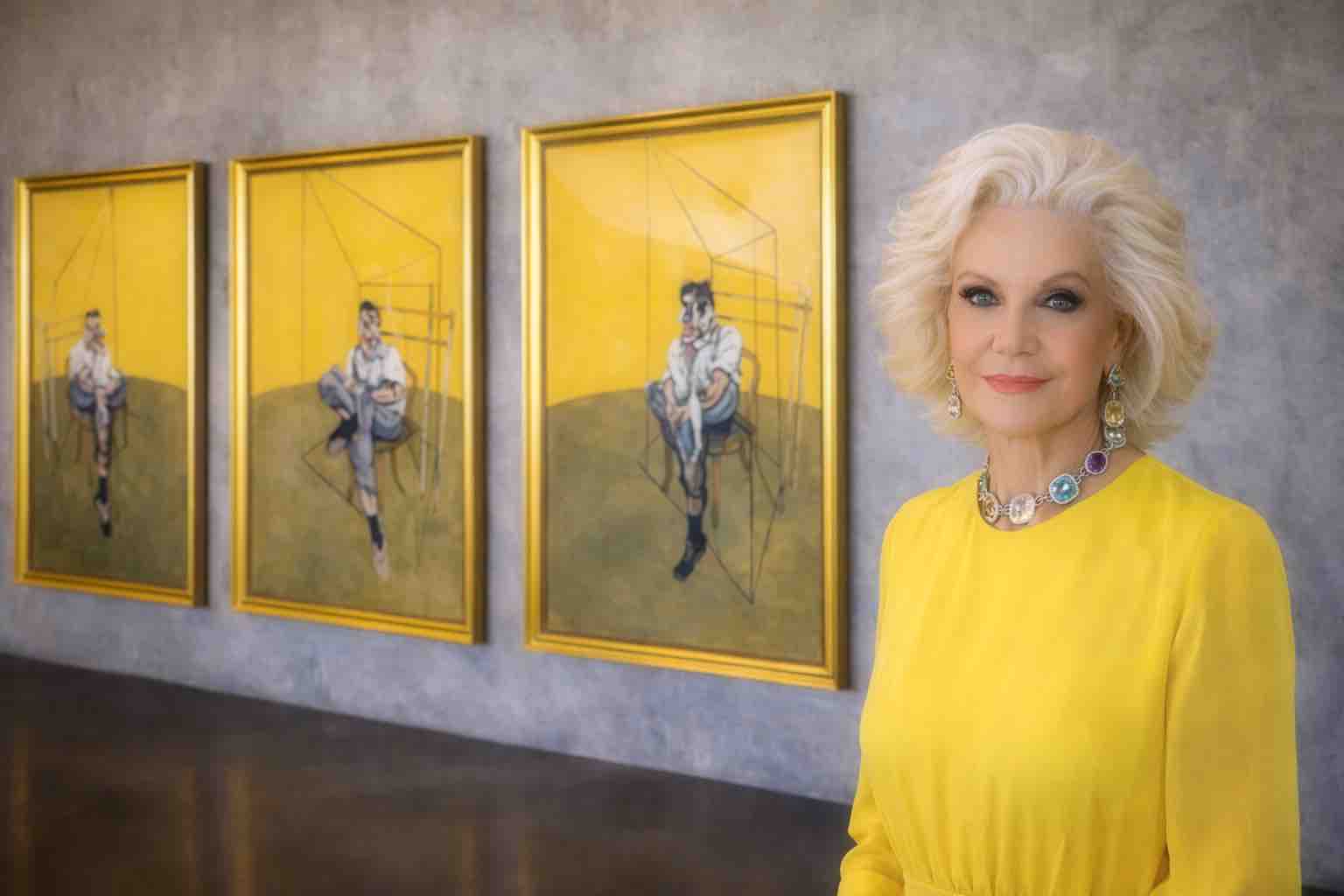
In the new David Geffen Galleries at the Los Angeles County Museum of Art, her $142.4 million Francis Bacon triptych, “Three Studies of Lucian Freud,” now occupies a central artery of the building, turning a onetime private trophy into a civic landmark and crystallizing the late casino magnate’s carefully engineered cultural legacy.
The paintings, completed in 1969, were already the stuff of art‑market lore when Wynn acquired them at auction in 2013, breaking the record for the most expensive artwork ever sold under the hammer. The three panels, each a distorted, kinetic vision of Bacon’s friend and rival Lucian Freud, flicker like frames from an experimental film: Freud sits on a chair, viewed from shifting angles and boxed in by black lines that suggest a psychological cage more than any physical architecture.
Bacon’s trademark pinks, oranges, and bruised flesh tones turn the human body into a battleground of impulses, while the golden grounds and bright gold frames amplify the sense that this is not simply a portrait but a kind of reliquary of modern painting’s anxieties. For years, the triptych hung in Wynn’s own home, out of view except to invited guests; now it is poised to become one of the most visible works in LACMA’s collection, alongside touchstones like Vincent van Gogh’s “Tarascon Stagecoach,” which entered the museum via the Pearlman Collection.
Michael Govan, LACMA’s director and chief executive, watched the installation with a mix of gratitude and grief. “She’s supposed to be here instead of the paintings,” he remarked as crews secured the triptych to a mottled gray concrete wall, its gilded frames catching ambient light and the glass reflecting the world beyond.
Wynn had pledged the work as a life interest gift: it would enter the museum after her death, a promise she repeatedly affirmed to Govan in life. He imagined celebrating the opening of the new building with her, then visiting the paintings at a cocktail party in her home afterward; instead, the art has arrived in her place, an embodiment of a conversation about legacy that began years before ground was ever broken for the museum’s new campus. “The story of this building and her gift,” Govan said, “part of the energy for it was, where do you leave these legacies?”
That question, for Wynn, was never purely about bricks, mortar or a headline‑grabbing auction price. A major LACMA trustee who became board co‑chair in 2015, she had already pledged $50 million toward the Peter Zumthor‑designed Geffen project by 2016, long before the Bacon bequest became public knowledge.
The north wing, where the triptych now hangs, bears her name, making the Elaine Wynn wing a permanent fixture in the topography of the museum.
Behind the naming rights, though, was a specific curatorial scenario: Wynn wanted the Bacon to live in a museum that could give it an audience commensurate with its importance and, as crucially, use it as an engine for public engagement.
The positioning of the work in the new building—a deliberate choice by Govan and his team—translates that donor intent into concrete experience.
The triptych occupies a key stretch of wall in a main thoroughfare that forms part of the building’s bridge over Wilshire Boulevard, a choice that carries both symbolic and practical weight.
Inside, visitors approaching from one direction move almost head‑on into the intense, flickering presence of Freud’s fractured likeness; a simple pivot of the head takes them from Bacon’s inward‑turning psychological drama to the outward rush of city life below, where traffic streams past and Chris Burden’s “Urban Light” installation glows in the distance.
The glass that shields the paintings, specified by Bacon along with the frames, not only protects the surface but throws back a partial mirror image, allowing viewers to see themselves ghosted into the triptych’s golden grounds. It is an effect that subtly collapses distinctions between subject and spectator, a reminder that the “mental cage” Bacon devised for Freud is not so different from the invisible structures that shape any viewer’s perception.
From outside the museum, the calculus of visibility changes again. Motorists and passengers traversing Wilshire may catch flashes of gold and figuration through the bridge’s floor‑to‑ceiling windows, an almost cinematic tease that suggests there is something rare and luminous hovering above the roadway.
This was not an accident of architecture, Govan noted, but part of an early design ambition: to let art itself become a visible component of the urban landscape, not just something sequestered behind opaque walls.
The Bacon triptych—once the ultimate symbol of private collecting power—is thus repurposed as a civic beacon, a work that can be glimpsed in motion, at a distance, by people who may never buy a ticket or even step inside the galleries.
In this sense, Wynn’s gift expands the painting’s audience far beyond the specialized circle that tracked its record sale, multiplying its reach in ways that are hard to quantify but easy to feel at street level.
For Govan, the installation underscores a broader philosophy about what museums are for in an era when private capital often outpaces public resources. “Museums are not just civic spaces meant for public gatherings, concerts and conviviality,” he said. “They are vessels to hold people’s legacies, hopes and dreams. Almost everything in our museum belonged to somebody, and it was a gift or somebody acquired it for us.”
That framing is more than rhetoric; it is a pitch to current and future collectors who may be weighing how, and where, to place their own prized holdings. By placing Wynn’s Bacon so prominently and naming the wing in her honor, LACMA offers a visible template: a donor’s personal conviction transformed into a permanent, public‑facing narrative embedded in the city’s cultural infrastructure.
The timing of the installation adds another layer of resonance. The David Geffen Galleries are in the final stretch before their grand public opening on May 4, with drills buzzing into concrete, construction lifts beeping, curtains being ironed, and works emerging from storage for their “moment in the sun,” as Govan put it.
Against that backdrop of organized chaos, the Bacon triptych reads as an anchor—a finished, luminous certainty in a space still full of potential.
Its presence signals that the new building will not open empty or tentative but already charged with heavyweight works that carry their own histories and controversies into the galleries.
As visitors encounter “Three Studies of Lucian Freud” this spring, stepping onto a bridge that connects one side of Wilshire to the other, they will also be stepping into a carefully orchestrated story about money, memory and meaning in the life of a city.
Govan hopes that, even for those who do not know the backstory, the emotional tenor of the work and its context will register. Bacon’s depiction of Freud, caught between revelation and disintegration, offers a powerful metaphor for artistic dialogue, something Govan, a self‑described “artist person,” says matters deeply: an artist’s portrait of another artist at the heart of a museum.
In that choice of centerpiece, LACMA places creativity itself—its pressures, rivalries, and intimacies—at the center of the visitor’s experience.
The fact that the portrait has arrived as a posthumous gift, fulfilling a promise that Wynn wove into her philanthropic commitments years ago, underscores another truth: that museums are built as much out of individual imaginations and long‑term intentions as they are out of concrete, steel, and glass.