
$125 million naming gift to university will create the Jack, Joseph and Morton Mandel Humanities Building that will house interdisciplinary programs combining humanities, arts, and STEM fields—and ethics of robotics
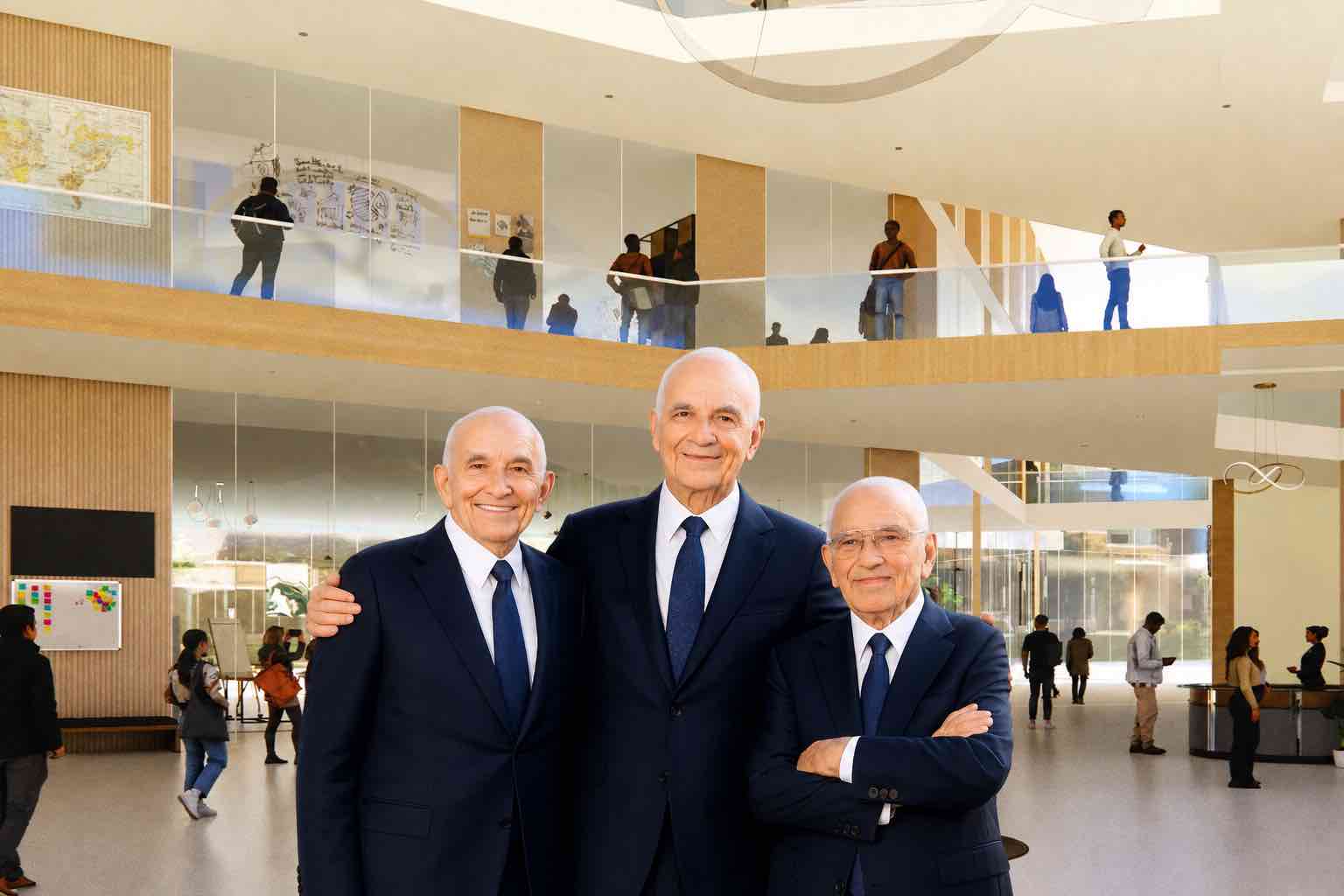
The Jack, Joseph and Morton Mandel Foundation has announced a transformative $125 million commitment to Case Western Reserve University—the largest philanthropic gift in the foundation’s 73-year history and believed to be the largest donation ever made to higher education in Ohio.
Coming during CWRU’s bicentennial year, the gift positions the humanities and social sciences as essential counterweights to the accelerating automation of traditional STEM careers by artificial intelligence.
The record commitment will fund four distinct priorities that reflect the foundation’s evolving vision under President and CEO Dr. Jehuda Reinharz, who has championed humanities education since joining the organization in 2010.
The centerpiece is a new Jack, Joseph, and Morton Mandel Humanities Building that will house interdisciplinary programs combining humanities, arts, and STEM fields—including emerging areas like the ethics of robotics.
The gift will also more than double the scholarship endowment at the university’s Mandel School of Applied Social Sciences, expand leadership development initiatives, and advance ethical innovation in technology.
“The Mandel Foundation’s investment in Case Western Reserve reflects our continued belief in the increasing value and importance of higher education, particularly in the humanities,” said Stephen Hoffman, Mandel Foundation board chair and CWRU trustee. “It represents our confidence in President Eric W. Kaler’s leadership and vision as well as the remarkable momentum of this university as it celebrates its bicentennial.”
The announcement arrives at an inflection point for American higher education, as humanities departments face enrollment declines, program eliminations, and federal funding cuts while universities race to compete in artificial intelligence.
David Gerdes, dean of CWRU’s College of Arts and Sciences and a renowned physics professor, argues that recent labor market shifts validate the foundation’s contrarian bet on the liberal arts. “A traditional STEM degree in a technical discipline is proving to be more fragile than we thought even 10 years ago,” Gerdes stated.
“With the advances in AI, the humanities are becoming even more important today, as AI automates much of the work traditionally done in entry-level roles and employers demand such skills as high-level communication, empathy, critical thinking, and persistence.”
The gift specifically supports programs that produce double majors combining technical disciplines with humanities training—credentials Gerdes describes as essential to “workers who are really innovators and leaders” rather than those who simply “cut and paste answers from AI models.”
This educational philosophy reflects our foundation’s long-standing commitment to developing people who can drive meaningful change in their communities and professions.
The foundation traces its origins to the summer of 1940, when brothers Jack, Joseph, and Morton Mandel pooled $900 to purchase secondhand fixtures and inventory from their uncle’s struggling auto parts shop in Cleveland.
That modest investment became Premier Automotive Supply Company, which the brothers transformed through a “find a need and fill it” philosophy developed after Joe and Morton returned from World War II service.
Premier Industrial Corporation went public in 1960 and joined the New York Stock Exchange four years later, posting record earnings year after year for three decades.
In 1996, the company merged with Britain’s Farnell Electronics PLC in a $3 billion transaction that created one of the world’s largest industrial and electronic component suppliers. All three Mandel brothers appeared on the first Forbes 400 list of wealthiest Americans.
The brothers established their first charitable foundation in 1953, just 13 years after launching their business. They reorganized their individual family foundations in 1999 into what became the Jack, Joseph, and Morton Mandel Foundation and by 2019 had surpassed $1 billion in total giving.
Their mother, Rose, who raised four children largely alone after her husband, Simon, fell ill, served as the inspiration for their philanthropic values. “Despite these challenges, Rose always helped neighbors in need, a value that lay the foundation for the brothers’ future philanthropic efforts,” according to the foundation’s official history.
The foundation’s five core areas include leadership development, management of nonprofits, humanities education, Jewish life, and urban engagement—all aimed at building “just, compassionate, and democratic societies in the United States and Israel.”
The organization operates programs in Cleveland, Boston, and Israel, including the Mandel School for Educational Leadership in Jerusalem and the Mandel Institute for Nonprofit Leadership in Boston.
The Mandel family’s relationship with CWRU spans more than six decades, beginning with Morton Mandel’s undergraduate education at the university in the Class of 1943. In 1988, the foundation made a naming gift for what became the Mandel School of Applied Social Sciences, one of the nation’s oldest university-affiliated graduate social work programs.
That school has been designated a “scholarship priority” under the new $125 million commitment, with significant funding to address the shortage of qualified social workers in Ohio and nationwide.
More recently, the foundation invested $3.5 million to support humanities research projects that drive innovative ideas through scientific collaborations, establishing the Mandel Fellowship in the Experimental Humanities—a new major integrating humanities and STEM studies.
A separate $2 million grant funded the Jack, Joseph and Morton Mandel Studio in the Interdisciplinary Science and Engineering Building, creating a collaborative space where humanities faculty and students can work alongside their science and engineering peers.
The Case Western gift represents just one component of an extraordinary 2026 surge in giving by the Mandel Foundation. In late April, the foundation pledged up to $60 million to Cleveland’s Jewish Community Center in a 4-to-1 matching grant to overhaul day camps, overnight camps, and youth programming. For every dollar the community raises, the foundation will provide four dollars.
Earlier in 2025, the foundation awarded a $90 million matching grant to strengthen Cleveland’s Jewish day school system, supporting five institutions through the Jewish Federation of Cleveland’s Day School Transformation initiative. If fully matched, that grant would supply half of a $180 million fundraising goal.
Previous major commitments include a $30 million gift to the Cleveland Clinic in 2022 that endowed the position of CEO—now titled the Morton L. Mandel CEO Chair—and established the Morton L. Mandel Innovation Fund.
In 2014, under the leadership of newly appointed president Jehuda Reinharz, the foundation made its first major humanities investments: $3.6 million to Cleveland State University for the Mandel Honors College and Chair in the Humanities, plus $10 million for the Mandel Center for Humanities at Cuyahoga Community College.
Dr. Jehuda Reinharz, who serves as president and CEO of the foundation, came to the organization in 2010 after leading Brandeis University. Under his leadership, the foundation “adopted a deeper focus on the vital role of humanities education in developing inclusive, compassionate, democratic societies”—a vision that directly shaped the Case Western commitment.
The foundation’s current board chair, Stephen Hoffman, previously served as president of the Jewish Federation of Cleveland and became the first non-family member to chair the foundation.
The $125 million gift embodies the foundation’s belief that investing in people with “the values, capacity, and passion to make positive change” remains the most effective way to strengthen communities and improve society.
As CWRU President Eric W. Kaler noted, “This historic gift represents a commitment to the present and future of the university and an investment in the leaders it develops whose meaningful advances will improve our city and our society.”