$1 billion gift, no other donors needed: George Lucas and Mellody Hobson open the Lucas Museum of Narrative Art
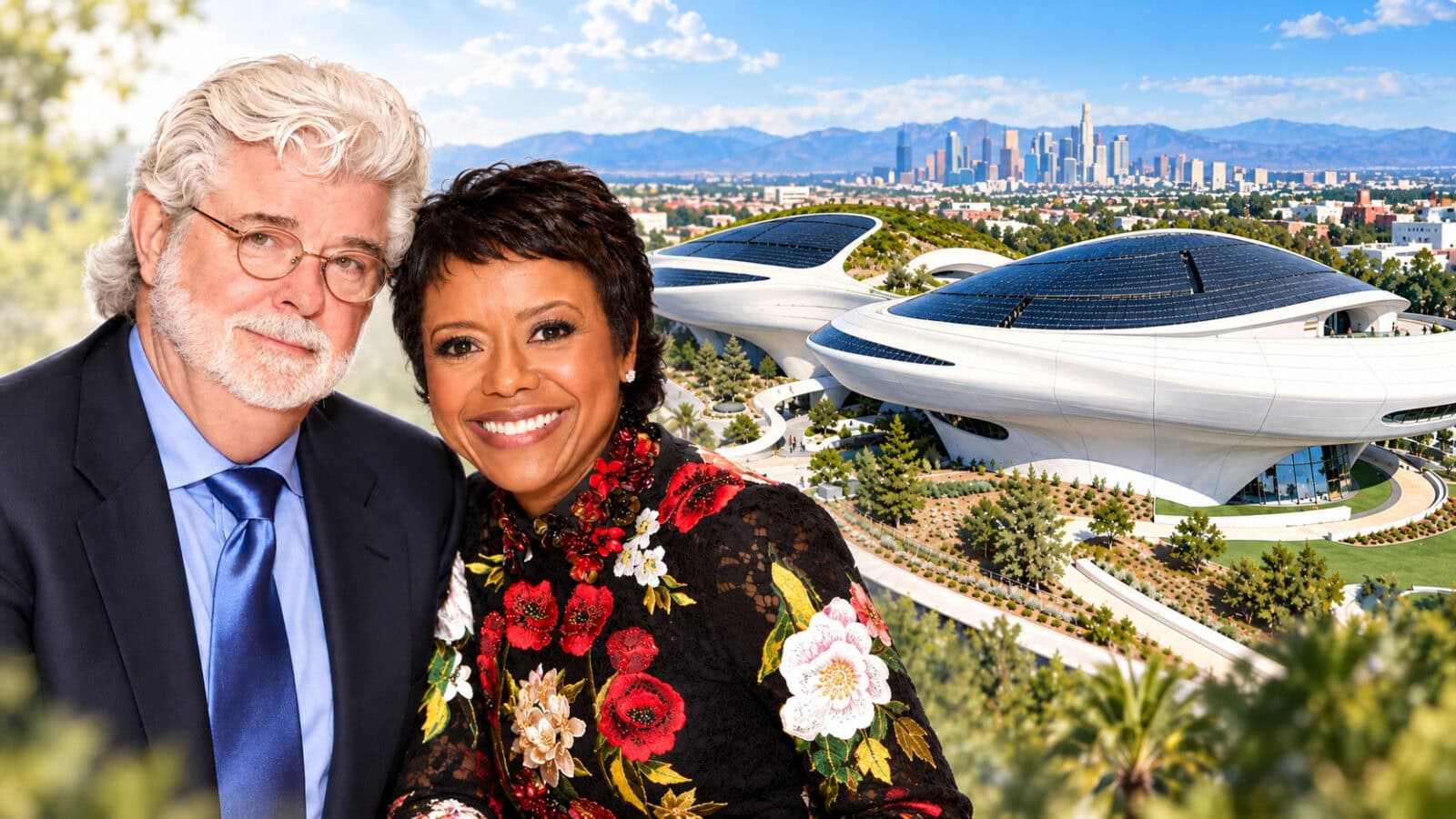
The Lucas Museum of Narrative Art is about to open its doors in Exposition Park, Los Angeles, and with it, one of the most generous acts of cultural patronage in modern American life will finally be complete.
The museum, co-founded by George Lucas and his wife, the businesswoman and Ariel Investments co-CEO Mellody Hobson, arrives after years of dreaming, drafting and building — and it arrives paid for, almost in full, by the man whose name is on it, at a cost of roughly a billion dollars.
No naming-rights consortium, no municipal bond, no anxious capital campaign. Lucas simply wrote the checks, donated the art, and kept faith with the idea until the right home appeared.
That home took some finding. The concept began in San Francisco and was later imagined for Chicago before Los Angeles said yes.
The long route turned out to be a gift in itself, because what it produced is a museum that could only have been built in this city—next door to the Natural History Museum and the California Science Center, in a South Los Angeles neighborhood where the audience Lucas keeps talking about actually lives: families, kids, and people who have never much thought of themselves as museumgoers.
Ahead of the public opening, the museum welcomed students and residents of its own 90037 ZIP code for a neighborhood preview, and those neighbors now hold passes granting them free annual admission.
For everyone else, adult admission is twenty-five dollars, and children get in free—a price that, for a billion-dollar building, reads less like economics than like a statement of purpose.
The building itself is the work of Ma Yansong of MAD Architects, with Stantec, and it is the most confidently imaginative piece of architecture to open in Los Angeles in a long while: a single continuous curving volume, five stories and about 300,000 square feet, lifted above the ground so the park flows underneath it. Everybody calls it a spaceship. Lucas seems delighted by that.
Around it, Mia Lehrer’s Studio-MLA has laid out an eleven- to thirteen-acre landscape of trees, lawns, and gardens that is free and open to anyone who wanders in, ticket or not—a genuine public park, on land that was once an asphalt lot, in a part of Los Angeles that has been short of green space.
Inside, 100,000 square feet of exhibition space is divided among more than thirty galleries holding upwards of 1,300 works drawn from five decades of Lucas’s collecting, themselves a fraction of a founding collection that runs to some 40,000 pieces.
The idea the galleries advance is the whole reason the museum exists, and it is a warm and welcoming one. Narrative art, in Lucas’s telling, is simply the art that tells a story.
So a Frida Kahlo self-portrait hangs in the same institution as Norman Rockwell’s Saturday Evening Post covers, and cave-painting imagery sits alongside manga, newspaper comic strips, children’s book illustrations, muralism, photography, costumes, and props.
The museum has themed galleries organized around adventure, motherhood, comics, manga, and illustration, plus rooms devoted to single artists, Rockwell among them. “Is it fine art?” Lucas asked. “It’s finer art, because it’s actually telling a story.”
Because this museum was built by a filmmaker, moving pictures are not a sideshow. Two theaters on the ground floor—the Robert Flaherty, named for the documentary pioneer, and the Slavko Vorkapich, named for the montage experimentalist who once chaired the film department at USC, just across the park — run all day continuously, treated as drop-in galleries rather than scheduled screenings.
Programs range from a few minutes to ninety; visitors come and go as they please, and admission includes everything.
The first cinema exhibition is “Star Wars in Motion,” which gathers vehicle designs, props, costumes, and illustrations from across the saga’s first six films—Luke’s Landspeeder from the original film and the first physical build of General Grievous’s Wheel Bike from Revenge of the Sith, among them. One early delight: the Vorkapich has been screening portions of “Star Wars Detours,” the animated comedy series that was never released.
The quieter pleasures may end up being the ones people talk about for a long time. There is a research library, free and open to any visitor without a ticket, with dark wood and soft light and a wall of windows over the main lawn, with more than 3,000 art books available to read on the spot—a portion of the upper shelves donated by Steve Martin—and reshelving carts marked with Yoda’s instruction: “Reshelve, do not. Leave books here, you must!”
On the roof sits the Skywalker Grill, designed by Rockwell Group and inspired by the hospitality of Skywalker Ranch, serving classic American food with California ingredients, open past museum hours to anyone, with the downtown Los Angeles skyline laid out beyond the patio.
Restaurant reservations are already booked months in advance, and timed-entry museum tickets are being released well into next year.
What makes the whole thing land is the shape of the gift. Lucas and Hobson have signed the Giving Pledge, and this museum—the art, the building, the endowment behind it—is the largest single expression of it: an institution handed to Los Angeles and to one of its neighborhoods, dedicated to the pictures that shaped how most of us first fell in love with stories, priced so a family can afford it, wrapped in a park that costs nothing to enter.
A billion dollars of his own money, and a spaceship over Exposition Park.
Soon the doors open, and it ends the only way it could: with the public walking in.