
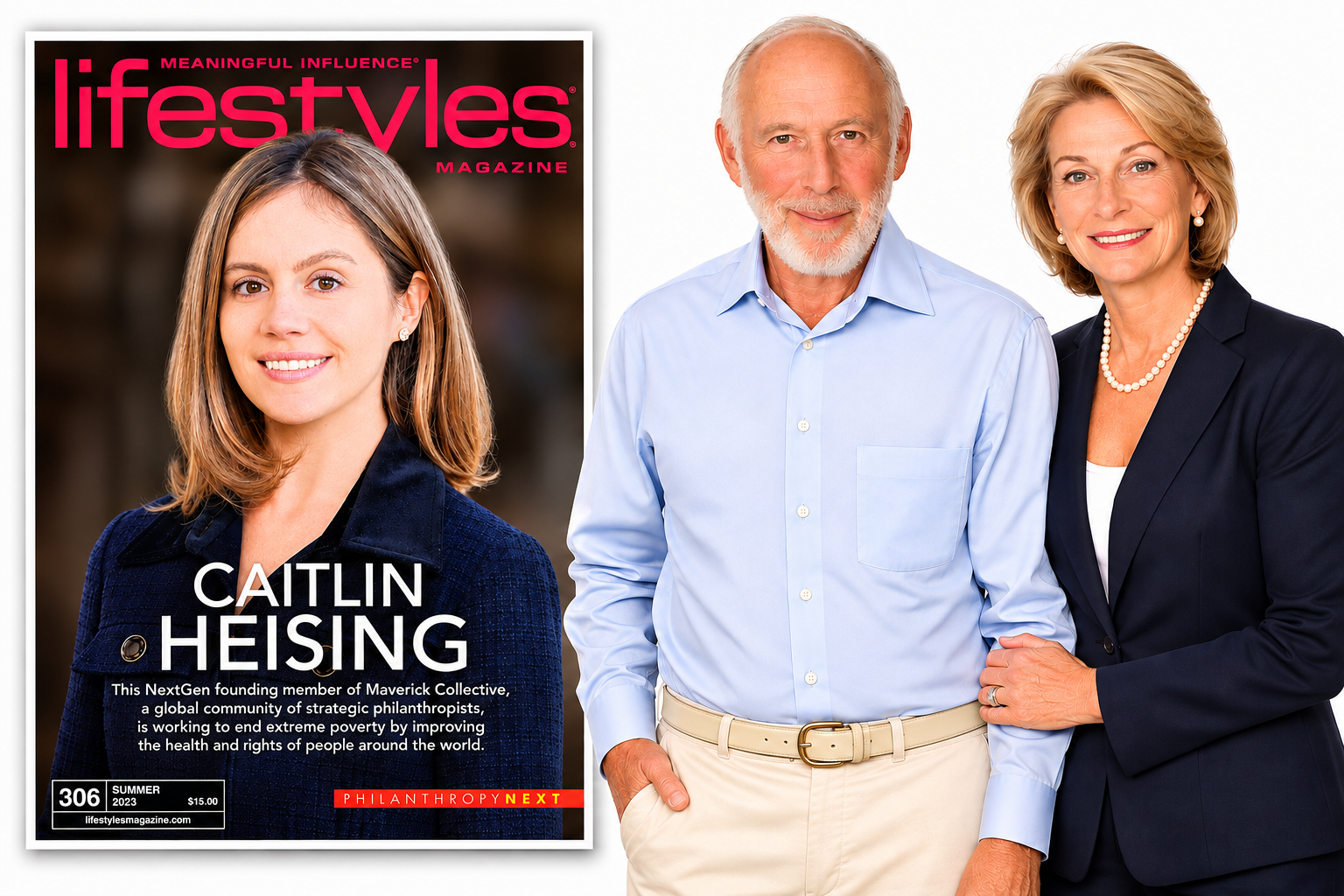
$80 million to decode how the brain powers thought: the family of Lifestyles Magazine/Meaningful Influence cover subject Caitlin Heising further advances a $10.3 billion legacy of science giving
Some families pass down a fortune.
The family of Caitlin Heising, the Lifestyles Magazine/Meaningful Influence cover subject, has also passed down a conviction: the hardest questions deserve support, and the answers deserve time.
This week that conviction turned to one of the deepest questions in biology.
The Simons Foundation, the New York philanthropy started by Caitlin’s grandfather, Jim Simons, and Marilyn Simons, and chaired today by Marilyn, committed $80 million over 10 years to learn how the brain powers thought.
The commitment adds a new chapter to a family legacy of science, giving now estimated at $10.3 billion.
The question is simple to ask and very hard to answer.
The brain makes up a small share of the body’s weight, yet it uses about a fifth of the body’s energy. It runs on roughly 20 watts, less than a dim light bulb.
Every memory, every glance across a room, and every decision depends on neurons firing in ways that use a great deal of energy.
Scientists still can’t fully say how the brain makes that energy, how it rations it, or what happens to thinking when the supply runs short.
The new Simons Collaboration on Brain Energetics, known as SCOBE, brings together 26 investigators from the United States, Britain, Austria and Norway.
Stanford neuroscientist Thomas Clandinin leads it, with Anna Devor of Boston University as co-director.
Its roster reads like a map of modern neuroscience: Stanford, Harvard, MIT, Yale, Columbia, Rockefeller University, Weill Cornell Medicine, Massachusetts General Hospital, UC San Francisco, Washington University, the Allen Institute, the Howard Hughes Medical Institute’s Janelia Research Campus, and the Max Planck Florida Institute for Neuroscience.
Abroad, it is joined by the University of Edinburgh, Cardiff University, the University of Oslo, and the Institute of Science and Technology Austria.
It is not one gift to one campus.
It is ten years of shared funding for a team built around a single question, the same model the family’s foundation has used to open whole fields.
“Every thought and action depends on neurons performing computations that are extraordinarily costly in energy terms, yet we don’t understand how those energetic limits shape the way the brain is built and how it computes,” said Kelsey Martin, who leads the foundation’s autism and neuroscience division.
The central idea is that the need for efficiency may set real limits on how the brain is organized and how accurately it works, from single cells to whole circuits and behavior.
The work follows four lines.
The first looks at single brain cells: how much energy each type needs to fire a signal or clear away waste, and how cells share resources.
Researchers plan to build new sensors that can follow glucose and ATP, the cell’s energy currency, as they move through living tissue.
The second moves up to circuits.
It asks whether harder mental work, such as vision, navigation, and memory, requires more energy and how the brain decides what comes first when energy is scarce.
The third studies how neurons work with blood vessels, which could help scientists read fMRI scans more accurately, since those scans measure blood flow as a stand-in for brain activity.
The fourth asks how the brain holds up when energy dips because of diabetes, low oxygen, or pregnancy, and what happens when those protections fail.
To find rules that hold across nature, the team will study worms, flies, mice, and humans and pair every experiment with theory and computer modeling.
At the Institute of Science and Technology Austria, computational neuroscientist Tim Vogels will receive $3 million to build models that link mitochondrial energy production to neuronal activity.
Colleagues at Stanford, the Allen Institute, and the University of Oslo will help grow those models into larger networks to understand how energy shapes learning.
Alyssa Picchini Schaffer, who oversees the foundation’s neuroscience collaborations, called energy “one of the backbone constraints for understanding the brain,” with effects that reach into autism, brain development and aging.
The foundation has also required the team to share its data openly so researchers well beyond the collaboration can use what it finds.
This commitment to legacy began in 1994.
That year Jim Simons, the mathematician who built Renaissance Technologies into one of the most successful investment firms in history, and Marilyn Simons, an economist with a doctorate from Stony Brook University, chose to fund basic science.
This is patient, curiosity-driven research that rarely pays off quickly and often struggles to find support.
Marilyn has carried that commitment forward as chair. SCOBE comes a little more than a year after another $80 million collaboration she launched on ecological neuroscience to study how the brain works in natural settings.
It joins the foundation’s collaborations on plasticity and the aging brain and on the global brain. Alongside them, the foundation’s autism research initiative has committed more than $525 million since 2006.
Taken together, the family’s science giving ranks among the most consequential in American history.
The lifetime giving of Marilyn Simons and her family is estimated at $10.3 billion, sixth among all American philanthropists, built largely through the Simons Foundation and its sister philanthropies.
The foundation holds about $4.5 billion in assets and gives roughly $312 million a year, through some 2,750 grants and gifts reaching researchers in 49 states.
Its generosity shows most clearly at Stony Brook.
There, the couple and the foundation have committed more than $1.2 billion since a first gift of $750 in 1983.
That total includes a $500 million endowment gift, the largest unrestricted gift ever made to an American college or university.
The legacy also lives on in the next generation.
In 2007, Caitlin’s parents, Liz Simons and Mark Heising, founded the Heising-Simons Foundation in California, with programs reaching from early childhood education to climate, clean energy, and science.
Caitlin joined its board in 2014, straight out of Brown, and now serves as vice chair.
There she built the foundation’s human rights program, focused on criminal justice and immigration in the United States.
She also serves on the Human Rights Watch board and is a founding member of Maverick Collective.
Her causes are different from her grandfather’s mathematics or the neuroscience the family now funds.
The belief underneath is the same: real change takes time, close partnership with the people doing the work, and the patience to stay.
That patience is what sets this new commitment apart.
Ten years is long enough to build tools that don’t exist yet, test ideas across species, and let a young field grow into a discipline.
If the collaboration succeeds, it could change how scientists understand the brain’s limits and its resilience.
It could also offer new ways to think about conditions in which the brain’s energy supply falters, from metabolic disease to developmental disorders to the slow changes of aging.
For a family that has spent three generations giving the deepest questions the longest runway, it is a fitting next step in its legacy: by learning how the brain pays for every thought, we may learn something essential about thought itself.