
$10 million latest gift from Len Blavatnik’s self-funded family foundation—which has contributed more than $1.5 billion to over 300 institutions over the past decade—launches Yale’s new “Science of Inflammation” initiative
When Len Blavatnik arrived in the United States in 1978, a young emigrant from Odesa with his family and little else, his first American job was writing computer code in the biostatistics department of what was then the Mount Sinai School of Medicine in New York.
He saved enough to study computer science at Columbia, part-time at first and then full-time.
Nearly five decades later, the man who once ran numbers for medical researchers has become one of the most consequential private champions of medical research in the world.
His latest gift brings him back, fittingly, to the scientists themselves.
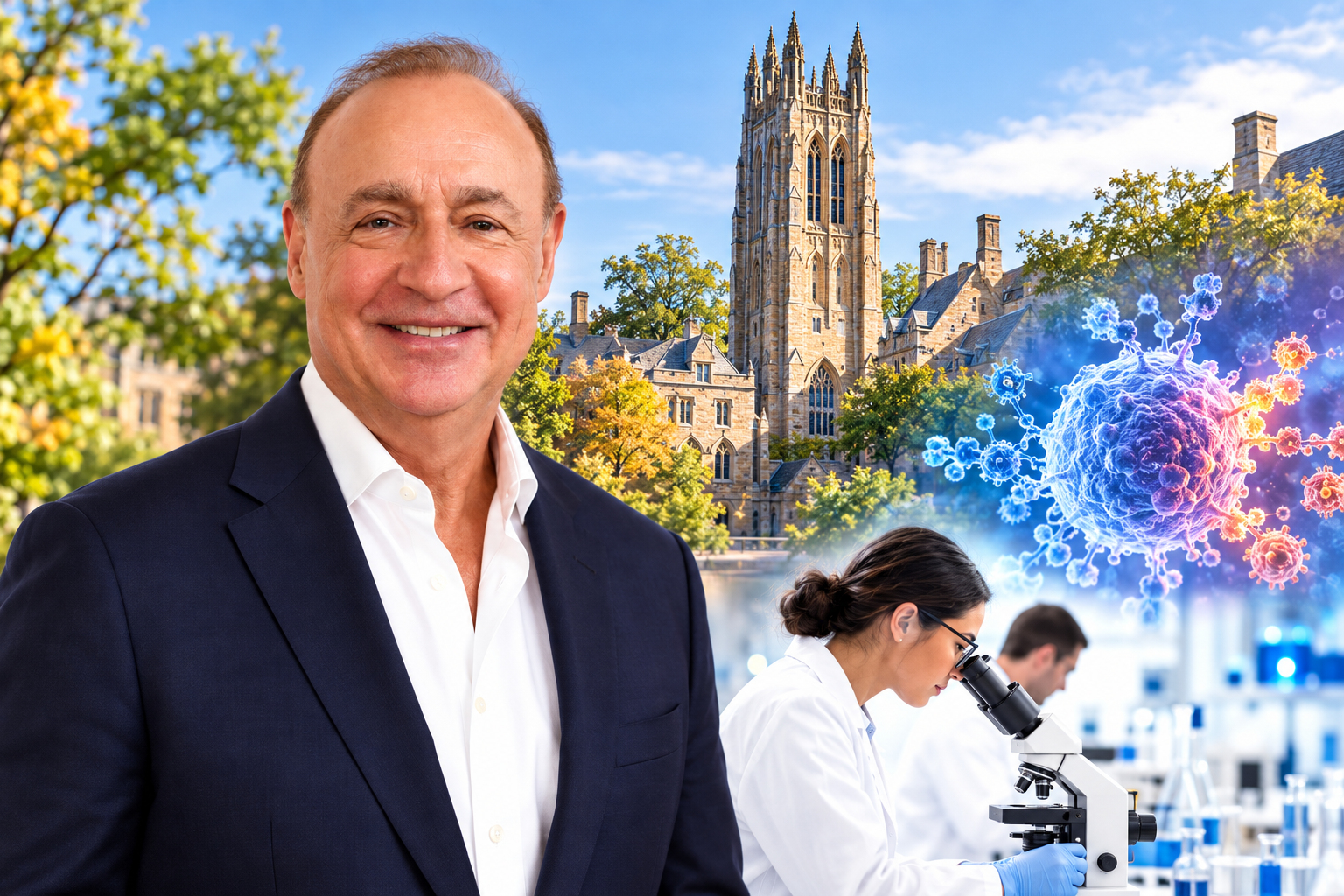
The Blavatnik Family Foundation has given $10 million to Yale School of Medicine to launch a new initiative in inflammation science, the study of the immune response now linked to cancer, diabetes, heart disease, autoimmune disorders, Alzheimer’s, and Parkinson’s.
The grant also creates the Blavatnik Graduate and Postdoctoral Fellows program, a pipeline of young researchers who will carry the field forward.
“Yale School of Medicine’s exceptional scientists are uniquely positioned to break new ground in inflammation science,” Sir Leonard said.
“We are proud to support their efforts and promote new and integrated research for improved health.”
At the center of the initiative is a friendship nearly two decades in the making. Ruslan Medzhitov, Sterling Professor of Immunobiology and one of the scientists who revealed how the body’s innate immune system works, will serve as director.
In 2007 he was among the very first winners of the Blavatnik Awards for Young Scientists, the prize program Blavatnik created to find brilliant researchers early and back them boldly.
“Having known Len Blavatnik since I was honored with the first Blavatnik Award for Young Scientists in 2007, I am especially grateful for the foundation’s continued support,” Medzhitov said.
“This new grant is transformative.”
He added that philanthropy like this “enables the kind of creative, high-risk research that is often constrained by the rigid structure of federal funding.”
Medzhitov will lead alongside three remarkable colleagues: Noah Palm, who studies how the microbiome shapes immune health; Liza Konnikova, a physician-scientist focused on immunity in the earliest days of life; and Akiko Iwasaki, the Sterling Professor whose work on how viruses, including the one behind COVID-19, can permanently alter the immune system has drawn worldwide attention.
Together they will explore how infection, environment, and the microbes living within us trigger inflammation that touches everything from fetal development to the health of the brain.
“Inflammation underlies nearly every disease we face today,” said Nancy J. Brown, dean of the medical school, “and unraveling mechanisms of inflammation in health and disease can transform medicine for generations to come.”
The gift is the third $10 million grant the foundation has made at Yale.
The first, in 2013, backed Medzhitov and Richard Flavell as they tested a bold new theory linking inflammation to chronic disease.
The second, in 2016, created the Blavatnik Fund for Innovation at Yale, which helps turn laboratory discoveries into companies and therapies.
What emerges is a portrait of a donor who does not give once and walk away. He finds people he believes in and stays with them for years.
That instinct runs through everything the Blavatnik Family Foundation does.
Entirely self-funded, it has contributed more than $1.5 billion to over 300 institutions and charitable organizations in the past decade alone, across science, education, the arts, and Jewish history.
The Blavatnik Awards, administered by the New York Academy of Sciences, began as a regional prize in New York, New Jersey, and Connecticut and grew into national programs in the United States, the United Kingdom, and Israel.
They have now honored more than 500 young scientists with nearly $20 million in prizes, including national laureate awards of $250,000, among the largest unrestricted honors available to early-career researchers in America.
For a scientist in her thirties, that kind of freedom can change the course of a career.
Harvard, where Blavatnik earned his MBA in 1989, has felt that generosity across nearly two decades.
His support began with a biomedical accelerator fund, grew into the Blavatnik Biomedical Accelerator and a life-science entrepreneurship fellowship at Harvard Business School, and culminated in a $200 million commitment to Harvard Medical School, the largest gift in the school’s history.
It created the Blavatnik Institute, which unites the medical school’s basic and social science departments, and funded everything from cryo-electron microscopy to artificial intelligence to a biotech incubator in the Longwood Medical Area.
In 2025, the foundation pledged a further $18 million to the medical school at a moment when research funding was under strain.
And this fall, the American Repertory Theater announced that the largest stage in its new Allston home will be named the Blavatnik Theater, a 700-seat space made possible by Len and Emily Blavatnik, set to open with a David Bowie-inspired production directed by Diane Paulus.
His reach into medicine extends well beyond New Haven and Boston.
At NYU Langone Health, a $15 million gift supports the long-running work of biochemist Evgeny Nudler on antibiotic resistance, DNA repair, cancer, and aging, another example of Blavatnik standing behind a single gifted scientist over many years.
At Tel Aviv University, where he serves as a governor and holds an honorary doctorate, the foundation has given more than $65 million since 2014.
The Blavatnik School of Computer Science, the Blavatnik Center for Drug Discovery, a cyber research center, a faculty recruitment fund, a student film fund, and a major gift to the university’s center for AI and data science have become so central to campus life that people there have a name for it: “the Len Effect.”
In Britain, his adopted second home, his imprint is woven into the nation’s intellectual and cultural landscape.
His £75 million gift to the University of Oxford, one of the most generous in its 900-year history, founded the Blavatnik School of Government, Europe’s first major school of public policy, now housed in a luminous Herzog & de Meuron building where future leaders from around the world study how to govern well.
At Tate Modern, his foundation’s lead donation, one of the largest in Tate’s history, gave the museum’s soaring extension its name: the Blavatnik Building. A £10 million gift, the most significant in the National Portrait Gallery’s history, created the Blavatnik Wing, where Charles Darwin, Virginia Woolf, Oscar Wilde, and the Brontës now greet visitors.
The National Gallery honored the family’s support for its bicentenary by naming Room 34 the Blavatnik Family Foundation Room.
In 2017 Queen Elizabeth II knighted him for services to philanthropy, an honor that followed France’s Légion d’honneur for his support of education.
He looks forward as eagerly as he preserves.
A $25 million lead gift to the USC School of Cinematic Arts is building the Blavatnik Center for Virtual Production, preparing students for a future of filmmaking shaped by new technology.
And through the Blavatnik Archive, the family safeguards letters, diaries, and testimony from the twentieth century, with special attention to the World Wars and Soviet Jewish life.
The archive’s newest project, documenting the refuseniks and the movement to free Soviet Jewry, is deeply personal.
The Blavatniks were among the families who left the USSR in those years, and the story being preserved is, in part, their own.
Sir Leonard and Lady Emily Blavatnik have been married since 1994 and are raising four children, and their giving has the feel of a family enterprise built on gratitude: to the country that welcomed them, to the universities that educated him, and to the scientists and artists who make life richer.
Visiting Harvard Medical School a year after his landmark gift, he spent the day touring laboratories and meeting the people doing the work and said simply that he could already see progress.
That is the quiet signature of his philanthropy. He invests in talent, keeps showing up, and lets the discoveries speak.
In New Haven, the newest Blavatnik fellows will soon join Medzhitov’s team, young scientists who may one day explain why inflammation turns against us and how to stop it.
Some of them will be at the start of a journey not unlike the one that began for a young programmer at Mount Sinai in 1978.
Len Blavatnik, it seems, has never forgotten what it means to be given a chance.
When Len Blavatnik arrived in the United States in 1978, a young emigrant from Odesa with his family and little else, his first American job was writing computer code in the biostatistics department of what was then the Mount Sinai School of Medicine in New York.
He saved enough to study computer science at Columbia, part-time at first and then full-time.
Nearly five decades later, the man who once ran numbers for medical researchers has become one of the most consequential private champions of medical research in the world.
His latest gift brings him back, fittingly, to the scientists themselves.
The Blavatnik Family Foundation has given $10 million to Yale School of Medicine to launch a new initiative in inflammation science, the study of the immune response now linked to cancer, diabetes, heart disease, autoimmune disorders, Alzheimer’s, and Parkinson’s.
The grant also creates the Blavatnik Graduate and Postdoctoral Fellows program, a pipeline of young researchers who will carry the field forward.
“Yale School of Medicine’s exceptional scientists are uniquely positioned to break new ground in inflammation science,” Sir Leonard said.
“We are proud to support their efforts and promote new and integrated research for improved health.”
At the center of the initiative is a friendship nearly two decades in the making. Ruslan Medzhitov, Sterling Professor of Immunobiology and one of the scientists who revealed how the body’s innate immune system works, will serve as director.
In 2007 he was among the very first winners of the Blavatnik Awards for Young Scientists, the prize program Blavatnik created to find brilliant researchers early and back them boldly.
“Having known Len Blavatnik since I was honored with the first Blavatnik Award for Young Scientists in 2007, I am especially grateful for the foundation’s continued support,” Medzhitov said.
“This new grant is transformative.”
He added that philanthropy like this “enables the kind of creative, high-risk research that is often constrained by the rigid structure of federal funding.”
Medzhitov will lead alongside three remarkable colleagues: Noah Palm, who studies how the microbiome shapes immune health; Liza Konnikova, a physician-scientist focused on immunity in the earliest days of life; and Akiko Iwasaki, the Sterling Professor whose work on how viruses, including the one behind COVID-19, can permanently alter the immune system has drawn worldwide attention.
Together they will explore how infection, environment, and the microbes living within us trigger inflammation that touches everything from fetal development to the health of the brain.
“Inflammation underlies nearly every disease we face today,” said Nancy J. Brown, dean of the medical school, “and unraveling mechanisms of inflammation in health and disease can transform medicine for generations to come.”
The gift is the third $10 million grant the foundation has made at Yale.
The first, in 2013, backed Medzhitov and Richard Flavell as they tested a bold new theory linking inflammation to chronic disease.
The second, in 2016, created the Blavatnik Fund for Innovation at Yale, which helps turn laboratory discoveries into companies and therapies.
What emerges is a portrait of a donor who does not give once and walk away. He finds people he believes in and stays with them for years.
That instinct runs through everything the Blavatnik Family Foundation does.
Entirely self-funded, it has contributed more than $1.5 billion to over 300 institutions and charitable organizations in the past decade alone, across science, education, the arts, and Jewish history.
The Blavatnik Awards, administered by the New York Academy of Sciences, began as a regional prize in New York, New Jersey, and Connecticut and grew into national programs in the United States, the United Kingdom, and Israel.
They have now honored more than 500 young scientists with nearly $20 million in prizes, including national laureate awards of $250,000, among the largest unrestricted honors available to early-career researchers in America.
For a scientist in her thirties, that kind of freedom can change the course of a career.
Harvard, where Blavatnik earned his MBA in 1989, has felt that generosity across nearly two decades.
His support began with a biomedical accelerator fund, grew into the Blavatnik Biomedical Accelerator and a life-science entrepreneurship fellowship at Harvard Business School, and culminated in a $200 million commitment to Harvard Medical School, the largest gift in the school’s history.
It created the Blavatnik Institute, which unites the medical school’s basic and social science departments, and funded everything from cryo-electron microscopy to artificial intelligence to a biotech incubator in the Longwood Medical Area.
In 2025 the foundation pledged a further $18 million to the medical school at a moment when research funding was under strain.
And this fall, the American Repertory Theater announced that the largest stage in its new Allston home will be named the Blavatnik Theater, a 700-seat space made possible by Len and Emily Blavatnik, set to open with a David Bowie-inspired production directed by Diane Paulus.
His reach into medicine extends well beyond New Haven and Boston.
At NYU Langone Health, a $15 million gift supports the long-running work of biochemist Evgeny Nudler on antibiotic resistance, DNA repair, cancer, and aging, another example of Blavatnik standing behind a single gifted scientist over many years.
At Tel Aviv University, where he serves as a governor and holds an honorary doctorate, the foundation has given more than $65 million since 2014.
The Blavatnik School of Computer Science, the Blavatnik Center for Drug Discovery, a cyber research center, a faculty recruitment fund, a student film fund, and a major gift to the university’s center for AI and data science have become so central to campus life that people there have a name for it: “the Len Effect.”
In Britain, his adopted second home, his imprint is woven into the nation’s intellectual and cultural landscape.
His £75 million gift to the University of Oxford, one of the most generous in its 900-year history, founded the Blavatnik School of Government, Europe’s first major school of public policy, now housed in a luminous Herzog & de Meuron building where future leaders from around the world study how to govern well.
At Tate Modern, his foundation’s lead donation, one of the largest in Tate’s history, gave the museum’s soaring extension its name: the Blavatnik Building.
A £10 million gift, the most significant in the National Portrait Gallery’s history, created the Blavatnik Wing, where Charles Darwin, Virginia Woolf, Oscar Wilde, and the Brontës now greet visitors.
The National Gallery honored the family’s support for its bicentenary by naming Room 34 the Blavatnik Family Foundation Room.
In 2017 Queen Elizabeth II knighted him for services to philanthropy, an honor that followed France’s Légion d’honneur for his support of education.
He looks forward as eagerly as he preserves.
A $25 million lead gift to the USC School of Cinematic Arts is building the Blavatnik Center for Virtual Production, preparing students for a future of filmmaking shaped by new technology.
And through the Blavatnik Archive, the family safeguards letters, diaries, and testimony from the twentieth century, with special attention to the World Wars and Soviet Jewish life.
The archive’s newest project, documenting the refuseniks and the movement to free Soviet Jewry, is deeply personal.
The Blavatniks were among the families who left the USSR in those years, and the story being preserved is, in part, their own.
Sir Leonard and Lady Emily Blavatnik have been married since 1994 and are raising four children, and their giving feels like a family enterprise built on gratitude: to the country that welcomed them, to the universities that educated him, and to the scientists and artists who make life richer.
Visiting Harvard Medical School a year after his landmark gift, he spent the day touring laboratories and meeting the people doing the work and said simply that he could already see progress.
That is the quiet signature of his philanthropy. He invests in talent, keeps showing up, and lets the discoveries speak.
In New Haven, the newest Blavatnik fellows will soon join Medzhitov’s team, young scientists who may one day explain why inflammation turns against us and how to stop it.
Some of them will be at the start of a journey not unlike the one that began for a young programmer at Mount Sinai in 1978.
Len Blavatnik has never forgotten what it means to be given a chance.