
$530 million, and a Lucky 47: Sam and Emily Glick lead college’s originals campaign
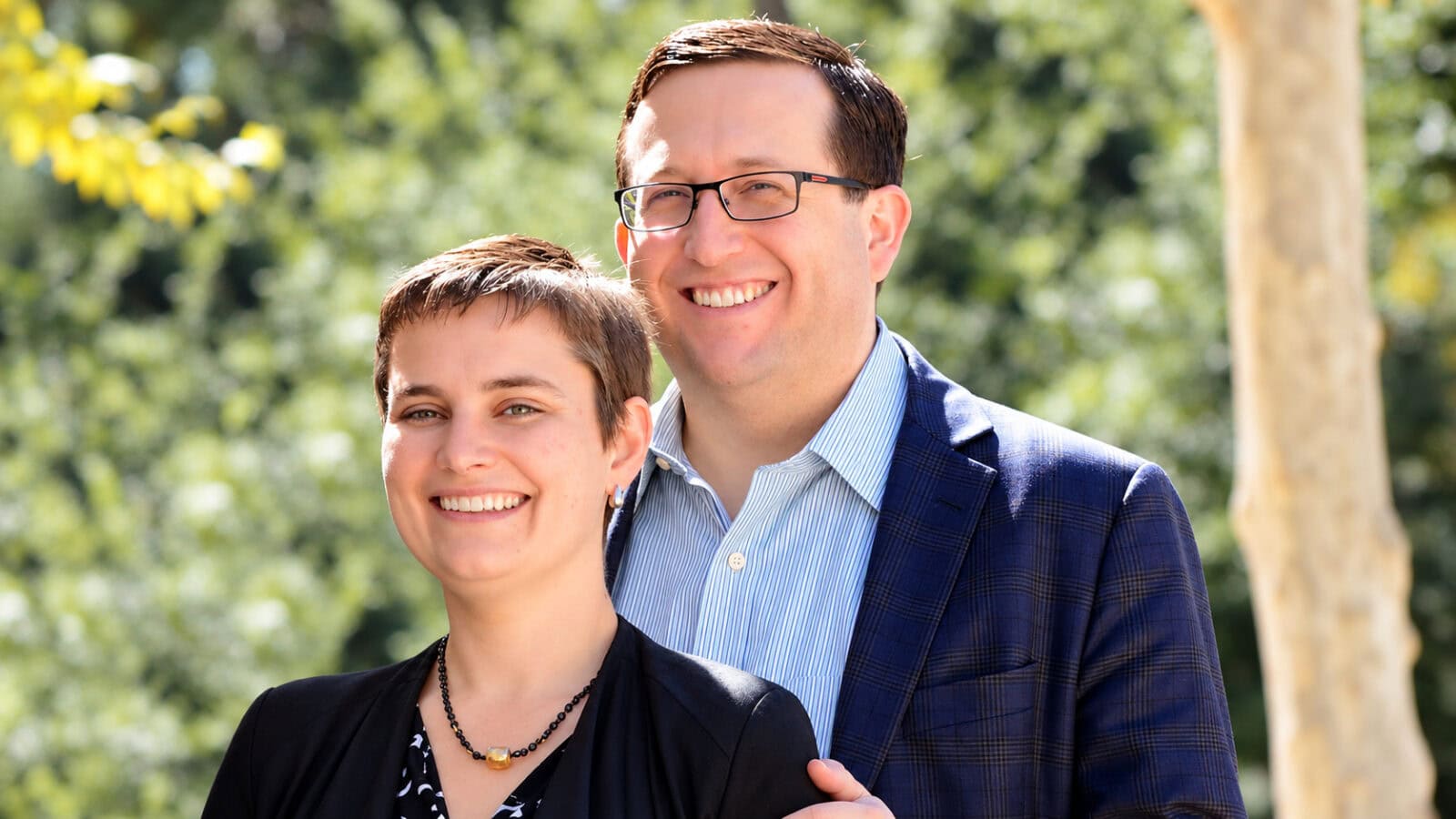
In 2002, a Pomona College junior named Emily George asked a classmate to borrow his economics textbook. Sam Glick lent it to her.
They became fast friends, started dating three weeks before graduation, and married in 2006. More than two decades later, the couple who met over a borrowed book are leading the college’s most ambitious fundraising effort in its 139-year history.
Recently, Pomona publicly launched Originals: The Campaign for Pomona College, a $530 million comprehensive campaign. Sam and Emily Glick, both Class of 2004, chair it.
The campaign arrived with a detail any Sagehen would enjoy. It has already raised 47 percent of its goal, nearly $250 million, from about 10,000 donors. At Pomona, 47 is more than a number. It is a long-running campus legend, and the Glicks have leaned into it before.
When the couple pledged to expand access for students from middle-income families in 2024, they did not give $2.5 million.
They gave exactly $2,474,747.47. The gift created the President’s Fund for Middle-Class Access, and it now sits at the center of the campaign’s top priority.
The Glicks understand the problem in detail. In 2022, only 17 percent of Pomona’s domestic first-year students came from middle-income families, defined as a family of four earning $75,000 to $150,000, compared with 30 percent of high school graduates nationally.
Fifty-five percent came from households earning $150,000 or more. Sam, who chaired Pomona’s Board of Trustees from 2016 to 2024 and grew up on a citrus nursery in Southern California, has described the pattern as a “whale” distribution: many wealthy families, a meaningful number of students of very modest means, and a thin middle.
“It creates a polarized environment of haves and have-nots,” he said. “And I think that’s important to address.”
These are the families the campaign is built to reach. They often earn too much to qualify for substantial aid but still struggle with the full cost of attendance, and many never apply because Pomona seems out of reach.
The Glicks’ fund pays for outreach so those students consider applying, stronger aid packages once they are admitted, and career and academic support once they arrive.
“Emily and I were incredibly fortunate to have received the kind of education that we did at Pomona,” Sam said. ”
Doing something to help make Pomona available to more people, we hope, in a small way, makes the world a better place.” Emily puts it more simply: “You come to Pomona to be changed.”
The couple have given as a team since the start of their marriage, with the belief that giving should grow along with their means.
An earlier gift of $625,000 in 2019 created an endowed fund that pairs faculty from different departments on shared research.
That gift supports another campaign priority: investing in faculty and new areas of scholarship.
Pomona’s commitment to access is already visible in this fall’s entering class. A record 29 percent of first-year students are the first in their families to attend college, and 63 percent receive financial aid.
The campaign will also grow quieter programs that matter just as much: the Technology Access Program, which gives laptops to new students on aid, and Access to Course Essentials, which provides free course materials.
“The Originals Campaign is about ensuring that Pomona remains a place where remarkable students, whatever their discipline, can thrive regardless of financial circumstances,” said President G. Gabrielle Starr.
If the Glicks represent the campaign’s newer generation, the man holding a shovel at its groundbreaking represents its deepest roots.
Trustee Emeritus Ranney E. Draper, Class of 1960, joined Starr and Board Chair Janet Inskeep Benton to break ground on the new Center for Global Engagement. Draper’s connection to Pomona began before he was born.
His parents, Ranney C. Draper ’25 and Virginia ’26, met there as students. He went on to captain the football team, run track, and later build Diversified Shopping Centers, which developed more than 75 shopping centers across California and the West.
After selling the company in 1998, he turned to philanthropy focused on closing the educational achievement gap.
Few people have shaped the campus more. With his late wife, Priscilla, and the Draper Family Foundation, he gave $5.5 million in 2009 to found the Draper Center for Community Partnerships, which links students and faculty with neighborhoods just outside the college gates.
The Drapers were also early lead donors to the Center for Athletics, Recreation, and Wellness, and his $1 million challenge gift helped install new turf on Merritt Field.
He served on the board for more than 25 years and now holds an emeritus seat on the campaign committee.
His philosophy comes straight from the college’s own motto: “They only are loyal to this college who, departing, bear their added riches in trust for mankind.”
Benton, who stood beside him, gives that same tradition a modern form. A history major from the Class of 1979 with an MBA from Harvard Business School, she gave $15 million to create the Benton Museum of Art, which opened in 2021.
In 2000, she founded the Frog Rock Foundation to improve long-term outcomes for underserved children in Westchester County, New York. She became board chair in July 2024 and serves on the campaign committee.
That committee also includes trustees, alumni, and parents spanning more than half a century of graduating classes.
They broke ground on Pomona’s largest construction project to date. The $125 million, 100,000-square-foot Center for Global Engagement will house 200 students and nine visiting scholars in language-and-culture living-and-learning communities, along with classrooms, conference space, and a large dining and event forum.
It is scheduled to open in fall 2028. It replaces the Oldenborg Center, which was made possible by a $1.1 million gift from Oldenborg and his wife, Maisie, and served as Pomona’s home for language immersion for 60 years.
In 2022, the trustees set a clear condition: the project could not move forward until donors committed $50 million. That target was met, and the board approved construction on March 6.
Among the families who helped launch the effort are Stewart R. Smith ’68, chair emeritus of the board, and his family.
Together with the H. Russell Smith Foundation, Robin A. Ferracone and current trustee MacKenzie C. Teymouri ’09 pledged $2.5 million to create the Stewart Smith Interdisciplinary Global Engagement Fund. It includes $2 million from the foundation and a $500,000 legacy commitment from Smith.
The fund supports faculty-led study abroad, stronger study abroad options and more visits from international scholars, and much of that work is already being tested in pilot programs.
“A liberal arts education has never been about preparing students for a world that stands still,” said Kara Godwin, the college’s chief global officer.
Some of the most meaningful gifts behind this momentum honor family history. Sue E. Berryman ’59 studied English literature and creative writing at Pomona, then built a career at the RAND Corporation, Columbia University, and the World Bank.
She pledged a $10 million legacy gift to create six endowed funds named for her mother, Frances Bowers Berryman ’30, her father, John Jordan Berryman ’28, her aunt, Ellen Evelyn Bowers ’31, and herself.
One of them, the Global Student Haven Outreach Fund, will support international students displaced by war, natural disasters, and global crises. Trustee Onetta Brooks ’74 played basketball and volleyball in the early years of Title IX, when women’s teams sometimes sewed their own uniforms.
She went on to spend more than three decades as an aerospace systems engineer and gave so that every student can feel what she once felt.
“There was a moment when I realized I belonged at Pomona,” she said.
The campaign builds on three straight years of record-breaking giving: $57.2 million in fiscal 2024, a record $82.8 million in fiscal 2025, and $63.8 million in fiscal 2026, the college’s second-largest year.
The next five years will show whether the college can sustain that generosity.
“Every generation of the Pomona community has inherited something extraordinary from the one before it,” said Maria Watson, vice president for advancement, “and then asked what it could make possible for those who would follow.”
For the Glicks, the answer is a middle-class student who had never considered Pomona, opening an acceptance letter, and finding the cost is within reach.