
$11 million: Damián J. Fernández leads college’s largest gift into the laboratory
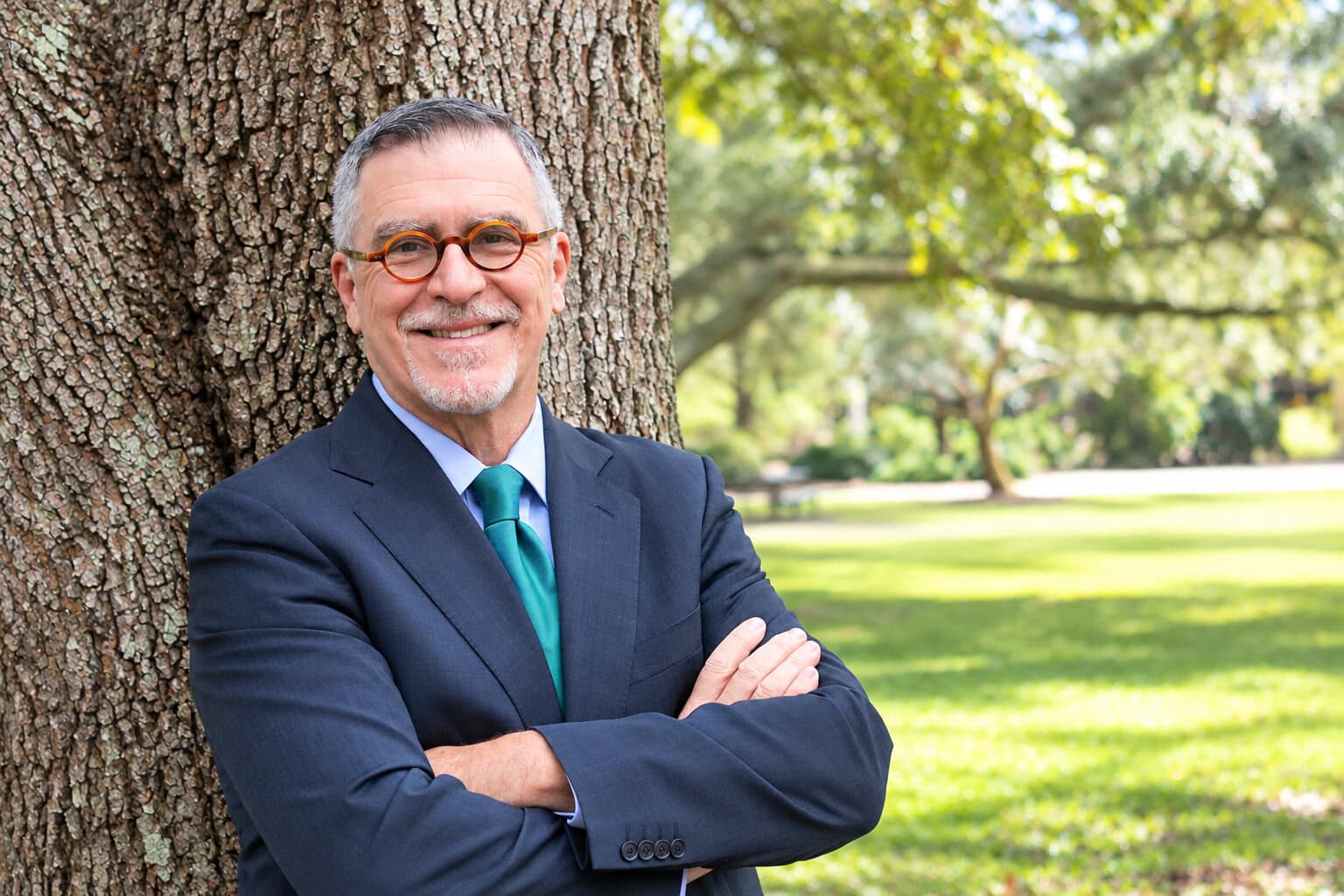
Two years ago, the Swannanoa River gave Damián J. Fernández a lesson he still talks about. He had come to western North Carolina from St. Petersburg, Florida, believing he had moved to a “climate sanctuary.”
Then Hurricane Helene came through the valley in September 2024. The river bordering Warren Wilson College rose to 26.1 feet, more than five feet above the 1916 record.
Bridges went underwater, more than 100 of the college’s trees fell, and the campus went two weeks without power, running water, internet, or cell service.
Floodwater covered the bottomlands of the college farm, destroying crops, animal feed, and a barn.
Fernández called it the hardest month of a career that had lasted more than 30 years.
“Before Helene, we thought we lived in a climate haven,” he said afterward. “Now, we know that there are no such things… We hope that there will never be another Helene, but our students need to be ready.”
This week, the college got the means to prepare them.
Recently, Warren Wilson announced an $11 million gift from anonymous donors, the largest in its 132-year history.
The money will rebuild how the small work college teaches science.
The gift launches Advancing Science in Action for the Common Good, an initiative to renovate and reequip the college’s science facilities, bring in advanced research instruments and digital learning spaces, and create an endowed fund so the equipment can keep being replaced.
The goal is to give undergraduates research experience and tools that most students don’t see until graduate school.
“This gift gives us an extraordinary opportunity to rethink what undergraduate science can look like,” Fernández said.
“We want our students to leave Warren Wilson not only knowing how science works but also knowing how to use science to make the world work better.”
The donors have chosen to remain anonymous, so the story of this gift is really the story of the president who will carry it out and the unusual college he leads.
Fernández is Warren Wilson’s tenth president and its first Latino president.
He was born in Cuba, grew up in Puerto Rico, and was the first in his family to go to college.
He earned his bachelor’s degree at Princeton’s Woodrow Wilson School of Public and International Affairs, a master’s in Latin American Studies at the University of Florida, and a Ph.D. in International Relations at the University of Miami.
He is a political scientist who wrote “Cuba and the Politics of Passion” and has received a National Science Foundation grant.
He began his career teaching high school at Phillips Academy. Since then he has held senior roles at Florida International University, SUNY Purchase, Ethical Culture Fieldston School, and Penn State Abington, and he was president of Eckerd College before coming to the Blue Ridge in June 2023.
At his inauguration that fall, the music in a chapel with standing room only blended Appalachian and Cuban traditions. He told the story of his grandmother, who grew up in Cuba during the Spanish-Cuban war, a war that started in 1895, one year after a Presbyterian mission opened the Asheville Farm School on this land.
He has described his educational philosophy in plain, personal terms: “I myself am a first-generation college graduate. I know that if you can provide students the opportunity to learn, they will thrive.”
That belief shapes the new gift. Warren Wilson is one of the country’s federally designated work colleges.
Nearly every student holds a work contract on crews that run the farm, the forests, the dining hall, and the campus technology, and the college teaches by putting tools in students’ hands.
About 375 students, nearly half the student body, major in or plan to major in STEM fields, including environmental sciences and a new animal sciences program.
The gift will also support a Health Sciences program currently under development and the college’s low-residency Master of Science in Applied Climate Studies, which Fernández launched shortly after he arrived.
“This gift underscores and amplifies our distinctive excellence in the sciences and science-aligned fields,” Fernández said.
“The generosity of our donors will allow us to deepen our commitment to the sciences, finalize our new Health Sciences program, and attract additional students.”
The plan is concrete. It calls for flexible teaching and research labs built for team investigation, with modern ventilation and collaboration space next door. New instruments will support research on carbon sequestration, soil health, genetics, animal science, and human health.
The college will add anatomy and physiology labs for the Health Sciences program, a Geographic Information Systems lab, and digital classrooms that use virtual reality and simulation.
The Center for Working Lands will upgrade the greenhouse complex and forestry facilities.
An endowed equipment fund will make sure the instruments bought now don’t become the college’s next deferred-maintenance problem.
The college also chose what it will not do. Instead of building a new science center, it will renovate three existing buildings, which keeps new construction to a minimum on a campus where about 800 of 1,000 acres are protected permanently.
Labs use more energy than almost any other space on a campus, so the project will aim for high energy-performance standards and lower operating costs.
A college that teaches climate science is choosing not to add to the problem it studies.
The gift is a milestone in a turnaround that has been fast and, given what the college has been through, remarkable.
Under Fernández, Warren Wilson has received more than $30 million in gifts in three years, posted three straight balanced budgets, and grown its endowment from about $50 million to $75 million.
Weeks after Helene, as repair estimates climbed toward $10 million, anonymous donors gave the college $10 million, its largest gift at the time, increasing the endowment by nearly 20 percent.
The college also preserved hundreds of acres of its Blue Ridge land through partnerships that added to the endowment. Then it made a move few private colleges have tried: it cut its published tuition by nearly 40 percent, from $41,500 to $25,500, starting in fall 2025, and kept giving aid to every student. Nearly half of its undergraduates receive Pell Grants.
Seen this way, the science gift is less a rescue than a reward for momentum. It also finishes a thought Fernández started in the mud of autumn 2024, when students were showering with untreated water from the local dam and crews were moving livestock to a neighbor’s farm.
He called that period a “double recovery,” meaning rebuilding the physical campus and renewing the institution, and he predicted the college would emerge “in a brighter position for the future.”
Two years later, the same valley that flooded will be the field site.
Students will measure carbon in its soils, map its watersheds in a new GIS lab, grow seedlings in rebuilt greenhouses, and learn anatomy in labs that didn’t exist when the river crested.
The donors have asked for no name on a building.
They have funded the kind of education Fernández has argued for since he arrived: science learned by doing and done for the common good.