
$950 million for Delaware’s children: Thomas G. Kuntz announces a new fund to carry Alfred I. duPont’s promise forward
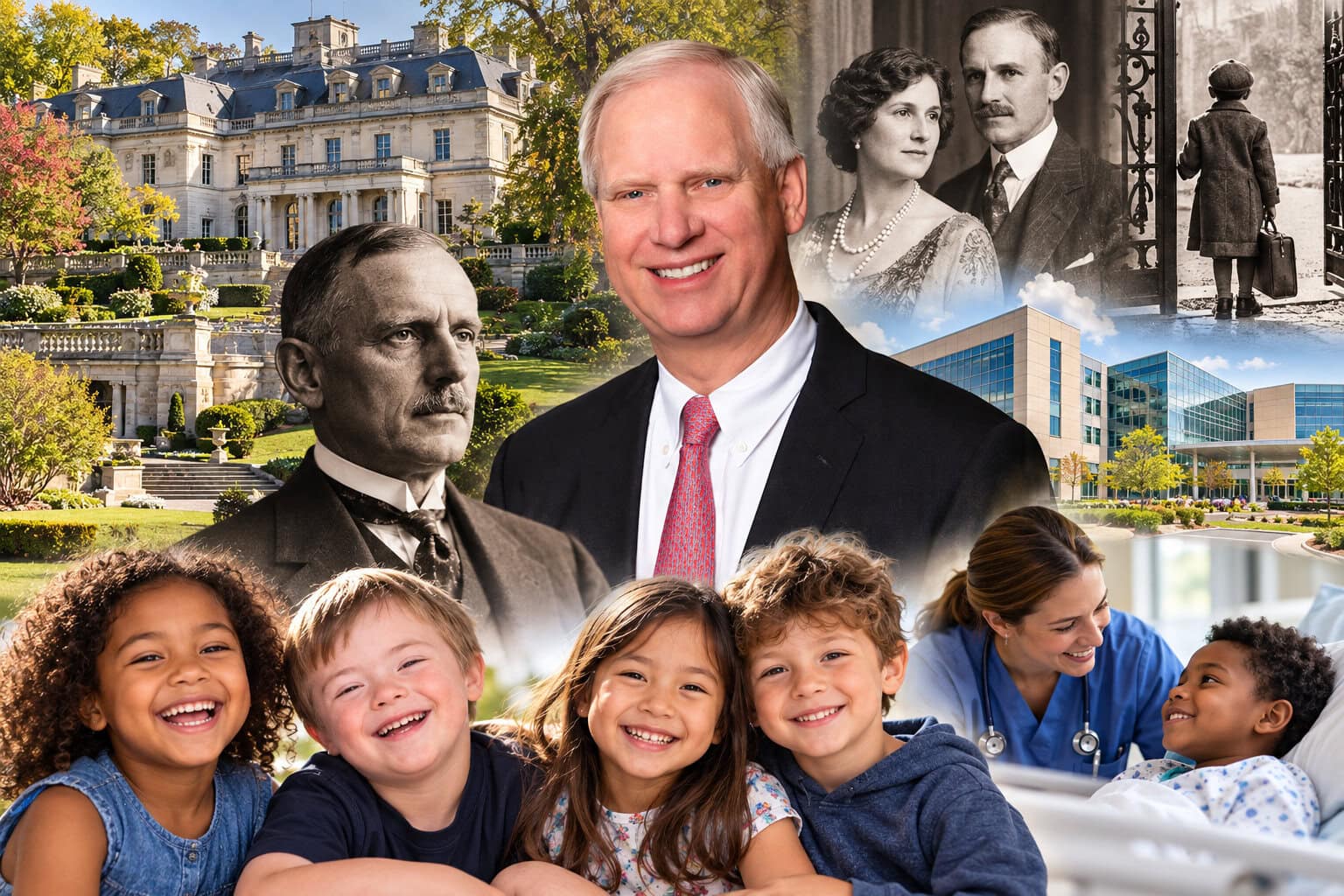
Alfred Irénée duPont was 13 when his childhood fell apart.
His mother was committed to an asylum in the Brandywine Valley and died within a week. His father died of tuberculosis about a month later.
The relatives planned to split up the children and sell the family home, and the children refused to go.
That orphaned boy grew into one of the most consequential industrialists of his era.
He lost an eye in a hunting accident and was nearly deaf by middle age.
When he wrote his will in the early 1930s, the first people on his mind were Delaware children with no one to look after them.
On October 2, 2026, that wish got its biggest new chapter in decades.
The Alfred I. duPont Charitable Trust, the Nemours Foundation, the State of Delaware, and the State of Florida announced an agreement committing $950 million over 11 years to Delaware children’s health and well-being.
The money will go through a new grantmaking body, the Alfred I. duPont Charitable Fund for Delaware’s Children, which will back nonprofit programs across the state.
At least $237.5 million is set aside for Nemours’ own initiatives in Delaware, and the parties have said the grantmaking will continue after the 11-year commitment ends.
Delaware Attorney General Kathy Jennings spoke about it as a matter of conscience as much as law.
“Alfred I. duPont was the greatest philanthropist in the history of our state, and his dying wish was a bequest to Delaware’s kids,” she said.
Her office, she noted, had worked “for roughly 50 years, through seven attorneys general, in two states, to fulfill that dream.”
At a press conference in Wilmington, she said the effort had never been about her or the attorneys general before her.
It had “always been about the future health of every child in the state of Delaware.”
Then she added, “The funds secured under this settlement could change the future and will change the future for Delaware’s kids.”
The story behind that sentence starts at Nemours, the 300-acre Wilmington estate du Pont built for his second wife, Alicia, in 1909 and 1910.
The 77-room mansion, designed in the Louis XVI style by Carrère and Hastings, took its name from the French town tied to his ancestor Pierre Samuel du Pont de Nemours.
In 1921, du Pont married Jessie Ball, a Virginia schoolteacher he had known since she was a teenager.
She took in the daughter he had fostered as her own and helped him reconcile with the children of his first marriage.
In 1926 the couple settled in Jacksonville, Florida.
There du Pont built a second fortune in banking and land, and during the 1929 bank run he put $15 million of his own money into the Florida National Bank of Jacksonville to keep it solvent.
He died in Jacksonville in the spring of 1935, at 70.
His estate was valued at about $56 million, and most of it went into a testamentary trust.
The will was specific.
The trust’s income was to maintain Nemours “as a charitable institution for the care and treatment of crippled children, but not of incurables, or the care of old men or old women, and particularly old couples,” with “first consideration, in each instance, being given to beneficiaries who are residents of Delaware.”
Jessie Ball duPont devoted the rest of her life to carrying out that vision. In 1940, the Alfred I. duPont Institute opened its doors on the Nemours grounds in Wilmington.
Du Pont, his wife, and her brother Edward Ball are buried in a mausoleum on that campus, within sight of the hospital that still carries his name.
What du Pont started has grown far beyond anything he could have imagined.
Since 1980, the trust has given more than $5 billion to The Nemours Foundation, its only qualified beneficiary.
That support built Nemours Children’s Health into one of the country’s largest pediatric systems, with two freestanding children’s hospitals, one in Wilmington and one in Orlando, and more than 80 primary, specialty, and urgent care practices.
The same growth produced a long, respectful but persistent disagreement over how much of the founder’s generosity should stay at home.
Delaware first went to court in 1979, and a 1980 settlement required that at least half of Nemours’ annual trust distributions be spent in Delaware.
Later, attorneys general returned to the issue, including Beau Biden in 2012 and Matt Denn, who filed suit in 2017.
Because Florida law governs the trust, Florida courts heard the case, and Florida’s attorney general also joined the proceedings.
A Florida appeals court eventually confirmed that Delaware’s attorney general had standing to speak for the children named in the will. With a trial date approaching, the parties chose to settle instead.
The new agreement replaces the 1980 formula with a structure aimed at the future.
A committee of directors will run the fund. Three will be appointed by the trust and one by Delaware Gov. Matt Meyer, and those four will choose a fifth, independent director.
Owen Lefkon, who leads the Delaware Department of Justice’s Fraud and Consumer Protection Division, explained that the committee will set its own grantmaking criteria. Because the fund sits within a private trust, it will not be a public body. Jennings said the uses can be broad.
“They can be capital grants for buildings. They can be grants for specific programs. They can be new programs or existing programs. But the experts are going to decide that.”
The settlement allows money for capital projects, education, and research that serve Delaware residents. The $237.5 million reserved for Nemours cannot cover the Wilmington hospital’s existing operating costs, though it can support strategic programs unlikely to pay for themselves.
The man who now chairs the trust, Thomas G. Kuntz, comes from the Florida banking world du Pont helped build.
He is a retired executive vice president of SunTrust Banks, once ran its Florida operations, and became chairman of the trust in May 2025 after eight years as a trustee.
“This collaboration directly delivers on Mr. duPont’s vision,” Kuntz said.
“Children’s health is our founder’s enduring legacy, and we remain committed to advancing that mission. By creating this new fund, we’re continuing to invest in what matters most: a future where all of Delaware’s children can achieve and thrive.”
His fellow trustees include two Delawareans from Greenville, a short drive from the Nemours estate. Terri L. Kelly is the former president and CEO of W. L. Gore and chairs the University of Delaware’s board of trustees. Geoffrey M. Rogers was the founding president of the Glenmede Trust Company of Delaware.
A trust spokesperson said the Nemours share will support children as well as “new, Delaware-based initiatives recommended by Nemours to the directors of the fund.”
For Dr. R. Lawrence Moss, the pediatric surgeon who has led Nemours Children’s Health since 2018, the agreement goes back to first principles.
Over a surgical career of more than 25 years, Moss has talked about the newborns he put on ECMO, a heart-lung bypass therapy, in its early days. Their families had been told the babies would not survive, and they did.
He came to Nemours wanting to redefine children’s health beyond the hospital walls.
“This agreement reflects the enduring power of the vision Alfred I. duPont set in motion nearly a century ago. Delaware holds a special place in that story,” Moss said.
“We are proud and grateful that the vision born in Delaware continues to flourish here, inspiring new possibilities and helping build a healthier future for children and families for generations.”
Nemours said it hopes the 11-year investment will strengthen “a broader network of organizations dedicated to children’s health and well-being.”
There was a moment of grace among the people who carried the cause for decades.
Matt Denn, the former attorney general who filed the 2017 suit before Jennings took office in 2019, said he never expected the issue to be resolved in his lifetime, and he thanked Jennings and her team for finishing the work.
Governor Meyer also thanked the attorney general and the Department of Justice for bringing the funds home.
The new fund has no grants, criteria, or first recipients yet.
Those decisions now belong to its directors.
What it has is a clear inheritance.
It began with a boy from the Brandywine who knew what it meant to lose his parents and nearly his home and who later wrote that Delaware’s children should come first.
Nearly a century after his passing, they will.