
$82 million turns one scholarship cohort into an institution
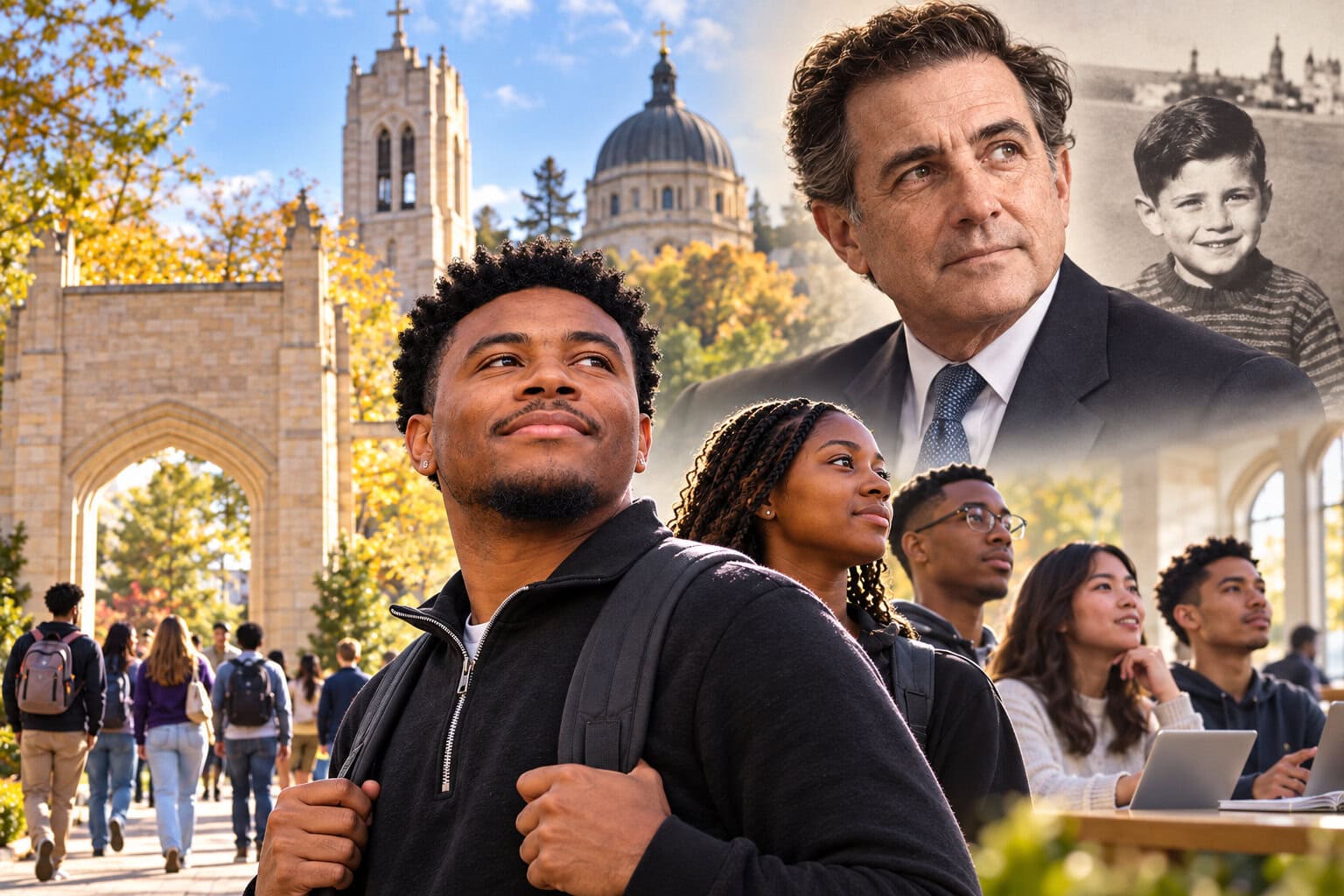
Mykal Howard was a transfer student in 2019 when someone told him about a scholarship program at the University of St. Thomas that came with more than money.
He applied, got in, graduated in 2022 with a degree in communications and journalism, spent two years tutoring and working as a teaching assistant in the St. Louis Park schools, and then did something scholarship recipients rarely do: he came back.
Today he is the program coordinator of the Ciresi Walburn Leadership Fellows, the person who runs the retreats, galas, and Dress for Success nights for the 28 students now moving through the program he once needed. On Thursday, the program he coordinates became the beneficiary of the largest gift in the university’s 141-year history.
St. Thomas announced an $82 million commitment, payable over 10 years, from the Ciresi Walburn Foundation and the Michael V. and Ann C. Ciresi Foundation, timed to the public launch of Be Brilliant. Be Bold, a $1 billion comprehensive campaign that has already secured nearly $800 million from more than 20,000 donors and ranks among the largest ever announced by a U.S. Catholic university and the largest publicly announced by any private Minnesota college.
It surpasses the $75 million that Lee and Penny Anderson, a Naples, Florida, couple who attended neither school, gave in January 2023 to build the hockey and basketball arena that now bears their name. The Anderson gift bought a building.
This one buys students — and it does so by dissolving the donor’s own foundation into the university.
“It kind of gave me my foundation, and feeling a sense of belonging at St. Thomas,” Howard said of his years as a fellow. “It just felt like a brotherhood. Seeing fellow peers who looked like me, and all of us working toward similar goals of success, was really inspiring.” He puts the practical case more bluntly: “I would have never gained real work experience to get employed if it weren’t for Ciresi Walburn”.
That is the outcome the man behind the $82 million has been chasing for 28 years. Michael V. Ciresi, College of St. Thomas class of 1968, is one of the most consequential trial lawyers Minnesota has produced—a career of nearly $12 billion in verdicts, awards, and settlements, including service as counsel to the government of India against Union Carbide after the Bhopal disaster and representation of women injured by the Dalkon Shield and Copper 7 intrauterine devices.
But the earlier biography explains the gift. He grew up in a working-class neighborhood in St. Paul. His mother died when he was young. His father spoke with an Italian accent, never got past the seventh grade, peddled fruit, then opened a grocery store in St. Paul and later a liquor store in White Bear Lake, and believed—with the specific ferocity of a man who had been denied it—in education for his children. Ciresi enrolled at St. Thomas as an undersized football player, went on to the University of Minnesota Law School, and began his career with a Minneapolis attorney named Solly Robins.
He joined Robins, Kaplan, Miller & Ciresi in 1971, stayed 44 years, chaired its executive board, and left in 2015 to co-found the boutique firm Ciresi Conlin LLP. In October 1998, at the height of the firm’s success, $30 million of its fees from a landmark Minnesota public health case was carved out to endow the Robins, Kaplan, Miller & Ciresi Foundation for Education, Public Health, and Social Justice—at the time believed to be the largest gift a law firm had ever made to a community foundation.
Ciresi’s stated aim then was narrow and personal: that all children in Minnesota, “no matter the circumstances of their birth,” get a fair shot at their potential. The board renamed itself the Ciresi Walburn Foundation in 2013, separated fully from the Minneapolis Foundation in 2020, and hired Daniel Sellers as its first and only paid staff member.
The second name belongs to Roberta Walburn, the foundation’s trustee and Ciresi’s longtime co-counsel—a former Star Tribune reporter turned lawyer, raised in New Jersey and New York, who clerked in 1982 for the late U.S. District Judge Miles Lord, the Iron Range-born “people’s judge,” and four decades later wrote his biography, “Miles Lord: The Maverick Judge Who Brought Corporate America to Justice.” The third is Ann C. Ciresi, Mike’s wife, a legal assistant during the IUD litigation; the couple live in Mendota Heights, have three children, and set up their own foundation in 1998.
The fellowship Howard runs began in 2018, initially split between Augsburg University and St. Thomas before consolidating entirely at St. Thomas, and it grew by increments a foundation with roughly $40 million in assets could afford: a $55,000 planning grant, then $316,500 for the first cohort, then $820,000 for the cohort of 2024-28. It now runs four cohorts of about 10 students each, one per graduating class, selected as incoming first-years on financial need and demonstrated commitment to leadership, service and social justice, with preference for first-generation students.
Historically, it served young Black men; in fall 2024, its sixth year, it inducted its first women.
One of them, Savanna Loken ’28—a high school speech champion, athlete, and student body president who wants to be a nurse—described the weight of going first: “It’s also a surreal feeling because I feel like a role model for the other girls who come up.” Ethan Asante ’28 put it more simply: “It’s more than just being a student of color—it feels like family.” Victoire Mwakana ’26, from the inaugural graduating cohort, rejected the charity framing outright: “We’re leaders. These are students who want to make a difference, who are willing to go the extra mile”.
The $82 million turns that annual grant cycle into permanent infrastructure. It will endow the fellows program outright, establish and endow a Ciresi Walburn Center for Leadership, and create a Ciresi Walburn Center for First-Generation College Students. The decisive detail sits in the mechanics: within 10 years the foundation’s assets transfer entirely to St. Thomas, retiring a 28-year-old grantmaker and making the university the permanent institutional home of its mission.
Ciresi, who has served on the St. Thomas board of trustees for more than 30 years, framed it as a handoff rather than a donation. “We created the foundation to serve children and young adults, and over time we learned that education was where we could have the greatest impact,” he said.
“This gift to St. Thomas ensures that work will continue in perpetuity. St. Thomas lives its mission to serve the common good, and that mission is our mission.” Walburn cited the students as evidence, not hope: “The Fellows have shown us what is possible when talented young people receive not only financial support but also the networks, experiences, and opportunities they need to become confident and effective leaders”.
The program is also changing hands. In August, Dr. Lily Asrat took over as director—born in Addis Ababa, raised partly in Nairobi, with a Berkeley doctorate, Teach For America in Baton Rouge, and most recently U.S. Peace Corps country director in Uganda. “My passion for social justice, particularly in education and health, has guided nearly every choice I have made,” she wrote in a letter to the fellows.
Scholarships are the campaign’s top priority, with roughly $350 million already committed to them, and President Rob Vischer describes the goal in terms a White Bear Lake liquor store owner with a seventh-grade education would have recognized: “It’s not enough that we help them develop job skills.
We have to help them find their core purpose.” Howard, who took the money and then came back to hand it out, describes the same idea from the other end: “As a program coordinator, I feel like it’s even more important for me to implement those skills of leadership to our fellows and show them that they, too, can be leaders in their own right.”