$40 million, one believer: Jacob Trefethen’s bet that OpenAI’s $130 billion fortune can crack the cancer vaccine code
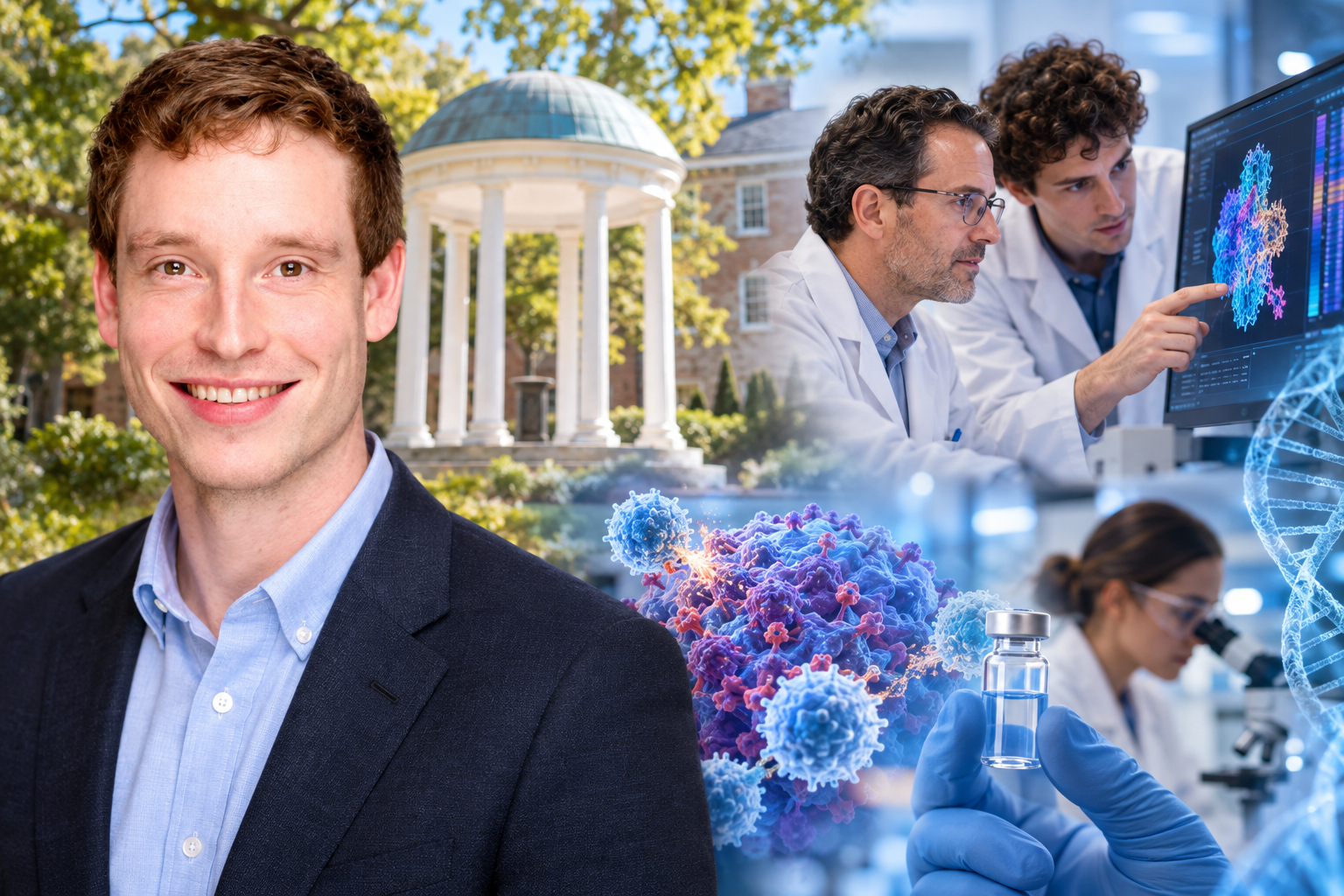
Mid-September, in a modest cluster of labs on the UNC-Chapel Hill campus, the world’s newest philanthropic superpower placed one of its most consequential bets yet.
The OpenAI Foundation—the nonprofit parent that now controls a roughly 26 percent stake in OpenAI Group PBC, a holding recently valued near $130 billion—announced a $40 million grant to UNC Lineberger Comprehensive Cancer Center, aimed at teaching artificial intelligence to do something doctors have struggled with for decades: design a cancer vaccine that actually works for the person standing in front of them.
It’s a story with an unusual cast.
On one end sits a foundation barely a year old, flush with more capital than almost any charity in history and only beginning to figure out how to spend it wisely.
On the other side sits a pair of North Carolina researchers—a physician-scientist who has spent his career chasing the immune system’s blind spots and a former Silicon Valley-adjacent computer scientist who traded machine-learning theory for the messy biology of tumors.
And standing between them, quietly shaping where the money actually goes, is a British-born grantmaker who, less than two years ago, was working a very different job at a very different philanthropy.
Cancer vaccines are not new, but their promise has always outrun their execution.
The idea is elegant: sequence a patient’s tumor, find the mutant proteins—neoantigens—jutting from its surface, and build a vaccine that trains the immune system to recognize those proteins as a threat and attack. In theory, it’s precision medicine at its purest. In practice, most candidate vaccines fail before they ever reach a patient, because picking which targets actually matter is still closer to guesswork than science.
“Personalized cancer vaccines are finally starting to show signs of clinical efficacy, but many fail in the development process because they are too arbitrary,” says Alex Rubinsteyn, the UNC computational biologist co-leading the new effort. “Our goal is to help the world design personalized and more effective cancer vaccines, using the power of rich data and artificial intelligence.”
The $40 million is meant to fix exactly that guesswork problem. Rubinsteyn and his co-investigator, immunologist Benjamin Vincent, will pull hundreds of de-identified tumor tissue and immune-cell samples from three biobanks and use them to train AI models that can more reliably flag which tumor antigens are worth chasing.
Alongside that, the team will run clinical trials comparing several vaccine formulations in triple-negative breast cancer—a notoriously aggressive subtype that disproportionately strikes younger women and women of color and offers far fewer treatment options than other forms of the disease because it lacks the molecular handles most targeted drugs rely on.
Crucially, none of this data will stay locked away in a UNC server room. It will be published through the OpenAI Foundation’s new Public Data for Health initiative, an open-access effort built so any researcher, anywhere, can pick up where Chapel Hill leaves off.
If this story has a heart, it beats in Benjamin Vincent’s lab. Vincent is an associate professor at UNC’s School of Medicine, but his path there was distinctly old-school for a man now defined by algorithms.
He trained in cellular immunology under Jeffrey Frelinger, the former chair of UNC’s microbiology and immunology department, and completed a fellowship under Jonathan Serody before becoming faculty director of Lineberger’s Immunogenomics Facility.
He’s done this before, too—years ago, alongside oncologist Jared Weiss, Vincent helped design PANDA-VAC, a personalized, adaptive vaccine for lung and head-and-neck cancers linked to smoking, and pushed it through FDA approval into an active clinical trial. He isn’t a newcomer chasing an AI trend. He’s a clinician who has already lived through the failures this new grant is meant to fix.
His partner took an almost mirror-image route to the same problem. Alex Rubinsteyn earned his doctorate in computer science at NYU, where his early work involved machine learning and parallel computing—about as far from an oncology ward as academia gets.
A postdoctoral pivot took him to the Icahn School of Medicine at Mount Sinai, where he helped launch and run some of the country’s first personalized cancer vaccine trials.
He now runs UNC’s Personalized Immunotherapy Research Lab, describing his work simply as trying to make personalized cancer immunotherapies that actually do something useful.
Vincent brings the clinical instinct; Rubinsteyn brings the code. Together, they’re the kind of hybrid—physician plus data scientist—that AI-era medicine keeps promising and rarely delivers.
The person who had to be convinced to write the check has an improbable story of his own. Jacob Trefethen joined the OpenAI Foundation this past March as its Head of Life Sciences and Curing Diseases, arriving from Coefficient Giving, the science- and health-focused grantmaker formerly known as Open Philanthropy.
Over nearly eight years there, he rose from research fellow to managing director, eventually overseeing more than half a billion dollars in biomedical science grants. Before that, he was a product manager on Snapchat’s augmented-reality team and co-founded a small startup that was later acquired—a Silicon Valley résumé that still seems to color how he thinks.
English by upbringing and based in San Francisco, he’s candid on his personal blog about his own biases, noting that many of his friends work in tech, and many are British. It’s an oddly disarming admission from someone who now helps decide how one of the richest philanthropies on earth spends its money fighting cancer.
His framing of the UNC gift says a lot about what the Foundation believes it’s actually buying—not a cure, but raw material. “AI has enormous potential to help researchers design better cancer treatments, but that progress depends on having the right biological data to learn from,” Trefethen says.
“UNC’s work will generate data that researchers don’t have at the scale they need today and make those findings broadly available so scientists around the world can build on them. By giving the broader scientific community a stronger foundation to work from, we hope to open up new possibilities for cancer research and ultimately help more patients benefit from advances that once felt out of reach.”
That philosophy—fund the dataset, not just the discovery—drives Public Data for Health, the Foundation’s second major science program. It follows an earlier hundred-million-dollar Alzheimer’s initiative launched in the spring across six research institutions and now anchors a broader tranche exceeding $125 million spread across universities and nonprofits, spanning everything from molecular data to epidemiology to regulatory knowledge.
None of this would exist without last October’s corporate earthquake.
On October 28, 2025, OpenAI completed a recapitalization that turned its original nonprofit into the OpenAI Foundation, while its commercial arm became OpenAI Group PBC, a public benefit corporation.
The nonprofit kept control and a substantial equity stake—one now worth tens of billions of dollars on paper, instantly making it one of the best-resourced philanthropic organizations that has ever existed.
Bret Taylor, the Foundation’s board chair and former Salesforce co-CEO, is tasked with turning that windfall into actual grants.
Back in March, Taylor pledged the Foundation would invest at least a billion dollars within the year across life sciences, jobs and economic impact, AI resilience, and community programs—an early installment on a previously announced $25 billion commitment to curing diseases and building AI safety over time.
Taylor brought in Trefethen to run the life sciences portfolio, betting that someone steeped in rigorous, evidence-driven giving would deploy serious money more thoughtfully than a tech company simply improvising its way into medical research.
For a foundation that, just two years ago, was still giving away single-digit millions annually as plain old OpenAI, the leap to nine-figure science initiatives is striking. And UNC Lineberger—North Carolina’s only public, NCI-designated Comprehensive Cancer Center, and one of just a few dozen nationwide rated “Exceptional”—is exactly the kind of institution built to absorb that kind of ambition.
If Vincent and Rubinsteyn’s models succeed, the payoff won’t be a single drug. It will be a public map, an open dataset any lab anywhere could use to stop guessing at which tumor targets matter and start knowing.
That, in the end, is the quiet bet underneath the announcement: that the fastest way to accelerate a cure isn’t to hoard the science but to give it away. As Vincent puts it, describing the puzzle his lab has circled for years, “Selecting tumor antigens that are actually good targets and understanding the relative potency of vaccine formulations for personalized therapy are big problems in the field, which our work will address.”
Whether an AI company’s charitable arm can help solve them may say as much about the future of philanthropy as it does about the future of oncology.