
$30 million gift to school from Richard Davis reflects a life built on islands and airstrips
In the mid-1970s, a young Texas Tech graduate named Richard Davis stepped off a plane in a country most Americans couldn’t have found on a map.
Belize was barely a blip on the tourist circuit then—flights from the United States landed once a week, and long stretches of coastline had never seen a hotel or a road. Davis, in his mid-twenties with a freshly minted master’s degree in education, decided to stay anyway.
Over the next two decades, he built an improbable life there: He bought into a hotel, ran a ranch, invested in real estate, and eventually helped operate a small regional airline that ferried travelers out to the country’s offshore islands, according to Texas Tech University.
Friends who knew him later in life describe a man who could pilot a boat, spar as a martial artist, dive a reef, and ride a motorcycle—and who almost never mentioned any of it.
That restless, understated younger Davis is not the version of the story Texas Tech typically tells about its biggest donors.
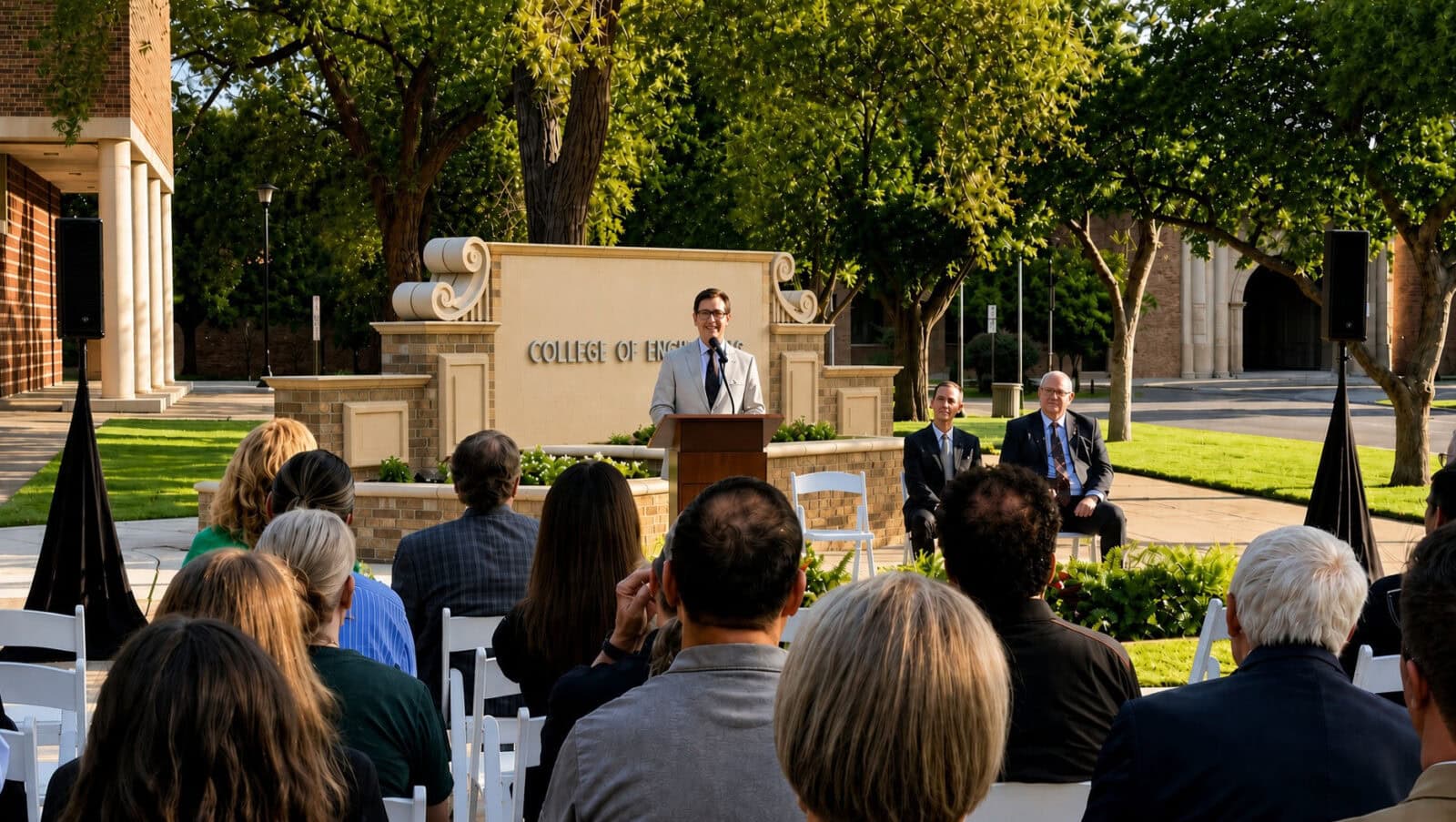
But it is, in many ways, the story that explains everything that came after: on August 27, the university announced it had received more than $30 million from Davis, the largest gift in the history of the Edward E. Whitacre Jr. College of Engineering and a record for the university.
The money will fund two new endowments bearing the Davis name, seed a faculty recruitment push, and help renovate engineering facilities across campus—an outcome that traces back, in a straight line, to a young man’s decision decades ago to keep faith with a family that had quietly supported this university since before he was born.
Davis’s own path to Texas Tech ran through the College of Arts & Sciences and the College of Education, not engineering—he earned a bachelor’s degree in physical education and a master’s in education in 1969.
But the family connection to the university’s engineering program ran much deeper and much further back.
His maternal grandfather, Mose Newman, sat on what was then the Texas Technological College Board of Directors from 1925 to 1927, when the school was barely getting off the ground.
And his father, Lt. Gen. Waymond Austin Davis, arrived on campus as a young engineering student in the 1930s, graduating with a mechanical engineering degree in 1936 — decades before he would return to deliver the university’s 1967 commencement address and accept an honorary doctorate the same year.
The elder Davis went on to a distinguished career in the U.S. Air Force, was named a Distinguished Engineer by the college in 1968, and received Texas Tech’s Distinguished Alumni Award in 1970.
He gave to the university every year from 1959 until his death in 1998, eventually establishing a scholarship named for his own father-in-law, Mose Newman, that still supports Whitacre College students today.
It was watching his father model that kind of quiet, decades-long generosity that seems to have shaped Richard Davis most. When Lt. Gen. Davis fell ill, Richard left Belize and resettled in Sweetwater, Texas, though he kept returning to Central America for months at a stretch even in his later years.
After his father died, he moved his mother, Josephine, to Sweetwater so she could be close to her only surviving sister and cared for her until her own death.
He then took on the long-term care of his younger brother, Austin, who needed lifelong support. Austin died just three days before Richard, on March 8, 2025 — a final, almost eerie act of the two brothers staying in step with each other to the end.
Those who knew Davis in Sweetwater say his wealth was something of an open secret rather than a visible fact. By most accounts he was the richest man in a small West Texas town, yet he drove the same model Volkswagen Beetle for years and never spoke ill of anyone he knew.
“Richard’s motivation to make this gift was to honor his parents and his brother, to whom he was very devoted throughout his life,” said Rod Wetsel, a longtime friend who served as Davis’s attorney.
“He wanted to do things with the money that are positive and have a lasting legacy for the students. He was really proud to have been a student at Texas Tech.”
Wetsel added that he hopes Davis’s decision offers a model for others weighing what to do with money they’ve accumulated over a lifetime: “In the end, he decided this was the best way to live on in everybody’s memory as someone who tried to make a difference in other people’s lives.”
The gift itself is built to work on two fronts at once. On the academic side, it establishes the Richard E. Davis Endowed Chair and the Lt. Gen. W.A., Josephine, and Austin Davis Memorial Endowed Professorship—positions designed to help the Whitacre College recruit and retain faculty whose research and teaching can elevate the entire program, university officials said.
“This endowment gives the Whitacre College the ability to compete at the highest level, recruiting and retaining scholars and teachers who will define the next generation of engineering research and education,” said Roland Faller, dean of the Whitacre College of Engineering.
“Richard Davis has invested in what this college can become, and we intend to honor that vision.”
On the physical side, the Richard E. Davis WCOE Enhancement Endowment and the Richard E. Davis Renovation Fund will pay for new construction, renovations, and upgraded learning spaces throughout the engineering college—with $10 million specifically set aside as dollar-for-dollar matching money, meaning every gift Texas Tech raises for facility renovations from this point forward can be doubled. University president Lawrence Schovanec called the gift “very humbling,” noting the responsibility that comes with it: “It makes it a grave responsibility to make sure we are good stewards of this money.”
Schovanec added that Davis’s gift “reflects a connection to Texas Tech that reaches back to our earliest days,” while Byron Kennedy, the university’s vice president for advancement, framed it as one of “the most profound expressions of generosity,” predicting it would help attract “world-class faculty” and “best-in-class facilities” for years to come.
The gift lands as part of a larger moment for the university. The Campaign for Texas Tech University, publicly launched in October 2024, has now raised more than $1 billion from over 93,000 donors, alumni, and friends.
But inside that billion-dollar campaign, Davis’s contribution stands out for how personal its arithmetic is: a grandfather on a founding board in the 1920s; a father who crossed campus as a young engineering cadet in the 1930s and gave back every year for nearly four decades afterward; and a son who spent much of his own adulthood a world away in Belize before quietly coming home to look after the people who raised him—and to make sure their names and their university would outlast him.
For a family whose Texas Tech story began with a twenty-something engineering student walking onto a campus that barely existed yet, it ends with a gift built to shape the campus for a century still to come.