$3.3 billion: how Peter Thiel’s unconventional philanthropy turned a college dropout into a billionaire at 25
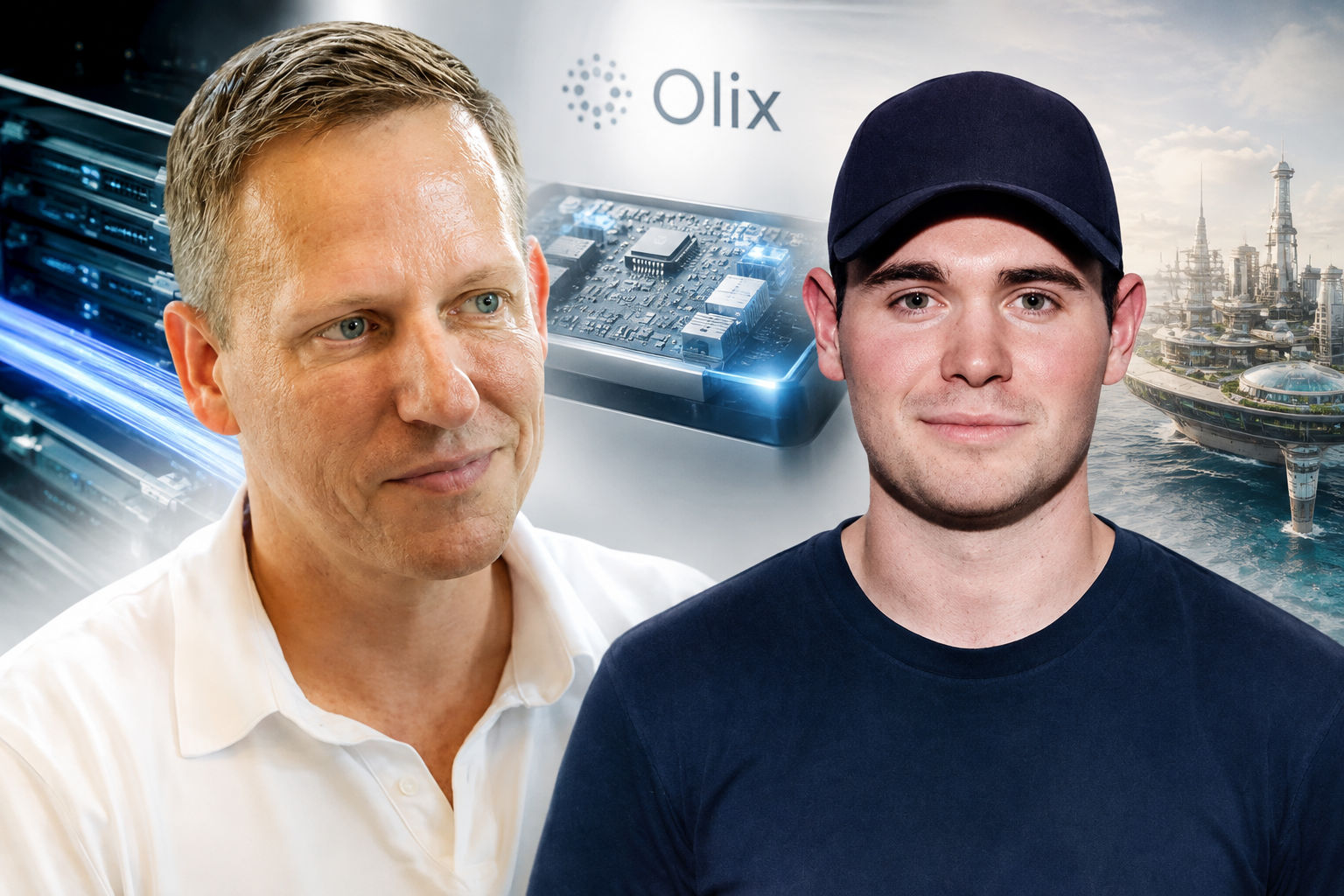
When 25-year-old James Dacombe became Europe’s youngest billionaire this month, the tech world celebrated it as a classic story of boy-genius meets artificial intelligence.
Dacombe’s startup, Olix, reached a staggering $3.3 billion valuation, making the high school dropout a newly minted member of the three-comma club with a personal fortune of roughly $1 billion.
But behind this sudden explosion of wealth is a patient, highly unconventional bet made by Silicon Valley’s most famous iconoclast, Peter Thiel, whose philanthropic foundation gave a teenager the permission to change the world.
Dacombe’s journey to the top began just two years ago when he wagered that the world’s AI infrastructure was broken.
While tech giant Nvidia builds massive, general-purpose chips, Olix slices the AI assembly line into pieces, crafting hyper-specialized chips for specific tasks like processing prompts or generating answers.
To connect these chips, Olix utilizes a custom optical network that employs infrared light rather than traditional electrical communication.
By replacing electrons with photons, Olix’s hardware overcomes the physical resistance bottlenecks—known as RC delay—that plague copper wires, achieving radically faster data transfer speeds while slashing the power consumption that threatens to overwhelm global energy grids.
Global heavyweights—including investment firm Fundomo, chip designer Arm, and even the U.K. government’s Sovereign AI fund—quickly fell in love with the vision, pouring $532 million into the company.
Yet, long before global venture funds or governments were willing to back a twenty-something, Thiel’s philanthropic apparatus took the ultimate gamble on his raw potential. In 2022, Dacombe was awarded a Thiel Fellowship.
Launched in 2011, this controversial program offers bright innovators aged 22 or younger a $250,000 grant to stop out of college or high school and build companies instead. At its inception, academia ridiculed the idea, calling it a misguided experiment that bypassed crucial life stages.
But Thiel’s philosophy was never about writing safe grants for university libraries or funding comfortable research fellowships. Instead, he pioneered a high-leverage model of venture philanthropy designed to combat what he views as a “higher education bubble”—a system that saddled youth with debt while actively housebreaking their creativity and funneling them into conformist corporate tracks.
Thiel’s philanthropy acts as a form of intellectual arbitrage: finding undervalued talent outside the traditional system, funding the individual rather than the institution, and providing a parallel pathway to execution.
Thiel practices a starkly different kind of philanthropy by rejecting traditional charity in favor of funding radical, contrarian ideas.
Most institutional giving focuses on treating the symptoms of a stagnant culture—funding incremental research, building campus wings, or supporting standard non-profit bureaucracies. Thiel’s philanthropy, by contrast, is designed to be highly concentrated, micro-targeted, and deliberately disruptive.
Instead of donating to established institutions, his Thiel Foundation focuses on speculative “hard tech” projects, artificial intelligence safety, and alternative education. By intentionally avoiding mainstream causes, Thiel treats philanthropy like venture capital—betting big on high-risk, high-reward concepts that he believes will fundamentally reshape human progress.
This unique philanthropic footprint centers on three distinct areas, each aimed at breaking the boundaries of human limitation. The first is disrupting higher education through his flagship fellowship, which actively pulls talent away from traditional degree tracks.The second is a deep commitment to radical life extension, where Thiel has poured millions into biomedical organizations like the Methuselah Foundation to fund research aimed at stopping or reversing human aging.
Today, that early philanthropic seed has matured into a robust portfolio of cutting-edge biology.
The foundation’s capital directly backs pioneering ventures like Oisín Biotechnologies, which uses gene therapy to clear toxic, non-dividing senescent cells to reverse age-related degeneration.
It also funds companies like Leucadia Therapeutics—developing devices to clear Alzheimers-causing toxins from brain fluid—and X-Therma, which utilizes advanced subzero technology to preserve human transplant organs for over 72 hours.
The ultimate goal of this targeted altruism is translation: moving high-risk longevity science out of academic labs and into the commercial market to make “90 the new 50”.
The third pillar is the exploration of alternative societies, which led him to heavily back the Seasteading Institute to explore building independent, politically autonomous communities on floating ocean platforms.
While critics originally dismissed seasteading as a billionaire’s libertarian fantasy, the technology has evolved dramatically from abstract sketches into practical marine engineering. Modern seasteading initiatives have shifted toward building sustainable, eco-friendly floating architecture and “SeaPods”—3D-printed, self-sufficient aquatic homes designed to withstand open-ocean waves.
These modern communities serve as real-world incubation sites for circular economies, testing breakthroughs in solar capture, rainwater purification, open-ocean aquaculture, and even bio-rock technology that attracts calcium carbonate to underwater structures to prevent saltwater corrosion.
For Thiel, the goal was always to popularize the ocean as a new frontier for human civic experimentation.
At the core of these diverse projects lie two foundational philosophies that dictate Thiel’s approach to giving: technological stagnation and mimetic theory. Long before he began funding dropouts, Thiel posited that society had entered an era of severe technological slowdown.
He famously observed that we wanted flying cars, but instead got 140 characters, arguing that modern innovation has been confined almost entirely to bits and software, while the physical world—atoms, hardware, transportation, and medicine—has stagnated under excessive institutional regulation.
His philanthropy is an intentional countermeasure, designed to bypass risk-averse legacy gatekeepers and push humanity from “zero to one” by funding tangible, complex engineering breakthroughs.
This rejection of the mainstream is deeply tied to his fascination with René Girard’s mimetic theory, which asserts that human desire is entirely imitative; people copy what others want, leading to fierce competition over identical, conventional prizes like Ivy League degrees, corporate titles, and consensus-driven social status.
Thiel views traditional philanthropy as the ultimate playground for mimetic behavior, where billionaires fund the same safe universities and prestige-driven medical foundations just to signal conformity to their peers.
His giving is built to break this cycle of imitation, functioning as a deliberate act of cultural contrarianism.
Rather than fueling competitions within established systems, his foundation seeks out individuals who are actively stepping off the competitive track to solve ignored, high-stakes problems.
It is an elitist model of altruism built on the firm belief that true human progress is not pushed forward by committees, but pulled forward by exceptional individuals who are given the financial and cultural air cover to take massive risks.
What makes Thiel’s philanthropy truly distinct from other tech-driven mega-funds is its radical, hands-off defiance of institutional metrics.
Compare it to Schmidt Sciences—run by former Google CEO Eric Schmidt—which leverages massive philanthropic data sets and requires scientists to hit rigorous, collaborative academic milestones to solve hard climate or biology problems.
Or consider Emerson Collective, established by Laurene Powell Jobs, which blends non-profit grants with for-profit investments to champion highly structured, systemic social justice and educational equity reform.
While Schmidt and Powell Jobs use philanthropy to repair and optimize the existing societal grid from the top down, Thiel uses it to sabotage the grid from the outside.
Furthermore, Thiel’s model strips away the paralyzing red tape of traditional grants.
The Thiel Fellowship imposes zero exact commercial milestones over its two-year period.
There are no quarterly boardroom reports, no mandate to launch a product, and the foundation takes absolute zero equity in the fellows’ companies.
The program demands only one non-negotiable milestone to unlock the capital: you must drop out or remain out of school.
Fellows are given total autonomy to iterate, pivot, or even completely fail, so long as they remain fully dedicated to execution rather than a classroom.
For a teenage Dacombe, who had already left school to build his first startup, CoMind, the fellowship was life-altering.
The primary value of Thiel’s gift was not just the cash, but the immense psychological and social validation it provided.
In a world that demands a college degree as proof of worth, Thiel’s philanthropy told a brilliant dropout that his ideas mattered right now.
It plugged him into a powerhouse network of Silicon Valley kingmakers, turning a lonely, high-risk teenage gamble into a fast-tracked reality.
The extraordinary return on that philanthropic investment is now clear.
Dacombe follows in the footsteps of previous Thiel Fellows like Ethereum creator Vitalik Buterin and automotive tech billionaire Austin Russell, proving that micro-targeted philanthropy can fracture traditional pathways to success.
Dacombe is far from alone in this generational shift; he is part of an aggressive, youth-driven macroeconomic wave where twenty-something founders are leveraging AI to completely bypass the traditional corporate climb.
A new breed of self-made titans is emerging globally, driven by the same ethos of rapid action over formal credentials.
The four young creators of the AI coding tool Cursor have built a massive engineering powerhouse that has secured them individual fortunes of $2.3 billion each.
Nearby in the ecosystem, Fabian Hedin has ridden the wave of natural-language software generation at Lovable to a net worth of $3.1 billion, while the three twenty-something founders behind the AI recruitment platform Mercor have successfully disrupted global hiring pipelines to land $2.2 billion apiece.
While this newest wave of software and hardware titans dominates the global market, Dacombe’s first breakthrough, CoMind, is simultaneously making massive strides.
The neurotech firm is currently running advanced clinical trials at London’s St Bartholomew’s Hospital, using non-invasive lasers to safely measure brain blood flow and pressure in intensive care patients—heading toward a projected commercial launch by 2027.
By substituting an institutional safety net with radical trust, capital, and mentorship, Thiel’s unique philanthropy didn’t just fund a business—it successfully minted a billionaire.