$180 million: Sealy & Smith gives university medical branch largest-ever gift for a new heart institute, raising their total giving to school to $1.2 billion
The Sealy & Smith Foundation has committed more than $180 million to the University of Texas Medical Branch to expand the Sealy Heart & Vascular Institute — a combined total that folds in a new $130 million grant on top of the roughly $50 million the Foundation put in over the past year to get the Institute and its cardiovascular department running.
UTMB is calling it the largest single philanthropic commitment in its 135-year history.
The Foundation is calling it the largest grant it has ever made, in just over a century of giving to the same institution.
“The Sealy & Smith Foundation has a long history of investing in initiatives that transform health care for the people of Galveston and beyond,” said John Kelso, president of the Foundation’s board.
“We believe the Sealy Heart & Vascular Institute has the potential to redefine cardiovascular care in our region by bringing together exceptional physicians, advanced technology, innovative research, and a commitment to improving patient outcomes.”
The money is earmarked with the kind of precision you get from a funder that has spent a century literally constructing the campus it gives to: $80 million for a new inpatient cardiovascular hub on the sixth floor of Jennie Sealy Hospital, with expanded catheterization labs, a new electrophysiology lab and hybrid catheterization capability; $43 million for an outpatient cardiovascular center that brings cardiology, cardiac surgery and vascular surgery under one roof; $7 million to relocate and modernize interventional radiology; and the balance for advanced imaging and new research and teaching space (UTMB). UTMB’s year-old Department of Cardiovascular Medicine will be permanently renamed the Sealy Department of Cardiovascular Medicine as part of the gift.
“This extraordinary investment reflects The Sealy & Smith Foundation’s unwavering commitment to improving health and advancing medical excellence,” said Dr. Jochen Reiser, UTMB’s president and CEO of the UTMB Health System. “Built on generations of shared vision and trust, it continues to redefine what an academic health system can achieve”.
Dr. Hani Jneid, the interventional cardiologist who chairs the new department and directs the Institute, called it “a transformational milestone for UTMB, creating the first fully integrated clinical institute in UTMB history,” aimed at building “a leading regional, national and international referral destination for patients with complex cardiovascular disease”.
Behind the announcement is a man named Douglas Rogers, and if you’ve never heard of him, that’s by design.
Rogers has run the Sealy & Smith Foundation as its executive director and secretary-treasurer since 2015, working out of a modest office on Galveston’s Market Street.
He also sits on the board of Atlas Energy Solutions, a Permian Basin sand-mining company traded on the New York Stock Exchange — not because he has a side interest in frac sand, but because the Foundation owns roughly 12 percent of the company, about 14.8 million shares, and wanted its own person in the room.
Atlas also pays the Foundation mining royalties on a facility in Monahans, Texas — close to $5 million in 2024 alone. A Texas A&M-trained banker, Rogers is, in practice, the person deciding how a hundred-year-old fortune gets invested so it can keep paying for things like a new heart hospital wing. The money that built the Sealy Heart & Vascular Institute this week did not come from a checkbook. It came from a portfolio he manages.
The fortune itself goes back much further than Rogers, or Kelso, or anyone currently drawing a salary from the Foundation. It starts with a Pennsylvania merchant named John Sealy, who arrived in Galveston in 1846 chasing stories about the new state of Texas and built a fortune in banking, shipping, cotton and rail at a time when Galveston was the busiest port in the state.
He died in 1884, leaving $50,000 in his will for an unspecified charitable purpose.
His widow and his brother George decided the money should build a hospital, and John Sealy Hospital opened in 1890 — a decision credited with tipping the state’s choice to put its new medical school in Galveston, which is how UTMB came to exist at all.
For the next three decades, the elder Sealy’s children quietly kept the hospital afloat with their own money.
His son, John Hutchings Sealy, was by most accounts the wealthiest man in Texas by the time he died.
Princeton-educated, he ran the family bank, took over a major railroad and the Galveston Wharf Company from his uncle, and in 1911 founded Magnolia Petroleum, later absorbed into what is now Mobil.
Around 1920, he reportedly studied how families like the Rockefellers had structured their giving to last and decided his father’s hospital needed something sturdier than annual personal checks.
In 1922, he and his sister, Jennie Sealy Smith, along with her husband, R. Waverley Smith, chartered the Sealy and Smith Foundation for the John Sealy Hospital, with a mission so narrow it has never needed rewriting: build and maintain hospital buildings in Galveston, for the people of Galveston.
Then came the detail that actually explains why this foundation still has money to give away a century later. John Hutchings Sealy died unexpectedly in 1926, at 55, on his way home from cancer treatment in Italy. He never married and had no children. Roughly 4,000 Galvestonians met the train carrying his body home.
With no heirs, the bulk of his fortune passed directly into the four-year-old Foundation. His sister Jennie died in 1938, also without children, and her estate followed his (Sealy & Smith Foundation). Neither of them lived to see the Foundation become what it is now. Both of them, by dying childless, are the reason it exists in its current form at all.
What it became is hard to overstate. The Foundation’s cumulative giving to UTMB since 1922 tops $1.2 billion and includes 25 major buildings on the Galveston campus — both John Sealy and Jennie Sealy hospitals, the Shriners Burns Institute, the region’s Level 1 trauma center, and the first Biosafety Level 4 lab ever built on a U.S. university campus.
After Hurricane Ike devastated Galveston in 2008, the Foundation put up $170 million toward a new Jennie Sealy Hospital, at the time the largest single gift ever made to a University of Texas System institution. In 2022, on the Foundation’s hundredth anniversary, UTMB renamed its medical school the John Sealy School of Medicine. By then the relationship had already cleared $1 billion, and during the pandemic the Foundation had chipped in for COVID-19 research at an institution that had also led the fight against Ebola and Zika, as Kelso put it at the time.
None of that giving would still be possible without the machinery Rogers oversees. The Foundation’s most recent tax filing shows total assets of roughly $2.3 billion, drawn from investment income, oil and gas royalties, rental income and periodic asset sales — a portfolio that, a hundred years on, still leans on the same instincts John Hutchings Sealy had when he moved his money into banks, railroads and oil wells rather than just letting it sit. The Atlas Energy Solutions stake is simply the current-generation version of that same bet, run by a man whose job title, boiled down, is keeping a dead banker’s fortune growing fast enough to keep funding a hospital he never lived to see.
The board that signed off on this particular gift is small and unglamorous by design. Kelso has been its public face for over a decade, and the warmth in his language is genuine rather than rehearsed — in 2016, accepting the University of Texas System’s highest honor on the Foundation’s behalf, he said simply: “This island is our home and we believe every contribution one makes to their hometown is returned to them ten-fold”.
Alongside Kelso, Rogers and directors Keith Bassett, Jere Pederson and Jim Galbraith sits one name that still carries the founding family forward: William “Bill” Sealy, whose seat continues a line running back to the Foundation’s original trustees and to a prior director, George Sealy, who served from 1980 to 2022.
A century after John Hutchings Sealy signed a charter for a hospital he’d already been personally bankrolling for thirty years, his money is still arriving in nine-figure installments — managed now by a banker who also sits on the board of a sand-mining company, voted through by a small board that still includes a Sealy, and delivered to a heart institute full of patients who won’t ever know any of their names.
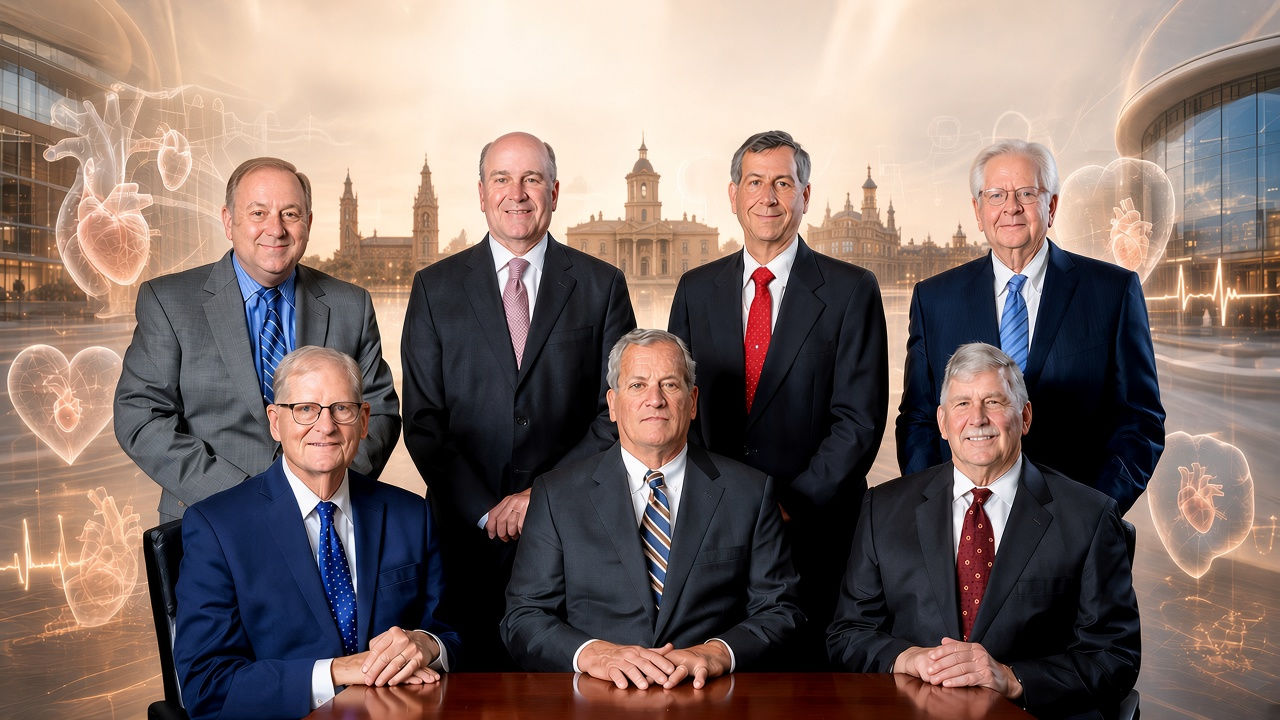
Photo: The Sealy & Smith leadership; John Kelso, Michael Doherty, James Galbraith, E. J. Pederson, Keith Bassett, William Sealy and Douglas Rogers