
$118 million and rising: Gina and Frank Day lead transformational donor wave behind university’s Roadrunners Rise campaign
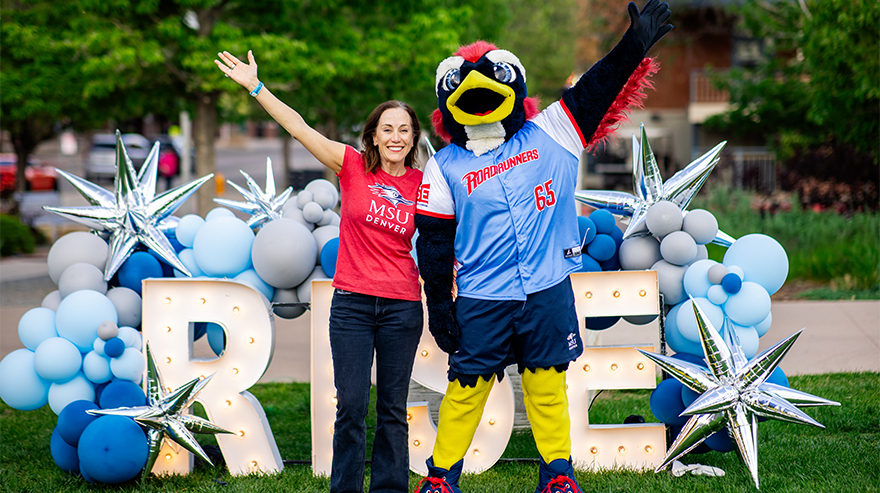
The Roadrunners Rise campaign at Metropolitan State University of Denver has closed not simply as a financial success but as a defining moment in the institution’s philanthropic coming‑of‑age, with more than $118 million raised to accelerate social mobility for Colorado students.
At the center of that story stand a handful of lead donors, foremost among them Gina and Frank Day—whose gifts are reshaping MSU Denver’s physical campus, talent pipeline, and long‑term ambitions.
Neither the sweltering summer sun nor intermittent wind gusts could keep nearly 350 students, alumni, faculty, staff, and community members from gathering on campus last Thursday to mark the close of MSU Denver’s first‑ever comprehensive fundraising campaign.
When Roadrunners Rise began its silent phase in fall 2020, the $100 million goal felt aspirational for a regional public university long defined by its commuter culture and scrappy resourcefulness.
The campaign set out to fund four pillars—facilitating student success, creating classroom‑to‑career pathways, cultivating inclusive excellence, and advancing Colorado’s talent pipeline—with a clear throughline: philanthropy would be measured in social‑mobility outcomes as much as in square footage or naming rights.
Nine months after the public launch in February 2025, the campaign goal was surpassed; as the university community convened last week, the running total had climbed past $118 million, well beyond what even optimistic insiders predicted at the outset.
From the stage, Christine Márquez‑Hudson, vice president for University Advancement, framed the number not as a fundraising trophy but as visible proof of a cultural shift.
She reminded the audience that more than 800 faculty and staff members had made over 13,000 gifts, signaling deep internal belief in the institution’s mission and assuring outside donors that those closest to the work were willing to invest their own resources.
Across the five‑year span of the campaign, 3,500 students received scholarship support totaling $12.7 million, a critical intervention at a university where many students juggle coursework with jobs, caregiving, and long commutes.
Nearly 60,000 total gifts poured in, and 85 percent of them were under $100—a deliberate demonstration that participation, not just capacity, was central to Roadrunners Rise. More than 10,000 first‑time donors chose to back MSU Denver, and nearly 5,000 donors gave more than once, expanding and deepening a philanthropic community around a campus historically underrepresented in big‑ticket giving conversations.
Yet even in a campaign that leaned heavily into broad‑based support, a small group of lead donors provided the structural beams that allowed MSU Denver to imagine—and then build—something far larger.
Chief among them are Gina and Frank Day, longtime hospitality entrepreneurs whose $10 million pledge to the university’s Health Institute stands as the largest gift in MSU Denver history and as the flagship capital commitment of Roadrunners Rise. Their philanthropy, layered over an earlier seven‑figure investment in the university’s School of Hospitality, has effectively stitched together two of Colorado’s most consequential service sectors—hospitality and health care—through a single public‑university platform.
The Days’ path to becoming cornerstone donors at MSU Denver began not in a boardroom but in Colorado’s restaurants and hotels. Over decades, Frank built a formidable hospitality portfolio, helping launch or lead brands that became fixtures of the state’s dining and tourism identity, while Gina developed a parallel reputation as a savvy operator and civic leader in the Boulder‑Denver corridor.
Their vantage point was always dual: they understood the front‑of‑house choreography of service and the back‑of‑house logistics of staffing, training, and margins.
That perspective shaped their philanthropy when they first deepened their relationship with MSU Denver through a major gift to the School of Hospitality, where they helped create a Hospitality Industry Leadership major and a leadership academy that pairs classroom instruction with executive‑style training and mentorship, deliberately designed to elevate students already working in hotels, restaurants and breweries into management and ownership tracks.
When the couple turned their attention to health care, the move was less a departure than an extension of their long‑standing preoccupation with service industries that underpin Colorado’s economy.
Their $10 million pledge to MSU Denver’s Health Institute is powering the creation of the Gina and Frank Day Health Institute, including a new tower that will consolidate 10 health‑related academic departments under one roof.
The five‑story, roughly 70,000‑square‑foot facility is being designed as a hybrid space: part cutting‑edge teaching environment, part clinical lab, part community hub. Inside, students in nursing, nutrition, behavioral health, physical therapy, speech‑language pathology, and social work will learn alongside one another in simulation suites, interdisciplinary classrooms, and community‑facing clinics that mirror the team‑based care models transforming today’s health systems.
Just as important as the building itself is what it makes possible. For years, MSU Denver has turned away large numbers of qualified applicants in fields such as nursing and social work because of capacity constraints in labs and clinical placements.
The Day Health Institute is projected to meaningfully expand enrollment in these programs, allowing the university to send more graduates into a state health‑care workforce that has struggled with shortages across urban, suburban, and rural communities alike.
For the Days, whose careers were built on anticipating demand and scaling operations, the investment is a familiar playbook in a new sector: build the infrastructure that produces the people who keep a service economy running.
Within the campaign’s internal narrative, the Days occupy a role that is both symbolic and highly practical. Symbolically, their record‑setting pledge announced that a couple rooted in Colorado’s business community sees MSU Denver as a peer institution to more historically endowed campuses, worthy of eight‑figure bets and long‑term partnerships.
Practically, their gift unlocked momentum: it gave campaign leaders a marquee commitment to point to in conversations with other prospects and aligned neatly with the campaign’s emphasis on building Colorado’s talent pipeline.
Their earlier hospitality gift and their later healthcare pledge together trace an arc from the front desk to the hospital floor, weaving two of the state’s most labor‑intensive industries into the fabric of a single public university.
The Days are not the only lead donors shaping that fabric. The Kemper Family foundations, for example, have emerged as critical partners on the classroom‑to‑career front, committing a new $3 million gift to the Classroom to Career Hub, building on a previous transformational investment.
Their support is expanding career‑readiness training, employer engagement, and paid experiential opportunities that help MSU Denver students translate degrees into economic stability—often the fulcrum on which social mobility turns.
The Morgridge Family Foundation has likewise played a pivotal role with a seven‑figure gift focused on career preparation, ensuring that more students can access mentorship, skills training, and applied learning even as they balance work and family responsibilities.
Together with the Days, these donors form a constellation of lead investors whose gifts are decisively shaping where Roadrunners Rise could go.
Still, the celebration made clear that the university sees the campaign’s thousands of smaller donors as part of the same story. The fact that 85 percent of gifts came in under $100 was repeated not as a caveat but as a point of pride, evidence that philanthropy at MSU Denver has become a shared practice rather than the purview of a distant few.
Faculty and staff giving underscored that those closest to students are personally committed to the institution’s trajectory, while the surge of first‑time donors—many of them alumni who once viewed their campus as purely transactional—suggests a growing sense of long‑term identification with the university’s mission.
In that sense, the Days and other lead donors are not standing apart from the crowd but standing out within it, offering scale and permanence to the same instincts that animated a $25 payroll‑deduction gift or a recent graduate’s first $50 check.
In her remarks, President Janine Davidson, Ph.D., situated Roadrunners Rise within the broader 60‑year story of a university founded on the idea that higher education should be accessible, adaptable, and anchored to the realities of its region.
Over time, that idea has expanded and evolved, but its core promise has remained: to give students—many of them the first in their families to pursue a degree—a real shot at success.
The campaign, she argued, did more than raise money; it expanded access, strengthened programs, built facilities, created partnerships and “reimagined possible” for both the institution and the students it serves.
The momentum, belief and community forged through Roadrunners Rise are, in her framing, the university’s true inheritance from this moment.
Seen through a philanthropic lens, Gina and Frank Day’s leadership crystallizes that inheritance. Their record-setting healthcare commitment and earlier hospitality investment knit together two of the campaign’s pillars—classroom-to-career pathways and a stronger state talent pipeline—into a single, tangible narrative about what big bets on public universities can do.
As steel for the future Day Health Institute tower rises and scholarship recipients move from classrooms into clinics, hotels, and community centers, the Days’ names will be visible on the building, but their deeper imprint will be on the thousands of lives rerouted by the opportunities it houses.
In that way, they embody the central thesis of Roadrunners Rise itself: when philanthropy aligns with lived experience and local need, it doesn’t just add to a total—it changes what a university can dare to imagine.