
$12 billion earmarked for causes and annual giving of $500 million: how Gordon and Betty Moore’s legacy of philanthropy continues with Aileen S. Lee at the helm
Gordon Earle Moore was a chemist-turned-engineer, co‑founder and longtime leader of Intel Corporation, originator of “Moore’s law,” and a major philanthropist who, with his wife Betty, created the Gordon and Betty Moore Foundation in 2000 and devoted roughly half of their wealth to advancing scientific discovery, improving patient care, conserving critical ecosystems such as the Andes–Amazon and world oceans, and preserving the character of California’s Bay Area through more than 5 billion dollars in grants aimed at producing measurable, long-term benefits for future generations.
In the mid‑2020s, as wildfires, warming oceans, and political volatility reshaped the landscape in which science and conservation must operate, Gordon and Betty Moore’s philanthropy quietly entered a new chapter—one defined less by the founders’ personal decisions and more by the institution built to carry their intent forward.
Their namesake foundation, headquartered in Palo Alto with an endowment now estimated at roughly $12 billion and annual grantmaking north of $500 million, continues to deploy capital at a pace that would have been impossible when the couple first began writing personal checks decades ago.
Yet the through-line remains unmistakable: big bets on scientific discovery, environmental conservation, and patient care, pursued with a rigor that would feel familiar to anyone who watched Gordon Moore build Intel or Betty Irene Moore press hospitals to take patient safety seriously.
A defining expression of that legacy—in health, at least—was the $50 million personal gift that created the Betty Irene Moore Children’s Heart Center at Lucile Packard Children’s Hospital Stanford, expanding and renaming the hospital’s pediatric heart program in her honor.
That gift built on an earlier $50 million commitment to UCSF that helped establish the Betty Irene Moore Women’s Hospital at Mission Bay, together representing at least $100 million in personal giving focused on transforming care for women and children.
Around those marquee gifts, the Gordon and Betty Moore Foundation has continued to invest in diagnostic excellence, nursing education, and patient‑safety science, illustrating the couple’s conviction that the health system’s invisible infrastructure—protocols, training, and culture—is just as important as bricks and mortar.
If health care has been one visible face of the Moores’ philanthropy, science and conservation have been its structural backbone. The foundation’s scientific discovery portfolio has funded everything from physics and astronomy to marine microbiology, often focusing on tools and infrastructure that allow researchers to see phenomena they could not previously detect.
In conservation, the Moore Foundation has used its resources to protect biodiversity at scale, backing efforts to conserve critical ecosystems on land and at sea while also working to align commodity markets with environmental outcomes.
A 2020 recommitment of $173 million to the Conservation and Markets Initiative, for example, extended a strategy to push major buyers and financiers of high‑forest‑risk commodities and top‑traded seafood toward supply chains that are delinked from ecosystem degradation.
That kind of systems-level work is emblematic of the foundation’s approach: it is less about sponsoring individual protected areas and more about changing the rules and incentives that drive how nature is used.
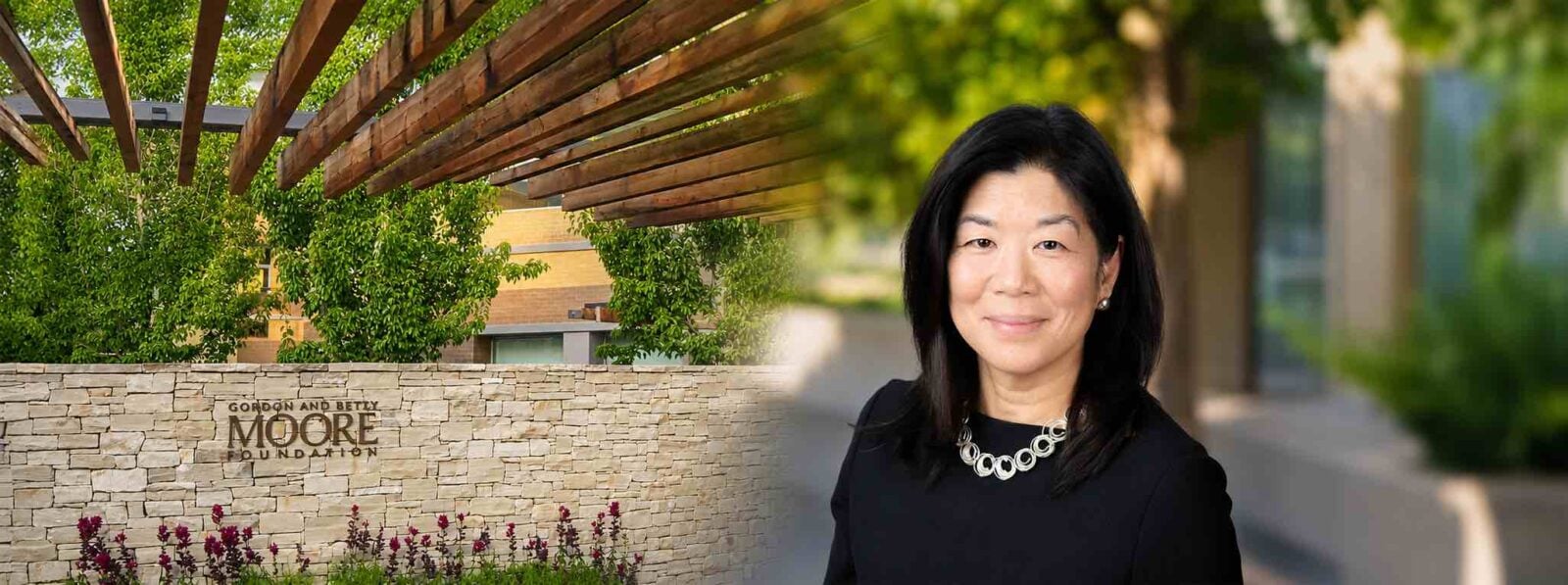
The transition from founder-driven philanthropy to institutionally led giving has been managed from the inside. In December 2025, the foundation’s board named Aileen S. Lee—then chief of programs and a two‑decade veteran of the organization—as its next president, effective January 1, 2026, succeeding Harvey V. Fineberg.
As chief of programs, Lee was already responsible for overseeing more than $500 million in annual outcomes-driven grantmaking across scientific discovery, environmental conservation, and the Bay Area portfolio, consolidating grantmaking leadership under a single executive since 2022.
Her elevation to president was framed explicitly as continuity: trustees highlighted her role in shaping existing initiatives and reaffirmed the foundation’s commitment to “tackling large, important issues at scale” rather than signaling a pivot into new thematic territory.
At the same time, Lee’s own public profile hints at how founder intent is being adapted to a more climate-constrained era. In interviews and on partner platforms, she has emphasized that conservation gains in places like the Amazon remain “fragile,” arguing that philanthropic capital must be paired with public policy and private finance for them to endure.
Her leadership on landscape-scale collaborations and climate-linked funds—efforts that connect protected areas with national “nature and climate” packages and emerging carbon markets—shows how the Moore Foundation’s conservation work is evolving from discrete projects to systems designed to secure biodiversity and carbon over generations.
For grantees, that means seeing the foundation not just as a source of large grants, but as a convenor and technical partner that can help knit together the science, economics, and governance required to keep ecosystems intact.
Internally, the grantmaking architecture around her has grown more sophisticated but remains firmly rooted in the Moores’ priorities.
Guidance for the current grant cycle describes a portfolio that still revolves around three pillars: environmental conservation (with a focus on oceans, forests, and biodiversity), science and discovery (including emerging phenomena and cutting‑edge instrumentation), and patient care and safety.
Grants typically range from the mid‑six figures to the multimillion‑dollar level, often running two to five years with the possibility of renewal, and are awarded through a mix of invited proposals and strategic partnerships rather than open calls.
The foundation’s Bay Area work, a quieter but telling piece of the picture, supports regional science institutions, community organizations, and projects that preserve the “special character” of the region that nurtured both Intel and the Moores themselves.
From the outside, what distinguishes the Gordon and Betty Moore Foundation under Lee is not a radical change of direction but a sharpening of the tools used to pursue a familiar mission. Board statements about her appointment emphasize values such as humility, collaboration, and measurable impact—language that could have come straight from Gordon Moore’s engineering ethos.
Yet the context in which those values now operate is decidedly 21st century: climate tipping points, global health system strain, and rapid advances in data-driven science all demand a kind of philanthropy that is both technically literate and comfortable operating through complex, multi-stakeholder coalitions.
In positioning Lee, a conservation and climate specialist with deep internal experience, as president, the trustees effectively signaled that the best way to honor the founders’ intent is not to freeze their agenda in time but to give capable stewards the mandate to reinterpret it for the challenges ahead.
The result is a form of giving that still bears the unmistakable imprint of Gordon and Betty Moore—but that is no longer dependent on their direct involvement to function.
Their early personal gifts, such as the transformative commitments to Caltech, UCSF, and Lucile Packard Children’s Hospital Stanford, established a pattern of philanthropy that is ambitious in scale and unafraid of complex, technical problems.
Today, that pattern is reproduced through the machinery of a large, professionally run foundation that can commit hundreds of millions of dollars to multiyear initiatives, backed by scientific advisory committees and robust evaluation practices.
As Aileen S. Lee and her colleagues look out over the next decade, the story of the Moore family’s philanthropy is no longer just about how two individuals chose to give—it is about how an institution can keep that choice alive, adapting it to a world their founders helped shape but could never fully foresee.