
$35 million AI and data center opens at university through King and Sherman Fairchild family gifts
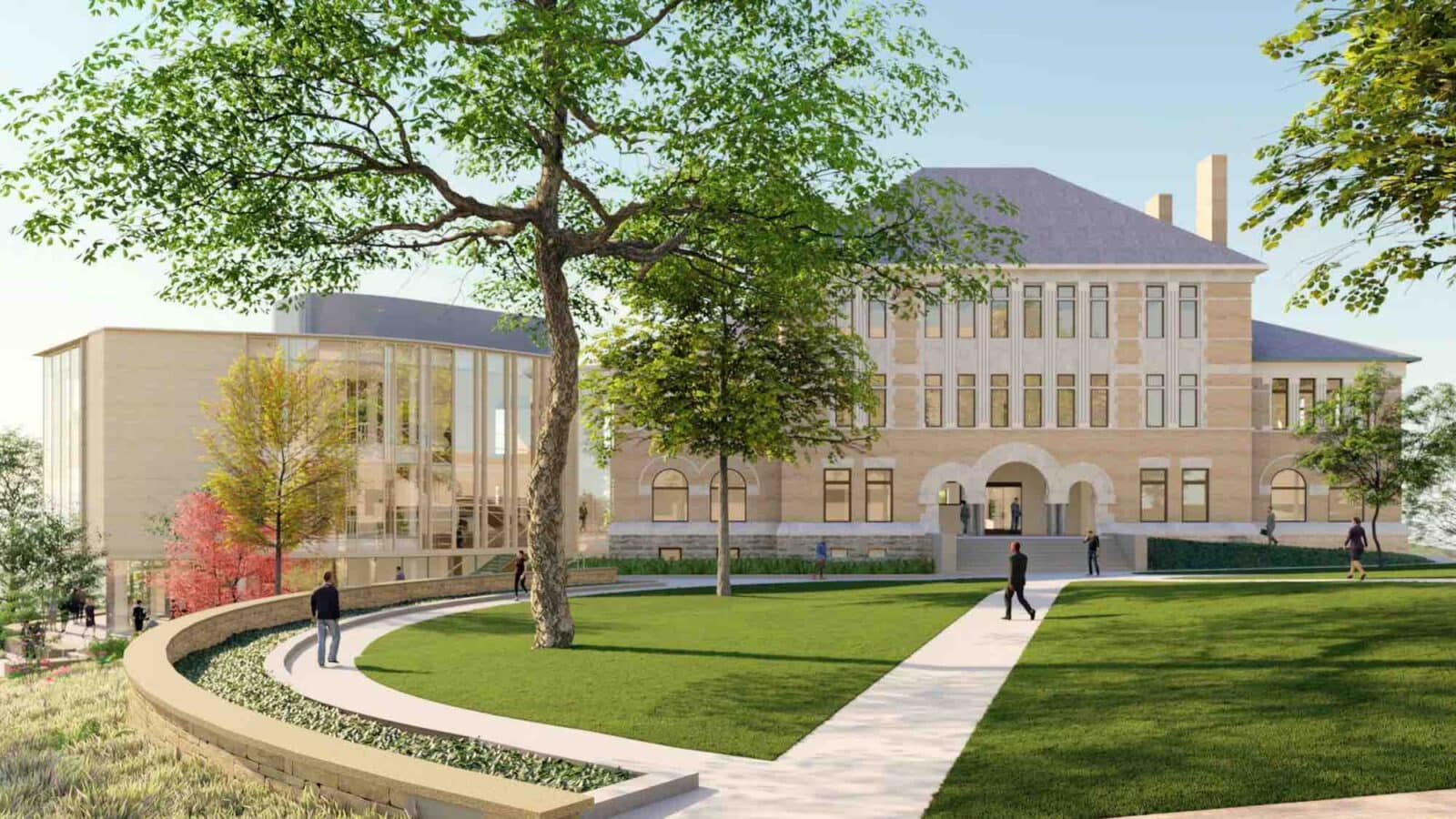
Denison University prepares to open the doors to a $35 million facility that represents one of the most significant transformations in the Ohio liberal arts college’s history, driven almost entirely by individual and family philanthropy that reflects both longtime institutional relationships and a shared vision for the role of artificial intelligence and data science in undergraduate education.
The reimagined Dale and Tina Knobel Hall and the Emily Hauser King and Robert E. King Center for Data & Innovation emerge from more than $30.5 million in commitments by alumni, foundations, and friends, with the project remaining entirely donor-funded, free of institutional debt.
At the heart of this philanthropic effort stands Emily Hauser King, a member of Denison’s Class of 1963, and her husband Robert E. King, whose lead naming gift established the King Center for Data & Innovation, the square-foot addition that will serve as the campus-wide hub for integrating data across the liberal arts curriculum.
Robert King, founder of Collegis Education, brings to this commitment a career-long dedication to educational innovation and technology integration in higher education, making the couple’s investment in Denison’s data science future a natural extension of their philanthropic priorities.
The Sherman Fairchild Foundation, established by inventor and aviation executive Sherman Mills Fairchild, provided a second major naming gift that honors President Emeritus Dale Knobel, who led Denison from 1998 to 2013, and his wife, Tina. While the foundation is not an individual donor, it operates through a small board that includes two figures with deep Denison connections: Dale Knobel himself serves as chairman of the foundation’s board, and Walter F. Burke III, a 1971 Denison graduate and life trustee of the university, serves as chief investment officer.
The foundation, which maintains assets of approximately $676 million and distributed $47 million across 73 grants, operates on an invitation-only model and does not accept unsolicited applications, preferring instead to identify institutions through trustee discretion and high-level networking.
This approach makes the Denison commitment particularly significant, as it reflects the foundation’s confidence in the university’s vision and the personal advocacy of board members with firsthand knowledge of the institution’s trajectory.
The project transforms the historic Doane Hall, originally designed as the college’s science building, through a comprehensive renovation of the existing structure paired with the new King Center addition. The facility will house computer science and data analytics departments while serving faculty and students across applied mathematics, digital humanities, financial economics, and political research with specialized spaces including robotics fabrication workshops, AI testing environments, virtual reality labs, and technology-rich classrooms designed specifically for coding and programming instruction.
The university describes the center as the first liberal arts college hub devoted entirely to integrating data across the curriculum, positioning Denison at the forefront of a national conversation about how undergraduate institutions should prepare students for an increasingly data-driven economy.
Beyond the two named lead gifts, Denison has assembled a broader coalition of donors whose identities remain largely undisclosed, consistent with many institutions’ practices of announcing only the most visible naming opportunities while preserving privacy for other major contributors.
The more than $30.5 million raised represents contributions from multiple alumni classes, foundation partners, and individual friends of the college, though the university has not released a complete donor roster or gift table showing the distribution of commitments across giving levels.
This fundraising success follows a pattern of strong philanthropic support at Denison, demonstrating the institution’s advancement team’s ability to leverage both geographic proximity to alumni in major metropolitan centers and the compelling nature of the AI and data science initiative to build momentum, particularly among donors who graduated during eras when the college’s science programs underwent previous transformations.
The timing of this philanthropic campaign coincides with Denison’s broader institutional commitment to integrating artificial intelligence, including the creation of student and staff certification programs in AI and the launch of classes through Denison Edge, the university’s Columbus-based campus.
Students have earned AI credentials, and their training is already opening doors with employers, demonstrating the practical impact that motivated many donors to support the physical infrastructure now nearing completion.
The university recently announced the Tomorrow Tech Institute, a summer camp for high school students focused on AI and data skills, further extending the reach of programs that will operate from the new facility.
Emily Marshall, Class of 2010, has been appointed as the inaugural director of the King Center, bringing the project full circle as an alumna leads an initiative made possible by alumni generosity.
The Sherman Fairchild Foundation’s participation in this effort aligns with its established pattern of supporting elite private colleges and large public universities across the United States, with recent grants including $10 million to Dartmouth College and $5 million each to the University of North Carolina at Chapel Hill and Connecticut College.
The foundation’s typical higher-education grants remain above $1 million, placing the Denison commitment in the upper tier of its grantmaking portfolio.
For Denison, securing a foundation grant of this magnitude required the kind of high-level networking and institutional relationships that the Burke and Knobel board connections provided, as the foundation’s invitation-only model makes it effectively inaccessible to most institutions without such direct advocacy.
The Kings’ decision to make their lead gift reflects a philanthropic philosophy shared by many donors to this project: the belief that liberal arts colleges must actively engage with technological transformation rather than retreating from it, and that integrating data science across traditional humanities and social science disciplines represents the future of undergraduate education.
Their gift naming the King Center for Data & Innovation ensures that this vision remains central to how the facility operates, with the “innovation” designation signaling an expectation that faculty and students will push beyond conventional applications of data analysis into creative interdisciplinary work.
The choice to renovate and expand a historic building rather than construct an entirely new facility also appealed to donors who value preserving campus architectural heritage while modernizing its functions to meet contemporary academic needs.
As construction nears completion and the university prepares for the opening, the philanthropic achievement of this $35 million project positions Denison in a competitive landscape where peer institutions increasingly compete for students based on their technology infrastructure and AI preparedness.
The entirely donor-funded model, while more challenging than debt-financed construction, gives the university flexibility in allocating operating resources and demonstrates to prospective students and faculty that Denison’s alumni and supporters actively invest in the institution’s future rather than expecting it to be financed through tuition increases or endowment draws.
For the individual and family donors whose commitments made this transformation possible, the opening will mark the realization of a vision that began with conversations about how Denison could lead rather than follow in integrating artificial intelligence and data science into liberal arts education.