
$25 million gift to school from Nvidia executive Debora Shoquist will launch a new artificial intelligence hub explicitly framed around human dignity, ethics, and the common good
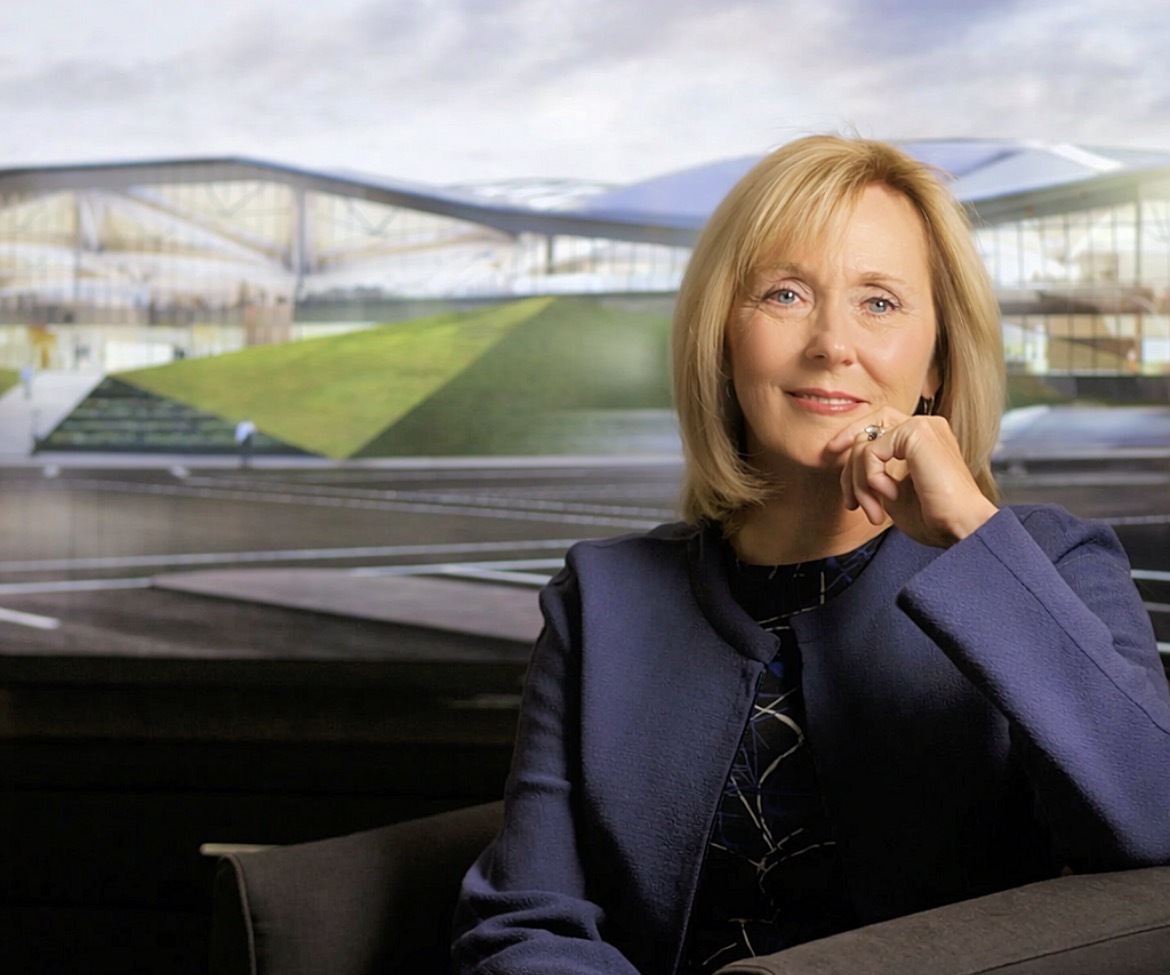
Santa Clara University has secured one of the largest gifts in its 175-year history: a $25 million commitment from Nvidia executive Debora Shoquist that will launch a new artificial intelligence hub explicitly centered on human dignity, ethics, and the common good.
The Cunningham Shoquist Center for Applied AI and Human Potential will be the Jesuit university’s fourth Center of Distinction and instantly positions Santa Clara at the front edge of the race to define what “responsible AI” looks like from within Silicon Valley itself.
For Shoquist, Nvidia’s executive vice president of operations and a 1976 Santa Clara alumna, the gift is both a statement of confidence in her alma mater’s values and a personal act of gratitude that foregrounds the often-unseen scaffolding behind a high-powered tech career. In naming the Cunningham Shoquist Center, she deliberately placed her sister G. Lee Cunningham’s name alongside her own, crediting Cunningham—who earned a master’s degree from Santa Clara in 1973—with playing a formative, supportive role across her life and professional ascent.
That decision to twin the family names on a cutting-edge AI institute signals the donor’s insistence that technical prowess and personal relationships, experimental code and human care, belong in the same conversation.
Shoquist arrives at this moment from a vantage point few in the industry can match. As Nvidia’s operations chief, she is responsible for the company’s global manufacturing, supply chain and quality systems, a remit that spans product and test engineering, foundry operations, supplier and contract manufacturer relationships, supply planning, logistics, facilities, and IT.
She has overseen the construction of Nvidia’s 1.25‑million‑square‑foot headquarters in Santa Clara, a project that crystallized her reputation as a leader who can knit together capital projects, advanced engineering, and long-range workforce needs at a massive scale. Industry profiles now place her among the most influential supply chain executives in the United States, a recognition that reflects how central Nvidia’s hardware and platforms have become to the AI economy her new philanthropic investment aims to shape.
Her connection to Santa Clara is both longstanding and newly formalized. Shoquist earned her undergraduate degree there in 1976 and, after decades in industry, returned to the university’s inner circle when she was elected to the Board of Trustees in 2023.
Trustees and administrators describe her as a bridge figure between campus and the valley’s most powerful engineering corridors, someone who can translate between Jesuit humanism and hyperscale GPU production cycles. When Santa Clara president Julie Sullivan and School of Engineering dean Kendra Sharp began asking how the institution might lead on AI rather than merely respond to it, Shoquist quickly emerged as both thought partner and primary underwriter.
The gift lands at a moment when Nvidia’s technology sits at the core of the generative AI boom and the ethical, regulatory, and labor questions surrounding it. NVIDIA and its leaders have already experimented with large university partnerships—in 2020, the company and co-founder Chris Malachowsky announced a $50 million package of funds, technology, and services to the University of Florida to build what it called the world’s fastest AI supercomputer in higher education.
Shoquist’s Santa Clara donation differs in emphasis: rather than centering raw computational power, it is explicitly framed around “applied AI and human potential,” steering resources toward how AI interacts with healthcare, information access, robotics, human-computer interaction, infrastructure, and “computational creativity,” all under a Jesuit lens.
At Santa Clara, the new center will not be an isolated institute on the campus margins but an interdisciplinary hub embedded in the Sobrato Campus for Discovery and Innovation and formally housed within the School of Engineering. It will join the Miller Center for Global Social Impact, the Ignatian Center for Jesuit Education, and the Markkula Center for Applied Ethics as one of the university’s Centers of Distinction, a designation reserved for entities expected to shape academic life and external partnerships well beyond a single department or grant cycle.
Administrators say the center will seed faculty research grants, student fellowships, hackathons, and industry collaborations and is already planning to recruit an executive director with deep industry experience to build out an advisory board and faculty cluster hires.
Shoquist’s own language about the project has been less about prestige and more about positioning Santa Clara as a “values-first” interlocutor in AI debates that are rapidly spilling out of engineering schools into law, business, theology, and the arts.
On the center’s website, she is quoted emphasizing her belief that Santa Clara will “always lead with its values,” using an “ethical and humanistic lens” as it taps AI’s capacity to “unlock human potential across thousands of applications.”
That phrasing mirrors Santa Clara’s own messaging: the university describes the new hub as rooted in its Jesuit, humanistic mission and grounded in a foundational belief that the most powerful AI applications are those that “advance human dignity, deepen human connection, and drive the common good.”
This philanthropic move also has familial and gendered dimensions that resonate within an industry still wrestling with representation. By explicitly honoring G. Lee Cunningham in the center’s name, Shoquist surfaces the often invisible academic, emotional, and financial labor that undergirds elite STEM careers.
Cunningham, who completed her M.A. at Santa Clara in 1973, is cast in the university’s release as a “supportive” force whose influence Shoquist wanted permanently inscribed in the institution’s architecture.
In a sector where high-profile AI gifts frequently bear the names of male founders or billionaire donors, the Cunningham Shoquist Center stands out as a rare instance of a major AI institution branded with two sisters’ surnames, tethered to a narrative of mutual support and shared educational roots rather than lone-genius mythology.
Inside Santa Clara, the gift is already being treated as a strategic accelerant for the university’s “Impact 2030” plan, which calls for deeper engagement with Silicon Valley coupled with a recommitment to Jesuit social-justice traditions.
Sullivan has framed the donation as both validation and responsibility, arguing that it “confirms Santa Clara’s unwavering commitment” to asking not only “What can we do” with AI, but “what we should do” as it spreads into every sector.
For faculty and students, that translates into a concrete opportunity: a dedicated, well-funded structure where computer scientists, ethicists, theologians, lawyers, business scholars, and counselors will be expected to sit at the same table to design, audit, and reimagine AI systems that work “for—and in—the real world” of rapidly evolving technology and imperfect institutions.
Beyond campus, Shoquist’s $25 million gift subtly reframes how Nvidia’s leadership engages with the public square around AI. Santa Clara did not disclose the exact amount, but local reporting pegs it at just under $25 million, placing it among the largest donations in the university’s history and in the upper tier of single-donor AI-related higher-education gifts.
In contrast to more transactional corporate philanthropy, the structure here is firmly tied to Santa Clara’s nonprofit ecosystem: the center is built to outlast any single product cycle, driving curricular reform, faculty hiring, and student formation over decades rather than funding a short-lived lab.
If Nvidia’s rise has become shorthand for the explosive demand for AI infrastructure, Shoquist’s Santa Clara investment suggests that at least one of its most powerful insiders is now betting just as heavily on the social, ethical, and human infrastructure around AI.
From the Sobrato Campus, the Cunningham Shoquist Center is set to convene faculty researchers, industry partners, and students around a shared question: not simply how to push AI further, but how to ensure that the next generation of engineers, lawyers, and founders learn to see human potential—not compute—as the metric that ultimately matters.