
$100 million gift from philanthropists Maurice and Carolyn Cunniffe sparks a new era of STEM at university
In a Bronx neighborhood, at Fordham University’s Rose Hill campus, something quietly ambitious is taking shape.
Not just a new academic program.
Not just a new building.
But a shift in how young scientists are formed.
Beginning in the 2026–27 academic year, Fordham will welcome just 15 students into its new STEM Honors Program—a small, carefully chosen group of undergraduates who don’t want to wait until graduate school to feel like real scientists.
They want to begin now.
The program is designed less like a traditional honors track and more like an apprenticeship in discovery.
Students in biology, chemistry, physics, and computer science will move immediately into advanced, research-driven coursework.
They will design experiments, wrestle with data, and learn to think across disciplines.
Instead of memorizing what is already known, they will be encouraged to explore what isn’t.
Leading the effort is Joshua Schrier, professor of chemistry and biochemistry and the program’s inaugural director.
He envisions a selective but deeply collaborative environment—one that looks beyond transcripts.
Admissions will prioritize students who have already shown initiative: those who started coding clubs, led robotics teams, competed in science fairs, or launched community projects.
The aim is to build a cohort of builders and problem-solvers whose energy will ripple outward across campus.
This leap into advanced STEM education is powered by something deeply personal: alumni gratitude.
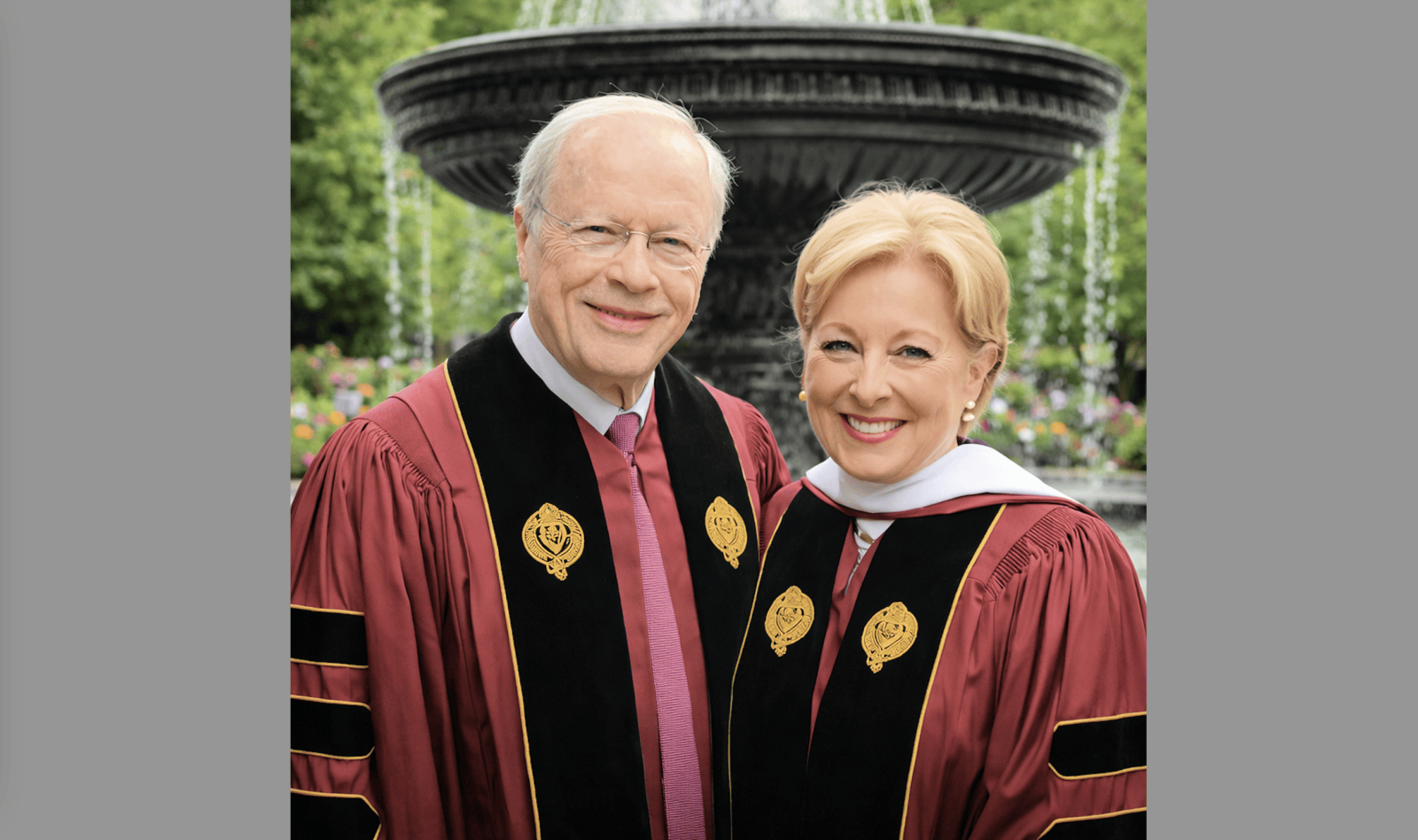
Maurice “Mo” Cunniffe and Carolyn Dursi Cunniffe made a $100 million gift to Fordham—the largest in the university’s history.
Their contribution is helping fund a 200,000-square-foot integrated science facility and expand STEM offerings, providing the physical and academic foundation that makes programs like the honors track possible.
Mo’s journey began humbly as the son of Irish immigrants.
A 1954 graduate of Fordham Prep and Fordham College at Rose Hill with a degree in physics, he began his career as a scientist before moving into consulting at McKinsey, investment banking, and corporate leadership.
Over the years, he served on Fordham’s Board of Trustees, becoming trustee emeritus, and was honored with the university’s Founder’s Award. His philanthropy reflects a lifelong loyalty to the institution that shaped him.
Carolyn’s path was equally distinguished. After studying at the Sorbonne and the University of Perugia, she earned her bachelor’s, master’s, and Ph.D. in French literature from Fordham.
She built a career in the beauty and media industries, rising to vice president at Revlon, helping launch major fragrance brands, and later serving as senior vice president at Cablevision. Like her husband, she served as a trustee and remains closely tied to the university’s mission.
Their giving has been steady and cumulative. In 2016, they donated $20 million to launch the Presidential Scholars Program, supporting standout undergraduates with scholarships and research opportunities. Earlier gifts brought their total impact to roughly $35 million before their record-setting pledge.
Today, Cunniffe House and the Carolyn Dursi Cunniffe Fountain stand on campus as visible reminders of their commitment, but the deeper legacy lies in the students whose ambitions have been expanded because someone believed in them.
Another alumnus, Peter Zangari, Fordham College class of 1989, and his wife, Jennifer, have added a complementary layer to the university’s STEM momentum with a $1 million gift establishing the Zangari Family Faculty Research and Innovation Fund.
Zangari built a career in global finance, holding senior roles at JPMorgan and Goldman Sachs and serving as global head of research at MSCI. Now teaching AI in financial markets at Fordham and serving on the President’s Council, he sees artificial intelligence as transformative — not just for Wall Street, but for how students research, learn, and prepare for careers.
His gift supports interdisciplinary AI work in finance, economics, and data science, helping faculty and students apply emerging tools to real-world challenges.
Together, these gifts create an ecosystem. One builds the laboratories and classrooms. The other fuels cutting-edge inquiry in a rapidly evolving field.
While the STEM Honors Program has its own dedicated funding, the broader philanthropic surge makes paid research positions possible, especially for underclassmen who might otherwise need outside jobs.
It gives talented students the chance to immerse themselves fully in science—to double down on curiosity.
The program will still reflect Fordham’s Jesuit identity.
Students will move through humanities, philosophy, and theology alongside their technical training. They will study research ethics and learn to communicate complex ideas clearly.
The experience will culminate in a capstone project, often tied to laboratory work or external partnerships. Pre-med ambitions are welcome, but so is a broader passion for innovation.
Fordham’s location in the Bronx also expands the laboratory beyond campus borders. Through partnerships like the Bronx Science Consortium, students can connect with institutions such as the Bronx Zoo, the New York Botanical Garden, and the Albert Einstein College of Medicine.
These relationships allow students to experience science not as an abstraction, but as something rooted in community and real-world impact.
In a national landscape where STEM competition is fierce, Fordham is positioning itself differently—blending technical rigor with ethical formation. The university is betting that the next generation of scientists will need both.
At its heart, this story is not simply about laboratories or lecture halls. It is about alumni who remember where they started and choose to build ladders for those who follow. It is about students eager to step into discovery earlier than ever before. And it is about an institution aligning gratitude, vision, and opportunity in a way that may shape scientists—and citizens—for decades to come.