
$25 million gift and a lifetime of service: Gilbert S. Omenn honored with 2026 AAAS Abelson Prize for science, policy, and philanthropy
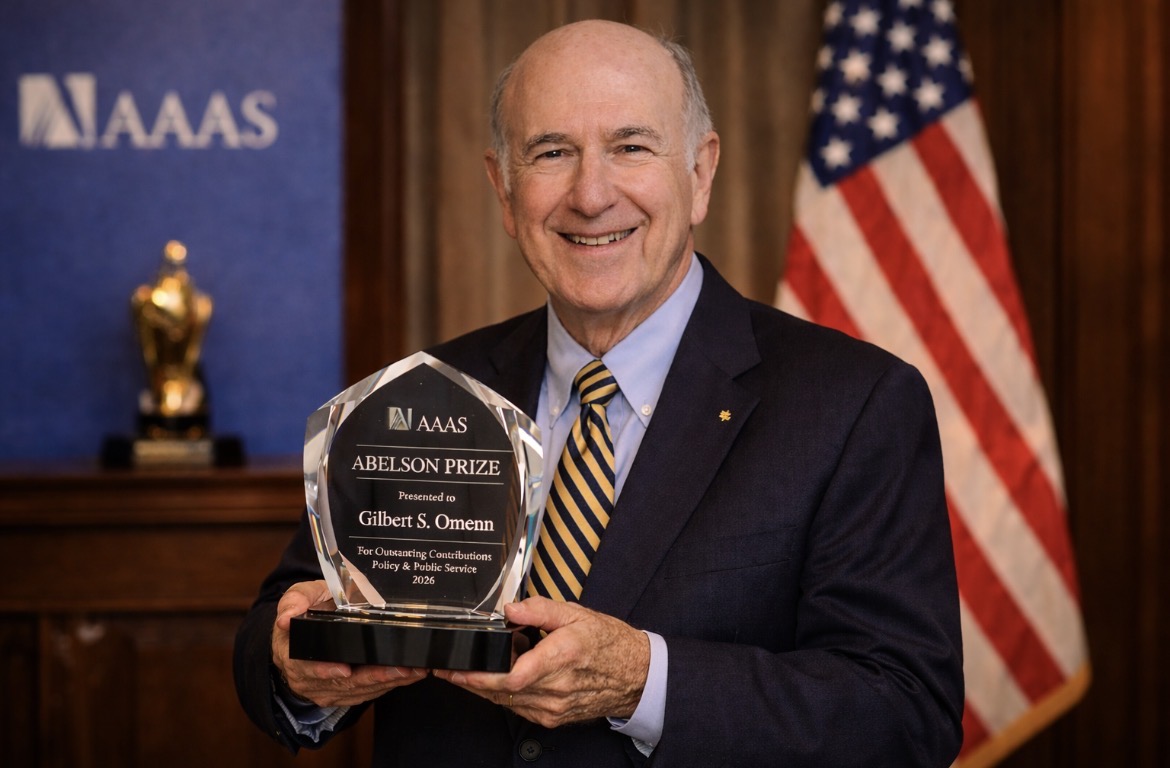
Gilbert S. Omenn’s selection as the 2026 recipient of the AAAS Philip Hauge Abelson Prize caps a five‑decade career in which scientific leadership, institution‑building and purpose‑driven philanthropy have been tightly intertwined.
The prize honors individuals whose cumulative work has significantly advanced science in the United States through research, policy or public service, and Omenn’s record spans all three dimensions, from the lab bench to the White House to major gifts that are reshaping academic medicine and public health.
As a young physician‑scientist, Omenn first came to prominence when he identified a rare and often fatal immunodeficiency disorder that now bears his name, Omenn syndrome.
That early discovery presaged a career spent at the intersection of genetics, molecular biology and cancer prevention, including leadership in the Human Proteome Project, a global effort to map the full set of human proteins in order to better understand disease mechanisms and identify new targets for therapy.
His research trajectory has consistently gravitated toward questions with direct implications for population health, prevention and risk reduction, rather than narrow technical puzzles.
Over time, his influence expanded far beyond research. In Washington, Omenn served as associate director of the White House Office of Science and Technology Policy, helping to connect emerging scientific evidence to federal decision‑making.
He later chaired the Presidential/Congressional Commission that now bears his name, the Omenn Commission, which pressed for more transparent, rational and science‑based regulatory approaches in environmental health, insisting that risk assessments and environmental rules be grounded in the best available evidence. This blend of scientific expertise and policy engagement exemplifies the Abelson ideal of using science to improve public life, not just to advance a discipline.
At the University of Michigan, Omenn’s leadership roles gave him another platform to shape the direction of academic medicine. He served as executive vice president for medical affairs and chief executive officer of the University of Michigan Health System from 1997 to 2002, guiding a complex academic health center through a challenging era of health‑care change.
He also held faculty appointments in internal medicine, human genetics, computational medicine and bioinformatics, and environmental health sciences, reflecting the cross‑disciplinary approach that would later define much of his philanthropy. Colleagues describe him as a mentor and educator as well as a strategist, someone as focused on training the next generation as on the immediate metrics of institutional performance.
In recent years, Omenn and his wife, Martha A. Darling, have increasingly turned their attention and resources to philanthropy that directly reinforces those long‑standing commitments.
Recently, the couple made a landmark $25 million gift to the University of Michigan Medical School’s Department of Computational Medicine and Bioinformatics, the largest in that department’s history and one of the largest basic science gifts at the institution.
In recognition, the department was renamed the Gilbert S. Omenn Department of Computational Medicine and Bioinformatics, the first named basic science department at Michigan and a signal statement about where they believe the future of medicine is headed.
The structure of the gift reveals Omenn’s philosophy of giving. Rather than focusing on a single building or narrow disease program, the endowment is designed to strengthen the entire ecosystem needed to translate data‑rich science and artificial intelligence into better patient care.
Funds will support graduate student stipends, pilot grants for early‑stage ideas, endowed professorships, a named department chair and an interdisciplinary collaboration fund that knits together data scientists, basic researchers and clinicians working on AI‑driven diagnostics and treatments.
University leaders have described the investment as “transformational” for Michigan’s ability to lead in health‑care AI and bioinformatics, highlighting how the gift positions the institution to “redefine treatments and transform lives” while embedding ethical and societal considerations into the technology’s development.
That focus on infrastructure, people and cross‑disciplinary collaboration is a recurring theme across the couple’s philanthropy. At Michigan alone, Omenn and Darling have directed more than $27 million in support to programs spanning the Medical School, the Gerald R. Ford School of Public Policy, the University Musical Society and the Livingston Awards, which recognize early‑career journalists.
This pattern suggests a coherent theory of change: investing in science and health, but also in policy education, the arts and independent journalism, the institutions that shape how scientific knowledge is used, debated and communicated in a democratic society.
Their giving extends well beyond Ann Arbor. Omenn and Darling have made major contributions to Reed College, Harvard Medical School, the Weizmann Institute of Science in Israel, the Hastings Center, the Institute for Systems Biology in Seattle and Princeton University, among others.
At Princeton, their support established the Omenn‑Darling Bioengineering Institute, an interdisciplinary hub that backs grand‑challenge projects in areas such as health, sustainability and resilience, emphasizing team‑based approaches to scientific problems with large social stakes.
At the University of Washington School of Public Health—where Omenn previously served as dean—the couple’s 50th‑anniversary gift is catalyzing a significant upgrade of facilities for the Department of Environmental & Occupational Health Sciences, including modern laboratories designed to accelerate collaborative research on environmental and workplace risks.
Many of these institutions sit at the junction of science, ethics and policy. The Hastings Center, for example, is a prominent independent bioethics research institute, and the Institute for Systems Biology focuses on the kind of integrative, data‑driven science that pairs naturally with Omenn’s own work in proteomics and computational medicine.
By backing organizations like these, Omenn and Darling are betting on the long arc of responsible innovation—supporting not just the generation of new knowledge, but also the frameworks that govern how that knowledge is used.
Their support for journalism fits this same pattern. Through gifts to the Livingston Awards, housed at the University of Michigan, they are helping to sustain one of the country’s most prestigious honors for young journalists at a time when the news industry is under severe financial pressure.
The awards encourage ambitious reporting on topics that often intersect with Omenn’s own domains—public policy, health, science and global affairs—reinforcing his belief that a well‑informed public and a robust press are essential complements to scientific progress.
Seen in light of his receipt of the AAAS Philip Hauge Abelson Prize, Omenn’s philanthropy reads less like a postscript to a distinguished career and more like a continuation of it by other means.
The Abelson Prize commemorates a scientist‑leader who used his platform to argue against paralyzing pessimism and for a responsible, optimistic engagement with the future, and Omenn has often cited Philip Abelson’s insistence that pessimism “leads nowhere but to paralysis and decay.”
His own major gifts, from AI‑enabled health care and systems biology to environmental health, bioethics and journalism, reflect a similar conviction that the best response to complex global challenges is not retreat, but building—institutions, talent pipelines and collaborative networks capable of steering scientific advances toward broad public benefit.
As Omenn accepts the 2026 Abelson Prize, he does so not only as a researcher and policy advisor, but also as a donor whose checkbook has become another tool for shaping the trajectory of science and public health.
His career suggests that, in the right hands, philanthropy can be an extension of scientific leadership, aimed at ensuring that discoveries do not remain isolated in journals and databases, but are translated into healthier people, stronger institutions and a more informed civic conversation.