
$50 million new gift from Neil G. Bluhm to cardiovascular institute lifts his local healthcare giving beyond $135 million
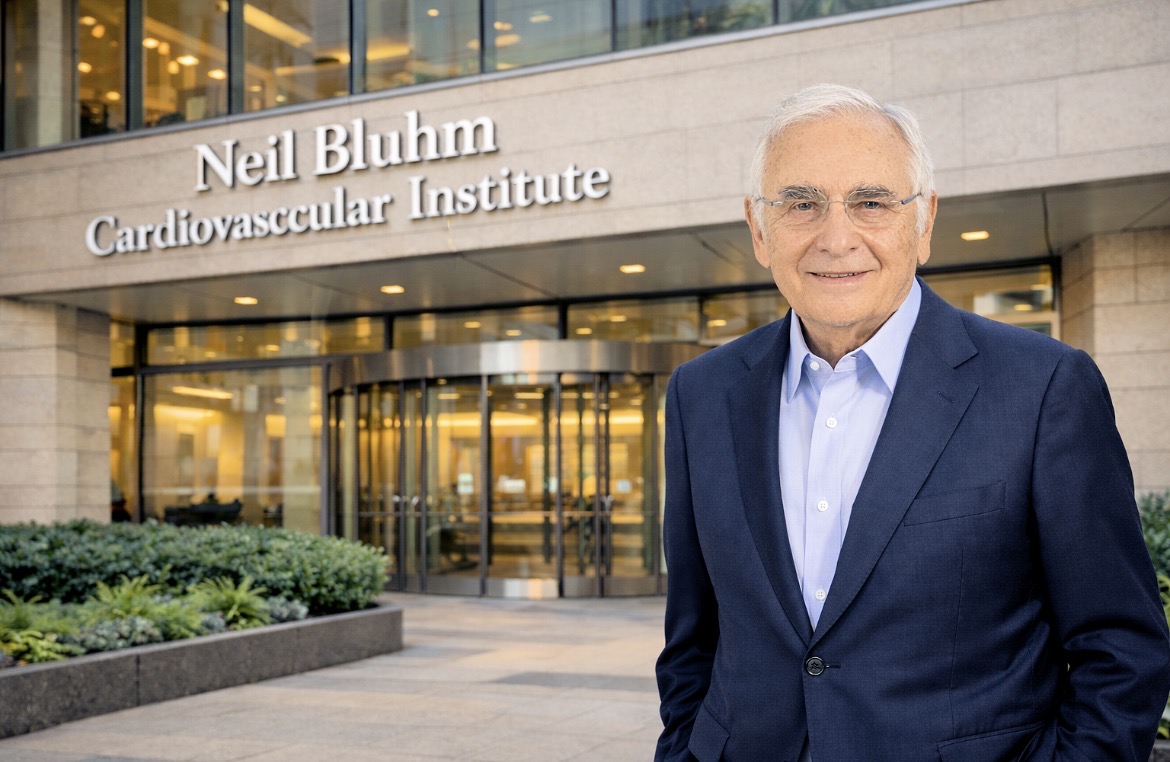
Chicago philanthropist Neil G. Bluhm is putting an emphatic new marker on a two-decade philanthropic bet that world-class heart care should be available to every patient who needs it, committing an additional $50 million to Northwestern Medicine’s Bluhm Cardiovascular Institute (BCVI) and bringing his total giving to the program to $135 million.
The latest gift, just announced, deepens a relationship that began in 2005 with an initial donation that helped recruit pioneering heart surgeon Patrick M. McCarthy, MD, to Northwestern and launch what has since become one of the country’s premier cardiovascular programs.
For Bluhm, the move is both intensely personal and pointedly strategic. A Chicago native and longtime patient of McCarthy, he has often described his philanthropy in heart care as a way of scaling the quality of treatment that saved his own life to benefit as many others as possible.
“My main goal has always been to ensure that anyone who needs world-class heart care can get it,” he said in connection with the new commitment, framing the $50 million not as a capstone but as fuel for the “next era” of cardiovascular innovation at Northwestern Medicine.
Over 20 years, his giving has become inseparable from the rise of BCVI itself, which now treats tens of thousands of patients annually and attracts some of the most complex cases from around the globe.
Bluhm’s philanthropic history extends beyond medicine, encompassing education, the arts and culture, and Jewish causes, largely through the Bluhm Family Charitable Foundation. However, his support for Northwestern Medicine stands out for its scale and long-term impact.
Through the foundation, he and his children have backed institutions such as Northwestern University’s law school—home to the Bluhm Legal Clinic—Northwestern’s music and medical schools, the Whitney Museum of American Art, and a range of Chicago-area and national Jewish organizations, from the Illinois Holocaust Museum & Education Center to the American Jewish Committee and the United States Holocaust Memorial Museum.
Yet it is in cardiovascular care that his philanthropy has taken on a systems-building character, steadily layering gifts to expand facilities, recruit talent, and push the boundaries of what an academic medical center can offer in heart and vascular medicine.
The story of BCVI itself is now tightly braided with that philanthropic arc. Bluhm’s first major gift to Northwestern’s heart program in 2005 enabled Northwestern Medicine to recruit McCarthy—then a leading surgeon at Cleveland Clinic—and formally establish the Bluhm Cardiovascular Institute with a mandate to build a world-class program accessible across Chicago.
From treating roughly 1,000 patients in its first year, the institute has grown to care for more than 48,000 patients in 2025, now operating across 18 locations in the greater Chicago area and employing about 2,400 clinicians.
A team of more than 186 specialized cardiologists and cardiac and vascular surgeons tackles some of the toughest cases, often those turned away by other centers, reflecting a clinical culture explicitly shaped by the resources and expectations that came with Bluhm’s early and sustained backing.
Over time, Bluhm’s giving has shifted from funding capital to targeted growth philanthropy.
In 2022, a $45 million gift from the Bluhm Family Charitable Foundation created the Northwestern Medicine Bluhm Heart Hospital at Northwestern Memorial Hospital, significantly expanding cardiac capacity on the downtown campus.
That gift is modernizing cardiovascular services, expanding the heart hospital to 140 beds, and supporting community partnerships focused on outreach, education, and addressing social determinants of health in under-resourced Chicago neighborhoods—an explicit effort to align top-tier specialty care with health equity goals.
In public remarks at the time, Bluhm cast the effort as a commitment not only to Northwestern Medicine but to the city itself, arguing that advanced cardiovascular care and targeted community engagement should move in lockstep.
The new $50 million commitment builds on those earlier investments, signaling BCVI’s evolution from a single flagship institute into a networked engine of cardiovascular innovation.
Northwestern Medicine leaders say the funding will support a slate of initiatives: expanding access to heart care across the system’s nine-hospital network through new technologies and therapies; increasing the footprint and procedural capacity of Bluhm Heart Hospital; underwriting new research and clinical trials; seeding breakthrough innovations in cardiovascular medicine; supporting fellowships to train the next generation of specialists; and recruiting additional world-class physician leaders.
In practice, that means more catheterization labs and operating suites, more bandwidth to adopt leading-edge devices and techniques, and a pipeline of trainees and senior recruits positioned to keep the program on the cutting edge of cardiology and cardiac surgery.
Institutional leaders are blunt in crediting Bluhm’s philanthropy with accelerating BCVI’s rise. Howard Chrisman, MD, president and chief executive officer of Northwestern Memorial HealthCare, said the Bluhm family’s support has “continuously fueled” the system’s commitment to saving lives and keeping patients at the center of its strategy, arguing that the latest gift will help ensure BCVI remains a “beacon of hope” for heart patients worldwide for generations.
McCarthy, now executive director of BCVI, framed the $50 million in the context of the institute’s 20th anniversary, suggesting that it both honors the first two decades of work and “shapes the next 20 years of cardiovascular care,” reinforcing Northwestern Medicine’s position at the forefront of the field.
Such comments underscore that the donor’s long-term involvement is integral to the institute’s identity, not a series of isolated transactions.
By standard measures, the results of that partnership are striking. BCVI has been ranked among the top 10 cardiology, heart, and vascular programs in the nation by U.S. News & World Report for the past decade, and Newsweek has listed Northwestern among the top 20 hospitals worldwide for cardiac surgery.
The institute reports 900 percent growth in cardiac surgery volume since 2005, 96 percent patient satisfaction, and outcomes that place it among the top 15 hospitals nationally for heart attack survival, metrics that speak to both clinical expertise and the supporting infrastructure.
Over the past three years alone, BCVI-affiliated clinicians and investigators have produced approximately 3,100 cardiac and vascular manuscripts and attracted approximately $100 million in National Institutes of Health funding, signaling that the philanthropic base has helped unlock substantial public and peer-reviewed research dollars.
The cultural impact of Bluhm’s giving at Northwestern extends beyond raw metrics.
With patients coming from all 50 states and at least 40 countries, BCVI has become a destination center whose reputation is amplified by the visibility of its benefactor, whose name now graces both the institute and the heart hospital.
In Chicago, philanthropy has also catalyzed collaboration: the Bluhm Heart Hospital gift supports partnerships with community organizations, including outreach in neighborhoods with higher rates of cardiovascular disease and limited access to specialty care.
For other would-be donors, particularly those interested in health equity, the structure of these gifts offers a template for combining high-end tertiary care investments with community-facing strategies.
Seen against the backdrop of his broader philanthropic portfolio, the $50 million gift confirms that cardiovascular medicine is a central throughline in Bluhm’s giving.
His foundation distributes more than $12 million annually across education, healthcare, arts, culture, and Jewish causes, and over time, he has emerged as one of Chicago’s most prominent civic benefactors, with his name attached to institutions ranging from Northwestern’s law school to the Art Institute of Chicago.
Yet the continuity and scale of his commitment to Northwestern Medicine—$135 million over roughly 20 years, multiple major capital and programmatic gifts, and personal involvement in strategy and talent recruitment—distinguish this relationship from his other, substantial philanthropic ties.
As heart disease remains the leading cause of death in the United States, BCVI’s leaders and the Bluhm family are positioning this newest infusion of capital as a way to keep the institute’s capabilities ahead of that curve, not merely reacting to the burden of disease but anticipating it with new technology, research, and training.
For Bluhm, whose own health journey pulled him into the world of advanced cardiac care two decades ago, the $50 million gift is the latest expression of a philosophy that pairs personal gratitude with institutional ambition: use private wealth to build platforms that can deliver public benefit at scale, and stay at the table long enough to see those platforms evolve.
At Northwestern Medicine, that philosophy has already reshaped the map of heart care across Chicago; with his latest commitment, the next chapter of that transformation is now funded and underway