
$70 million giving legacy: Richard O. Jacobson’s name set for university hospital
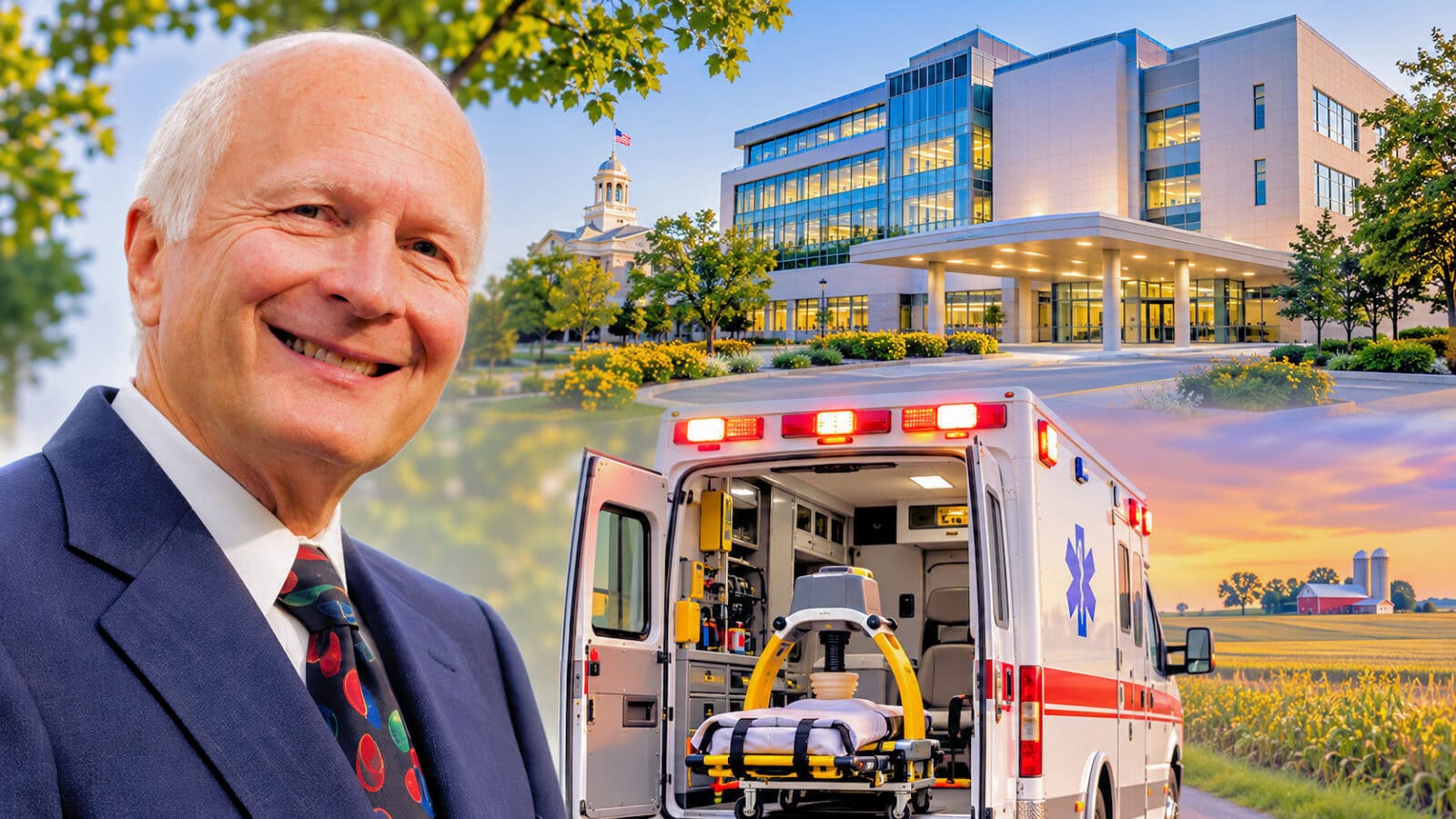
In Belmond, Iowa, a farm town of a few thousand people, the local ambulance service now carries a lifesaving machine in each of its three transfer ambulances.
The LUCAS device delivers steady, automatic chest compressions as a patient is moved from a farmhouse or small-town emergency room to more advanced care.
A $25,000 grant from the Richard O. Jacobson Fund for Belmond paid for all three this summer. For a rural crew facing long drives, it means a patient in cardiac arrest gets steady CPR for the whole ride.
The boy who grew up in Belmond would have liked that.
Richard O. Jacobson once explained the one test behind decades of giving: “I don’t ever fund anything that’s going to be good for a handful of people. Is it going to be good for hundreds or thousands? Yes, possible. If something could be for millions, that would really get my attention.”
For Iowa’s most complex cases, that chain of care leads to Iowa City.
Jacobson’s name may be placed on the hospital there.
At its November 11–12 meeting, the Iowa Board of Regents will consider a request from University of Iowa Health Care to move the naming recognition first approved for a planned patient care tower to the existing adult hospital on its university campus.
The honor recognizes the Richard O. Jacobson Foundation’s $70 million commitment to the University of Iowa.
It is the largest gift in the university’s 175-year history, made to expand care for Iowans who need the state’s most advanced medicine.
The tower was meant to be the hospital’s new front door, across from Kinnick Stadium.
But health care finances have shifted sharply, and expected changes in federal Medicaid funding have tightened hospital budgets across the country. UI Health Care has chosen a faster, more measured path. Instead of building one large tower, it will renovate, modernize, and expand its existing space.
The plan adds about 100 inpatient beds and will let an estimated 23,000 more patients get care closer to home, years sooner than the tower would have allowed.
Leaders called it a matter of stewardship: help the most Iowans, as soon as possible.
The hospital’s request says the change is meant “to appropriately honor Richard O. Jacobson’s generous contributions and philanthropic legacy.”
It keeps faith with his intent. His gift was never really about a building. It was about making sure a farmer, a child from Des Moines, or a grandmother in a river town could get world-class care without leaving the state. Now his name will go on the hospital where that care already happens.
His story began on the same streets the Belmond ambulances now drive.
Jacobson was born in Greeley, Colorado, in 1936, the only child of Orrin and Ruby Jacobson.
The family moved to Belmond when he was four.
He graduated from high school in a class of 35. As a boy during World War II, he collected old newspapers for recycling, and he paid for his business classes at the University of Iowa with money from part-time jobs, earning his degree in business administration in 1957.
Three years in the U.S. Army followed.
He then spent five years at Monsanto Chemical Company and briefly worked as an independent agricultural chemical wholesaler.
In 1968, he took $3,500 in savings and two employees and opened a warehouse in downtown Des Moines.
Over the following decades, the Jacobson Companies became one of the largest privately owned warehouse businesses in the country.
It grew to more than 9,000 employees and 194 locations and expanded into trucking, logistics, packaging, and staffing.
He later helped found Hawkeye Renewables, which grew into one of the nation’s largest ethanol producers.
Years later, while driving past the site of that first warehouse, he still turned to catch a glimpse of where it all began.
He started giving early.
In 1976, when he was 40 and his company was less than ten years old, he created the Richard O. Jacobson Foundation to support children, education, and medical research.
He explained his approach simply: “I don’t have a book that says go to page 19 for a certain type of gift, go to page 28 for another kind. It’s just my heart.”
That approach led to many record gifts.
His mother first took him to Mayo Clinic as a child, and he remained a patient there all his life.
“Mayo Clinic makes a profound impact on people,” he said when he gave $100 million to help start the clinic’s proton beam therapy program in Rochester and Phoenix.
It was the largest gift Mayo had ever received from a living donor.
The University of Northern Iowa received the largest gift in its history from him for its College of Education and literacy work.
He co-founded an I Have A Dream program that paired disadvantaged schoolchildren with mentors and promised fully funded college to those who graduated.
He supported Orchard Place, Youth and Shelter Services, Blank Children’s Hospital, Special Olympics Iowa, the Science Center of Iowa, the Des Moines Public Library, and his old elementary school in Belmond.
He loved the Iowa State Fair because it reached more people than the football games at all three of Iowa’s public universities combined.
The University of Iowa was always close to him.
A devoted Hawkeye fan, he joined a local I-Club in 1973. Today the Richard O. Jacobson Football Operations Building houses Iowa’s football program.
His support also helped build the Iowa Reading Research Center, the John Pappajohn Entrepreneurial Center, and a youth entrepreneurship institute at the Tippie College of Business. In 2000, the university gave him its Distinguished Alumni Award.
In total, his giving to the university during his lifetime and through his foundation exceeds $86 million.
Football coach Kirk Ferentz summed up his values this way: “Work hard, take pride in what you do, and understand the value of character.”
Jacobson had no children, and he often said his foundation was how he would take care of the people and places he loved.
Since his death, the foundation has done exactly that under chairman and CEO Bruce Rastetter, a longtime friend and business partner.
Rastetter has said Jacobson’s example taught him “that you ought to do that when you have success.”
The foundation has since created the Richard O. Jacobson Legacy Scholarship for Iowa students with financial need.
It made the largest individual gift in the Iowa State Fair Blue Ribbon Foundation’s history and endowed two Richard O. Jacobson Foundation Chairs in Pediatrics at the University of Iowa Stead Family Children’s Hospital.
It also made the historic $70 million commitment to UI Health Care, which then-President Barbara Wilson described as given “on his behalf.”
And it has kept coming back to Belmond, with $1 million for community improvements and now the equipment riding in the town’s ambulances.
Those who knew Jacobson say he had little interest in ceremony and rarely talked about what he had done.
Behind his famously blunt humor, friends saw a generous man with an “unshakable belief in the promise of humanity.”
He looked to the future with real optimism.
“I think you’re going to see the growth of fabulous ideas accelerate,” he said, “because people are more intelligent today than they were 20, 40, 60, 80 years ago.”
If the Regents approve, his name will stand over a hospital where those ideas are put to work every day: new therapies, trauma teams on call through the night, nurses at the bedside, families waiting for good news.
The care his foundation helps fund now runs all the way from a small-town ambulance in Belmond to the state’s largest hospital in Iowa City.
It is the kind of reach that always got his attention.