
$55 million new gift from Joe and Linda Chlapaty gives college largest donation, raising their total philanthropy to more than $225 million
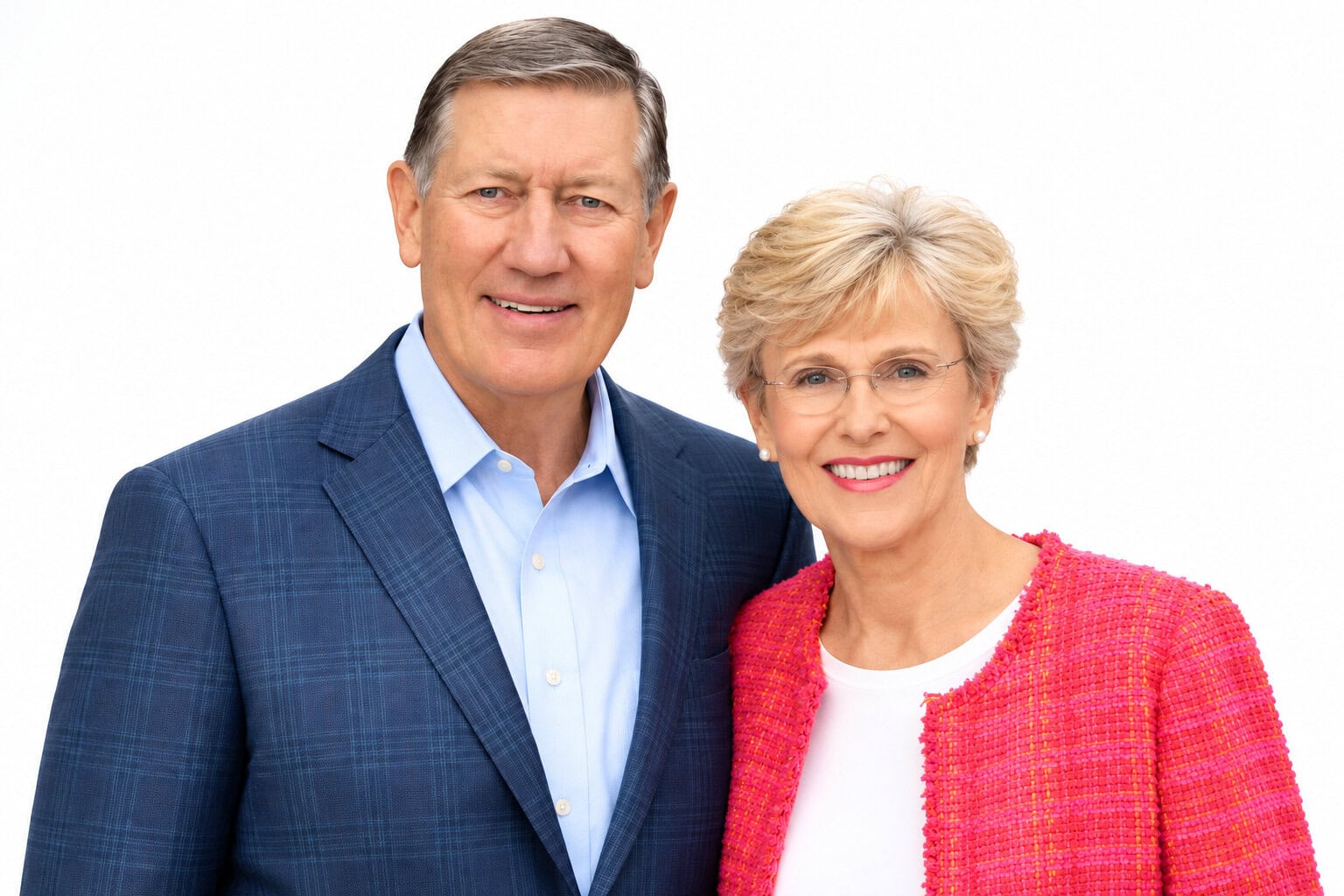
A graduate health sciences building and a renewed first-year home anchor a landmark commitment from an Ohio couple whose philanthropy now exceeds an estimated $225 million.
Recently, the gym floor of Fenton Court inside Marietta College’s Dyson Baudo Recreation Center was full of students, faculty, alumni, and local officials who had come for the State of the College address.
They expected a speech on strategy and enrollment.
They did not expect to be on their feet cheering a few minutes later.
“They have committed to Marietta College an astonishing $55 million,” President Kathleen Poorman Dougherty told the crowd, and the room erupted.
The “they” were Joe and Linda Chlapaty of Dublin, Ohio, and their commitment is the largest single gift the college has received since its founding in the river town where the Muskingum meets the Ohio.
It will pay for a new graduate health sciences building and a full renovation of the three residence halls where most Marietta students spend their first year: Marietta Hall and the paired Elsie Newton and Mary Beach Halls, which opened between 1957 and 1965.
The plan includes a new building connecting Elsie Newton and Mary Beach, turning the three halls into a single first-year quad meant to help new students find their people quickly.
“This will change the entire trajectory of our institution and the entire trajectory of the student experience here,” Dougherty said.
The timing was deliberate.
The same address served as the public launch of The Campaign for Marietta College: More History to Make, a five-year drive to raise $11 million a year to support the college’s strategic plan, adopted a year ago.
In one afternoon, the campaign went from an aspiration to a cause with $55 million already behind it.
What makes the moment remarkable is that Joe Chlapaty never studied at Marietta.
He grew up near Chicago in what he once called a “typical Chicago ethnic blue-collar family.”
His father, the son of a mother who died of cancer during the Depression, left school after about the ninth grade and spent his career as a skilled tool-and-die maker.
To pay for Joe’s college education, the elder Chlapaty sold one of two small home sites he had saved up to buy. Joe went to the University of Dubuque in Iowa, where he played four years of football.
He liked to joke that he was “the third tackle.”
As a freshman, a teammate broke his wrist in pregame drills before the homecoming game, and Joe sat through the whole game on the bench.
He worked as a residence hall adviser to help his parents with the bills and graduated cum laude in 1968.
He has never forgotten what happened next.
At his first job, at the accounting firm Arthur Andersen, new hires went around the room naming their colleges.
When Joe said “the University of Dubuque,” he got blank looks.
“It got me mad,” he recalled years later. “I said to myself, ‘Damn it, some day if I could ever right that, I’m going to do it.'”
He got his chance.
After learning from a mentor at Lindberg Corporation in Chicago, he moved to Columbus in 1980 to become chief financial officer of Advanced Drainage Systems, a maker of corrugated plastic pipe.
That year, by his own account, the company had about $55 million in sales. Over the next 37 years he became its president, then chairman and CEO, and took it public on the New York Stock Exchange.
When he retired in 2017, ADS was the country’s largest maker of high-density polyethylene pipe, with more than 4,000 employees.
He became known for visiting every plant every year and cooking out with the crews.
He was proud that ADS still offered a path for someone fresh out of high school to build a stable life with health care and a retirement plan.
He gives much of the credit to luck.
He has compared his career to Camelot, the boy who pulls the sword from the stone.
“Every time I’ve given a gift,” he said, “it’s kind of like I cut the alfalfa down and it’s growing up again.”
Marietta came into the family’s life the way it does for many parents: through a child.
Their son Keith was recruited to play football by the late coach Gene Epley. He majored in English and graduated in 1997.
Joe and Linda drove to games, got to know the campus, and saw what a small college could do for a young man.
“He received a solid education and made friends,” Joe said.
While Keith was still a student, the Chlapatys began giving to the annual fund and to athletics.
In 1999, two years after Keith graduated, Joe joined the Board of Trustees and later chaired its finance committee.
During those years the couple helped build Legacy Library, now home to the student-favorite Chlapaty Café, paid to renovate Don Drumm Stadium and add a second story, and made a planned gift.
In 2010 the college gave Joe an honorary doctorate.
In 2023 it named both Joe and Linda honorary alumni.
After his first stint on the board ended, Joe drifted away from Marietta for a while.
What brought him back was a run of social media posts asking whether the college would survive.
Like many small private colleges, Marietta was struggling with falling enrollment and tight budgets.
Joe called Margaret Drugovich, then the interim president, and got what he called an “honest and sobering update.”
He returned to the board and stayed close to the work of building a new plan.
Since then the Chlapatys have given in a steady stream. They gave $500,000 for recruitment and student support, plus $5,000 for a student party.
They offered the Chlapaty Challenge, matching every new or increased gift to the Marietta Fund up to $500,000.
They made a $3 million pledge toward the college’s turnaround and more than $1.5 million to rebuild the softball complex.
When the strategic plan launched in the summer of 2025, they added $4 million. When Joe came to campus for a board meeting, hundreds of students showed up just to thank him. Before the new gift, the college already counted him among the three most generous donors in its history.
The $55 million is aimed at two moments in a student’s life: arriving and preparing to serve. The residence halls are where families first picture their child at Marietta, where freshmen make their first friends, and where they have late-night talks.
The health sciences building is about where students go next. Fully funded by the Chlapatys, it will have classrooms, laboratories, and simulation spaces for graduate programs that build on Marietta’s physician assistant program.
Dougherty described plans for nurse anesthesia, occupational therapy, and a path into speech-language pathology, alongside a new master’s in clinical mental health counseling. “The idea is for us to be the destination for students who want to be healthcare professionals in southeastern Ohio,” she said.
In rural Ohio and the surrounding Appalachian counties, where clinics and hospitals have trouble filling jobs, that is a promise about care closer to home.
Joe frames the gift in human terms, not as buildings.
“Linda and I believe deeply in Marietta College and the human-centered education it provides,” he said.
“These projects are about creating the places where relationships will grow, students will discover what they are capable of, and lives will be changed. We want to see that impact.”
The couple chose these projects partly because they want to see the results in their lifetimes, in the students living and studying in these spaces.
He was just as clear about the stakes for the town.
“Marietta College is critically important for the city of Marietta and the southeast Ohio region,” he said. “The city of Marietta needs the college, and the college needs the city.”
Board chair Jim Wilson, a 1969 graduate, put it simply: “They have a son that’s an alumna, but more than that, they are stewards of our future.”
Marietta is only part of the Chlapatys’ giving.
At Dubuque, the school whose name once drew blank stares, they have been among the most important donors in its history.
Joe joined its board in 1992 and chaired it from 2002 to 2024, through hard years when trustees argued over whether the school could survive. In one tense meeting, a proposal came up to sell part of the campus for a big-box store.
Joe helped vote it down, refusing, he said, to “sell off our heritage and our future for 400 grand.”
The couple’s gifts have paid for professorships, student housing, a recreation and wellness center, a performing arts center, and a summer research fellowship that still pays undergraduates to work one-on-one with faculty.
By the Chronicle of Philanthropy’s count, they had given Dubuque at least $71.5 million by 2024.
Last fall they added a $35 million gift for the five-story Chlapaty Center for Innovation, which is now under construction.
In Columbus, where the couple has lived for more than four decades, their giving follows the people and places they love.
Joe has served on the board of Nationwide Children’s Hospital since 2008, and Linda has served on the board of its Center for Family Safety and Healing.
They have given the hospital more than $30 million, including $25 million in 2024 for its new Institute for Mental and Behavioral Health Research.
The hospital’s fourth research building now carries their names.
Their gifts to heart research grew out of Joe’s own treatment for atrial fibrillation.
They committed $15 million to Ohio State’s Wexner Medical Center, whose Interdisciplinary Research Facility includes the Linda and Joe Chlapaty Laboratories.
Their $6.25 million gift to the American Heart Association was the largest individual gift in that organization’s history. At KIPP Columbus, a free, open-enrollment public charter school that began with 50 students and now serves about 2,000, they committed more than $7 million for an athletics and wellness complex.
They also have made bequests to the American Heart Association and to The Columbus Foundation, the latter described as the largest unrestricted gift in the foundation’s history. Linda has long supported the food pantry in their hometown of Dublin.
A small endowment they created in Dubuque honors Sister Helen Huewe, a nun who once wrote Joe a letter asking for his help and whose work they chose to carry on after she died.
Put together, the record is striking. Counting only publicly reported commitments, the Chlapatys have given roughly $65 million or more to Marietta, including the new gift, and more than $106 million to the University of Dubuque.
Add their gifts to Nationwide Children’s, Ohio State, the American Heart Association, KIPP Columbus and others, and their lifetime giving comes to an estimated $225 million or more.
That figure does not include the estate gifts they have already promised, which have never been made public.
Behind those numbers is a family of four sons, Brent, Bryan, Keith and Kevin, and seven grandchildren. The couple says they love to travel and spend time with family.
Joe once said they had “provided for our kids and our grandchildren,” and that beyond that, he saw no reason to pile up wealth for some distant future no one can predict.
He would rather do good now, while he can still see it.
“There’s fewer years ahead of us than there are behind us,” he said. “What are we going to do with our legacy that makes a difference?”
On a recent Friday afternoon in Marietta, part of the answer came in the cheers in Fenton Court.
More of it will come when the first nursing and therapy students walk into their new labs, and when a nervous freshman opens the door to a renovated room in Mary Beach Hall and starts to feel at home.