
$50 million new gift from Mark Zuckerberg and Dr. Priscilla Chan is a bet that artificial intelligence applied to biology and broad-based STEM education will deliver the greatest impact of their lifetimes
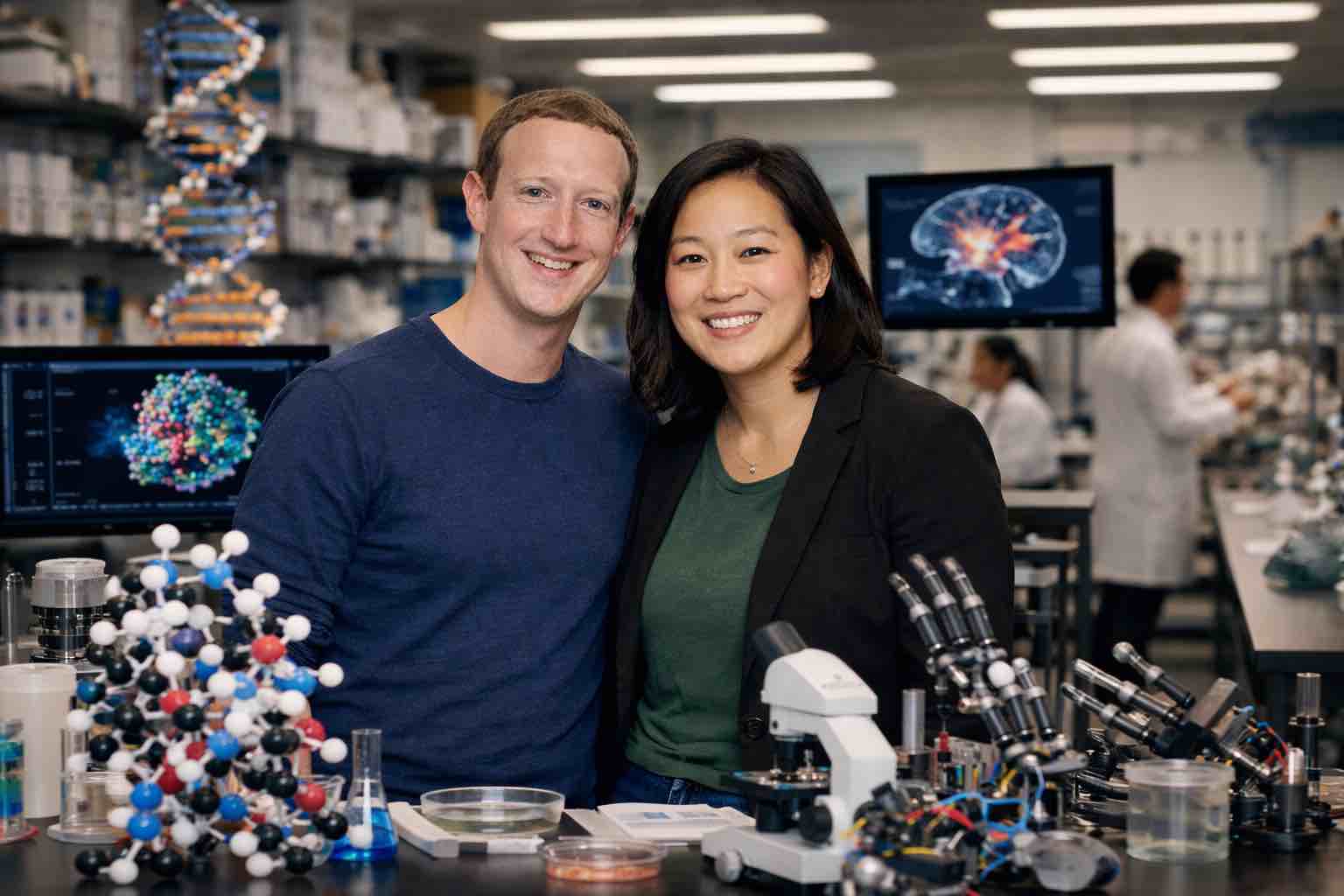
Mark Zuckerberg and Dr. Priscilla Chan are moving their philanthropy into a new, more explicitly technological era, betting that artificial intelligence applied to biology and broad-based STEM education will deliver the greatest impact of their lifetimes.
Their latest signal came with the announcement of a $50 million pledge from Zuckerberg and Meta to Sacramento State University.
The gift will help transform three long-vacant state office buildings into a new downtown campus, underwriting abatement, demolition, and the first phase of construction for student housing and academic space.
At its core will be state-of-the-art STEM labs and a dedicated AI center, intended to serve as a talent pipeline for the region’s technology and innovation economy. Newsom cast the gift as both an education play and a housing intervention, arguing that enabling students to “afford to live where they learn” is now inseparable from creating opportunity in public higher education.
The Sacramento State commitment did not come out of nowhere; it lands just as Zuckerberg and Chan are remaking the Chan Zuckerberg Initiative (CZI) around “AI-powered biology.”
Zuckerberg has been unusually blunt about what is driving that change.
Speaking at the Biohub Imaging Institute in Redwood City in November, he described the couple’s science work—and the Biohub model in particular—as “the most impactful thing that we have done,” and said they now plan to “double down” on that approach. In a joint blog post with Chan, he framed 2026 as the year they go “all in on AI-powered biology,” arguing that advances in AI make it plausible to accelerate their original ambition of helping scientists cure, prevent, or manage all disease, a goal that once sounded like a century-long project.
That language echoes their Giving Pledge commitment to donate 99% of their lifetime wealth, but it also narrows the aperture of where that capital will go.
At the center of this new strategy is CZI’s Biohub network, a collaborative constellation of nonprofit research institutes that work with universities such as UC San Francisco, Stanford, UC Berkeley, Northwestern, and Columbia. Biohub’s mandate is deliberately ambitious: generate massive biological datasets, build new AI models, and push “frontier AI” and “frontier biology” to create virtual cells, reprogrammable immune systems, and predictive models of disease. In practice, that has meant building one of the largest high-performance GPU clusters in the nonprofit life sciences sector and opening it to academic researchers who could not match that capacity with on-campus resources alone.
CZI’s recent requests for applications invite scientists to propose AI and machine-learning models that “cannot be created with conventional university resources,” signaling that the organization intends to function as an infrastructure provider as much as grant maker.
The pivot has been years in the making.
Between 2023 and 2025, CZI began winding down or not renewing a series of social justice and equity grants, including funding for organizations in housing and racial justice, and told partners it was moving to a “science-first” strategy.
At the same time, it invested in tools such as virtual immune-system models, advanced microscopy platforms like CryoLens, and AI models for cellular simulation, while planning to expand GPU capacity to as many as 10,000 units by 2028.
The acquisition of EvolutionaryScale, an AI lab focused on life sciences, further underscored that CZI now sees itself less as a generalist philanthropy and more as a specialized engine for AI-driven biomedical innovation.
Internally, hiring is being redirected toward researchers, data scientists, computational biologists, and other specialists who can leverage this infrastructure.
Seen through that lens, the Sacramento State gift looks less like a one-off campus donation and more like the other half of a two-pronged strategy.
On one side, CZI builds the high-end infrastructure—GPU clusters, Biohub labs, AI models, and tools—for elite scientists working at the frontiers of biology. On the other hand, Zuckerberg’s personal and corporate philanthropy invests in public institutions that can widen the funnel of students entering STEM fields and AI-heavy careers, especially in California, where Meta is headquartered and where the talent wars remain intense.
The Sacramento State project, which integrates an AI center with new student housing and STEM facilities in a downtown setting, is designed to modernize the regional public university and deepen its integration into the state’s technology economy.
Politically and symbolically, the timing is notable. As some high-profile billionaires relocate out of California or reduce their presence there, Fortune has framed Zuckerberg as “doubling down” on the state by channeling philanthropy into its public higher education system and urban core.
The Capitol Mall redevelopment—repurposing decaying state office buildings into a living-learning campus—aligns with Sacramento’s broader downtown revitalization ambitions, giving the gift an urban-regeneration dimension as well as an educational one.
It offers a way to highlight public–private partnerships in areas such as workforce development and affordability; for Zuckerberg, it ties his philanthropic brand more closely to the idea of a homegrown California AI and STEM talent pipeline.
CZI’s new direction also places the couple squarely within a broader reordering of big-ticket philanthropy.
Analysts note that where the Bill & Melinda Gates Foundation has concentrated on vaccines, infectious disease, and public-health systems, often in low- and middle-income countries, CZI is now channeling a large share of its resources into AI tools that decode cellular biology, with the promise—but not yet the guarantee—of downstream health breakthroughs.
That choice reflects Zuckerberg and Chan’s belief that their comparative advantage lies in building platforms—supercomputing clusters, open datasets, and shared research institutes that others can build on—rather than directly funding service delivery or policy advocacy.
The risk, as critics point out, is that as they retreat from social-equity programs and classroom-level education initiatives, communities that relied on their earlier grants may face gaps long before the benefits of AI-enabled biomedical science are felt.
For now, though, the pattern is clear: the couple who once spread their philanthropic bets across education reform, criminal justice, and community development are consolidating around a theory of change that runs through algorithms and laboratories.
On one track, they are pouring billions—plus rare technical infrastructure—into AI models meant to simulate life itself.
On another, they are writing large checks to public universities like Sacramento State to ensure more students, including first-generation and lower-income Californians, can train in the STEM and AI disciplines that those models will require.
In doing so, Zuckerberg and Chan are not just repositioning their own philanthropy; they are helping to define what a high-tech, AI-centered version of twenty‑first‑century giving looks like.