
$48 billion promise: Stephen Schwarzman’s plan to turn Wall Street fortune into a global foundation for AI, education, and opportunity
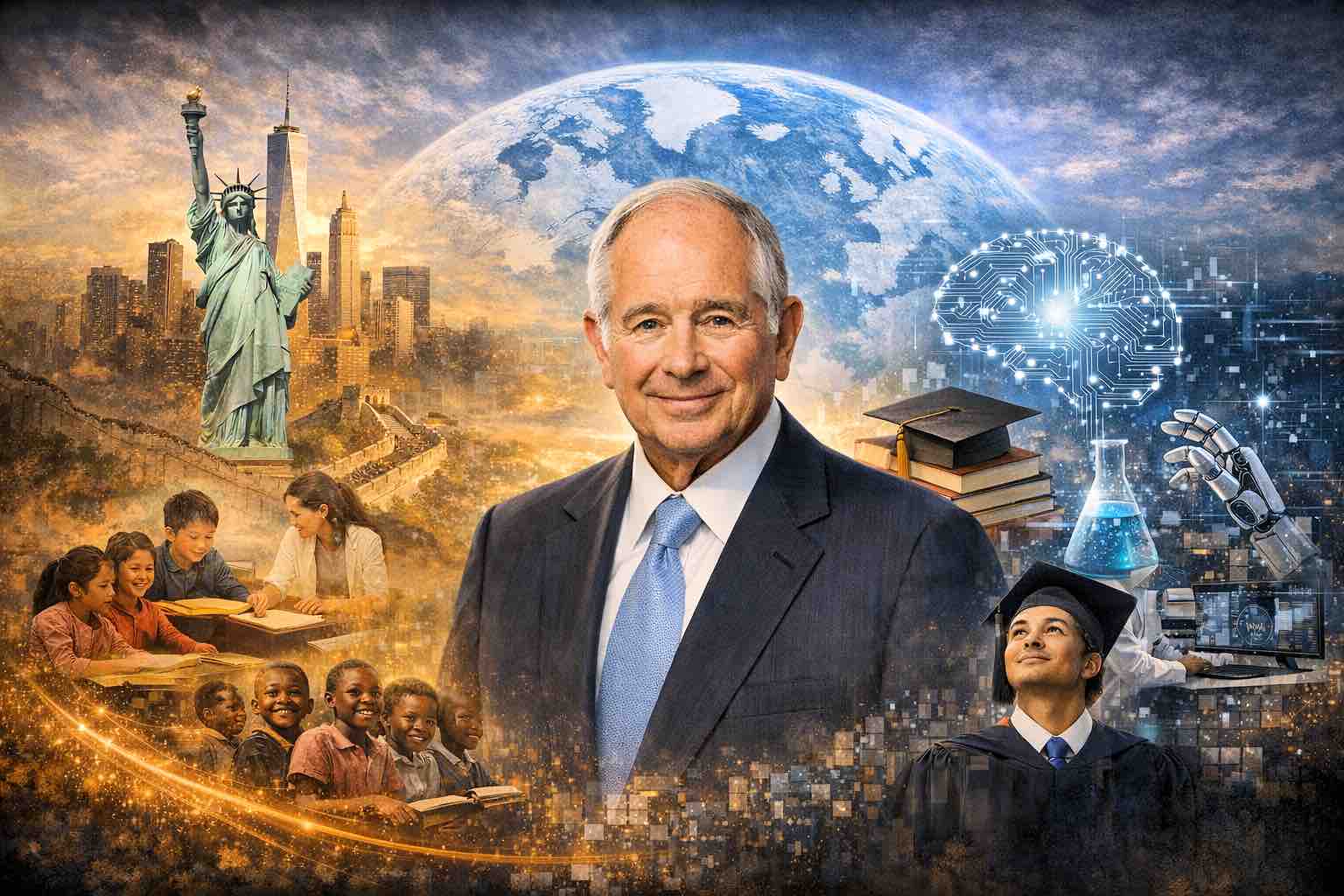
Mega-philanthropist Stephen A. Schwarzman is channeling much of his life’s work into a single, clear mission: to turn almost all of his roughly $48 billion fortune into a long‑term force for education, opportunity, and responsible technological progress, with a special emphasis on artificial intelligence.
He has publicly committed a “substantial majority” of his wealth to his foundation, with the ambition that it will stand alongside the Gates Foundation and the Wellcome Trust in both size and global influence.
In his pledge, he writes that giving brings him “joy and meaning” and stresses that he wants his resources to support practical, non‑political work that directly improves people’s lives.
AI sits at the center of that vision, and always in a positive, opportunity‑focused way. Schwarzman has said he was struck by how quickly advances in artificial intelligence and computing can reshape human development, work, and national competitiveness, and he talks about an “urgent need” to make sure societies are ready to benefit from these changes.
He has already backed this belief with record‑setting gifts. At MIT, his $350 million gift—its largest ever—created the MIT Schwarzman College of Computing, a new structure designed so that AI and computing touch every field, from engineering and science to economics, policy, and the humanities, with the explicit goal of generating breakthroughs that “improve our entire society.”
At Oxford, his roughly £150 million gift is funding the Schwarzman Centre for the Humanities, including an Institute for Ethics in AI so that the world’s leading thinkers on history, philosophy, and culture can work directly alongside those building the next generation of intelligent systems. The foundation he is now building is intended to expand exactly this kind of work: AI that lifts education and health care, and scholarship that helps people navigate a fast‑changing world constructively.
The roots of that generosity are personal. As a boy in Philadelphia, Schwarzman watched his grandfather regularly pack prosthetics, wheelchairs, clothes, books, and toys to send to children in Israel and explain that helping others was both a duty and a privilege.
He saw his father, who ran a small store, quietly extend credit to new immigrants who needed a start. Those experiences shaped his belief that success should translate into responsibility. In his Giving Pledge statement, he says he is drawn to organizations that “deliver real results,” and notes that he and his wife Christine are the largest donors to the Catholic school system in the United States.
In New York, the inner‑city Catholic schools they support, through the Inner‑City Scholarship Fund, achieve a 98% high‑school graduation rate even though about 70% of students come from families at or below the poverty line—an outcome he points to as exactly the kind of life‑changing impact he wants his philanthropy to have.
Education and opportunity are the through‑line of his largest gifts. He gave $100 million to the New York Public Library to renovate and protect its iconic Fifth Avenue main building, now the Stephen A. Schwarzman Building, helping secure one of the world’s great civic and intellectual landmarks for future generations.
At Yale, his $150 million gift—then the largest in the university’s history—created the Schwarzman Center, turning the old Commons into a vibrant hub for student life, arts, and culture that brings the entire campus together. In Beijing, he founded the Schwarzman Scholars program at Tsinghua University with a major personal commitment and helped build an endowment now around $300–$350 million, creating a fully funded one‑year master’s degree designed to educate future global leaders who understand China and the wider world.
The program’s long‑term vision is a worldwide network of more than 10,000 alumni, a living community of leaders connected by shared training and a sense of responsibility. Even at his public high school, Abington Senior High School outside Philadelphia, he has focused on preparing students for the future: his $25 million gift—one of the largest ever to a single U.S. public school—funded a modern science and technology center and campus upgrades, and he pushed for strong computer‑skills instruction because he believes that, today, every student needs technological literacy “whether you’re fixing cars, or whether you’re going to Google.”
Schwarzman often says he is practicing philanthropy “for the long haul,” and that philosophy runs through all of these projects. He gravitates to efforts that will still be delivering benefits decades from now: libraries, universities, scholarship programs, schools, and now a major foundation designed to work on AI, education, culture, and health well beyond his own lifetime.
He has also said it is important for people of means to “provide an example” of what they can do.
By pledging almost all of his wealth, building flagship institutions on three continents, and centering his future foundation on helping people adapt and thrive in the age of AI, he is clearly trying to set a very positive example—using extraordinary financial success to expand learning, opportunity, and human progress on a global scale.