
$30 million gift from Miller, Maggelet, Marriott, and Romney families aims to save the Great Salt Lake
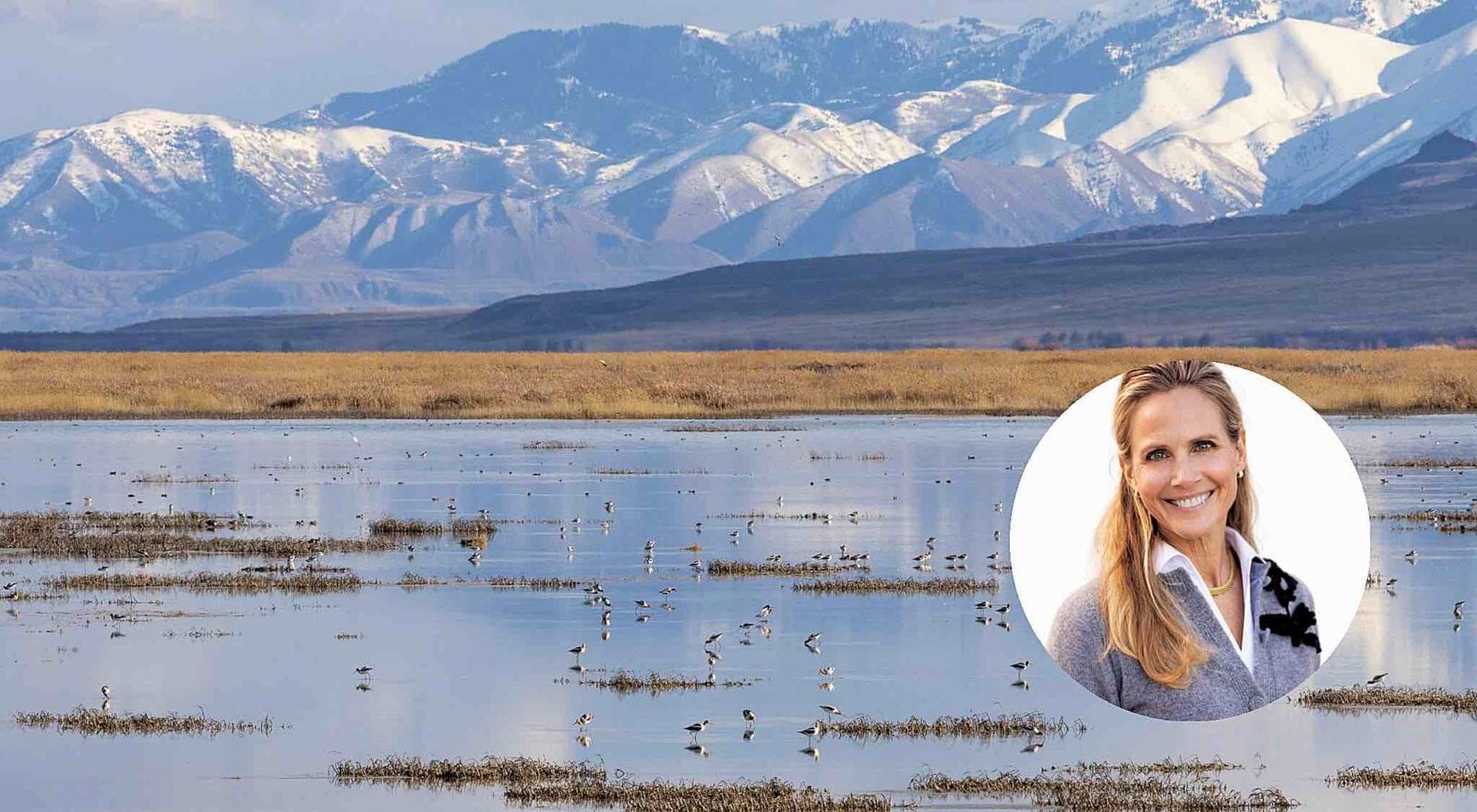
The announcement that Utah business and civic leaders would mobilize $30 million in new philanthropic funding for the Great Salt Lake began, fittingly, with one donor who decided that this crisis now defines his life’s work.
Josh Romney, a businessman who chairs Great Salt Lake Rising, told a packed room at the Eccles Wildlife Education Center in Farmington that what started as a side project nine months ago has become an all‑consuming mission once he grasped how little time remains to stabilize the lake.
He framed the lake’s condition bluntly: Great Salt Lake has already lost about half its water, its surface elevation hovers near record lows, and—most importantly—those drops are driven less by fate than by choices, with over‑allocated water rights and upstream diversions starving the lake of inflows it once reliably received.
That premise, that human decisions created the emergency and can still avert collapse, set the stage for three of Utah’s most prominent families to step forward with matching $10 million commitments that instantly changed the scale of the private response.
Greg Miller, trustee of the Larry H. & Gail Miller Family Foundation and vice chair of the Larry H. Miller Company, opened the giving by announcing his family’s $10 million pledge, casting it less as an act of charity than as an investment in the state’s long‑term viability.
He stressed that the decisions Utahns make in the next few years will determine not only whether the lake survives, but what kind of economy and communities the Wasatch Front can sustain in the decades ahead, tying environmental stewardship directly to job growth, property values, and public health.
The Miller family’s name is already synonymous with Utah business and sports, from the former ownership of the Utah Jazz to a diversified portfolio of automotive, real estate, and entertainment holdings, and Miller made clear that his family sees lake protection as the next logical extension of that legacy.
He said the foundation hopes its commitment will accelerate restoration efforts already underway, catalyze additional private support, and demonstrate that serious capital is now aligned behind pragmatic, near‑term solutions rather than speculative megaprojects.
If Miller provided the moral and economic argument, the second $10 million came with a very practical sense of self‑interest.
Drew Maggelet, a board member of FJ Management, Inc.—the parent company of Maverik, Adventure’s First Stop—explained that the convenience‑store chain’s gift is inseparable from the landscapes and lifestyles its brand celebrates.
Maverik, headquartered in Salt Lake City and operating more than 400 stores across 20 states, built its identity around outdoor adventure, from snowmobiling and skiing to boating, fishing, and high‑desert road trips that all depend on a functioning Great Salt Lake ecosystem and the snowpack it helps generate.
With FJ Management chair and CEO Crystal Maggelet looking on, her son described the donation as both a community obligation and a generational commitment from a third‑generation Utah family that wants to keep calling the Wasatch Front home.
He emphasized the contrast between a healthy lake that underwrites winter storms, recreation, and tourism, and a desiccated basin that would send toxic dust into nearby neighborhoods and undercut the region’s appeal as an “adventure base camp.”
The third pledge, from the J. Willard and Alice S. Marriott Foundation, arrived with the morning’s sharpest warning about time. Representing the foundation established by Bill and Allie Marriott, whose family built Marriott International,
Karen Marriott announced a $10 million commitment while recalling the moment a documentary, “The Lake,” transformed her concern into urgency. The Abby Ellis film, which follows Utah scientists racing to avert what one researcher calls an “environmental nuclear bomb,” left Marriott convinced that the lake could tip into collapse within roughly five years if current trends continue, exposing contaminated sediments and unleashing dust that would damage public health, agriculture, snowpack, and the region’s economy.
For a family whose roots in the Great Salt Lake Valley trace back to the mid‑19th‑century Mormon migration, the prospect of presiding over that kind of loss proved untenable, even though the foundation’s primary grantmaking typically occurs far from Utah.
She also linked the deadline to the 2034 Winter Olympics, which Salt Lake City is slated to host, arguing that Utah now faces a binary narrative: welcome the world to a dust‑blown, diminished lakebed, or showcase a statewide rescue effort that became a global model for water stewardship.
Behind the headline numbers, the donors were explicit that the $30 million is not intended for grandiose engineering projects or symbolic gestures, but for what Great Salt Lake Rising executive director Tim Hawkes calls “wet water.”
Hawkes drew a sharp distinction between paper water rights, which exist primarily on legal documents, and real, measurable inflows that actually reach the lake, arguing that every philanthropic dollar should move the needle on the latter.
That focus means directing funds toward acquiring, leasing, or otherwise securing water rights and shepherding the associated flows to the lake—often in partnership with the state—so that the rescue effort translates into additional acre‑feet rather than simply re‑labeling existing usage.
As a proof of concept, Hawkes pointed to Utah’s recent $30 million purchase of the shuttered U.S. Magnesium facility and its associated water rights and land, a bankruptcy‑court win that turned nearly 145,000 acre‑feet of annual rights and 4,500 acres of shoreline into a public asset the state now plans to dedicate to the lake.
That transaction, fast‑tracked by the Legislature and funded in the 2026 budget, illustrates the kind of narrow windows Hawkes believes philanthropy must be ready to exploit.
State officials have noted that simply leasing that volume of water rights on the open market would have cost millions of dollars per year, making outright acquisition both cheaper over time and more secure for the lake’s future.
For donors like Miller, Maggelet, and Marriott, the U.S. Magnesium deal offered a concrete example of how large, flexible pools of private capital can complement legislative action by enabling Utah to pounce when strategic assets come to market.
Hawkes was equally clear about what the coalition does not intend to chase: speculative schemes such as ocean pipelines that he described as highly complex, staggeringly expensive, and too slow to change the lake’s trajectory within the narrow five‑year window scientists describe.
Still, everyone on the stage acknowledged that even well‑targeted philanthropy can only go so far without a change in day‑to‑day water consumption. Hawkes and other speakers repeatedly circled back to the notion that the most powerful lever in this story is not a checkbook but a hose, a sprinkler system, or an irrigation gate.
They called on households to cut outdoor watering, on businesses, schools, and churches to examine landscaping and operations, and on farmers to participate in compensated conservation and efficiency programs that keep more water in rivers, canals, and, ultimately, the lake.
Hawkes highlighted Domo, the American Fork‑based data company, as an example of how the tech sector can engage early and constructively, noting that the firm stepped up when the Great Salt Lake Business Council was first formed, well before anyone asked for more than public support.
He also cited tools such as smart irrigation controls, precision agriculture, and cloud seeding as useful, if limited, contributors in a broader strategy grounded in conservation rather than augmentation alone.
On the public‑sector side, Utah Department of Natural Resources executive director Joel Ferry used his time at the podium to argue that the state must apply the same rigor it brings to its fiscal accounts to a “water budget” that has been out of balance for decades.
Ferry insisted there is enough water in the system to sustain both the lake and a growing population, provided Utahns reduce waste and align usage with hydrologic reality, an assertion that echoes academic calls for emergency streamflow requirements and watershed‑wide conservation targets. He reiterated the state’s commitment to restore the lake to a sustainable, “viable” level by 2034, aligning the goal with the Olympic timeline and reinforcing that recent deals, such as the U.S.
Magnesium acquisition is only a first step.
A video message from Governor Spencer Cox underscored that the executive branch, the Legislature, and now major private donors are, at least for the moment, pulling in the same direction on Great Salt Lake policy.
For Romney, who closed the event much as he began it, the day’s significance rested less in any single speech than in the speed with which informed skeptics tend to become advocates once they see the data for themselves.
He said most conversations follow a familiar arc: one or two meetings to walk through the hydrology, the health risks, and the economic stakes, and then a pivot to “How can I help?”—a pattern the $30 million in new gifts appears to confirm.
The science remains unforgiving: researchers estimate that if current losses continue, the lake could effectively collapse within roughly five years, with cascading damage that would take generations to reverse.
But the convergence of family foundations, corporate donors, state agencies, and civic groups around a strategy focused on “wet water,” conservation, and opportunistic acquisitions has given Utah’s bid to save its inland sea more structure—and more capital—than at any point in the lake’s modern decline.
Whether that is enough to turn “half a lake left” into a recovery story now hinges on how quickly more of Utah’s wealthiest families, and the millions of residents who share the watershed, follow the Millers, Maggelets, Marriotts, and Romneys into the work.
Photo: Karen Marriott