$3 Billion from Ken Griffin sets a new record for higher education and brings Carnegie Mellon to Miami
He just made the largest gift of his life, and it may prove to be one of his most lasting contributions.
The founder and CEO of Citadel is giving $3 billion to Carnegie Mellon University.
It is the largest gift any individual has ever made to higher education in the United States, and most of it will pay for something rare in American academia: a new research university campus designed from scratch in Miami.
The gift tops some of the best-known gifts in modern philanthropy. It passes Michael Bloomberg’s $1.8 billion gift to Johns Hopkins in 2018 and the $2 billion that Phil and Penny Knight gave Oregon Health & Science University in 2025.
Griffin summed up his thinking simply: “It is the investment in excellence.”
Two billion dollars will launch Carnegie Mellon University Miami, a campus of more than 35 acres in Wynwood, the neighborhood known for its bold street art.
The design of the school is as ambitious as its funding. Instead of organizing learning around traditional majors, CMU Miami will organize it around the big problems facing society. It will open with four grand challenges: human health and biological discovery, national security and strategic capabilities, energy and climate resilience, and advanced manufacturing and industrial transformation.
The humanities, arts and design will be treated as essential partners in that work. The campus will include industry research labs and venture studios, and it is meant to serve as a living laboratory where students, faculty, companies and government partners work side by side.
Construction is scheduled to begin in 2027. Pending regulatory approval, the first students would arrive in 2028, starting with graduate students.
At full scale, the campus plans to serve more than 3,500 undergraduate, master’s and doctoral students, supported by nearly 300 faculty and more than 600 staff.
“The opportunity to bring Carnegie Mellon to Miami places our city at the heart of humanistic and scientific advancement and amplifies the University’s international reach and impact,” Griffin said. He called CMU Miami “a generational opportunity to build a new center of research and intellectual life.”
He added that “we need more innovation, we need more job creation,” and described this as the way America keeps its standard of living and its competitive edge.
Pittsburgh, Carnegie Mellon’s home for 126 years, also shares in the gift.
One billion dollars will go to the original campus. Half of that will support the university’s highest priorities, including financial aid to make a CMU education more affordable.
The other half will go to the School of Computer Science, widely ranked as the nation’s best undergraduate program in the field. It will now be called the Kenneth C. Griffin School of Computer Science.
Griffin will also join the university’s board of trustees.
President Farnam Jahanian thanked Griffin for “his extraordinary vision, partnership and belief in what Carnegie Mellon can achieve.”
He described artificial intelligence as “one of the defining intellectual developments of our time,” one that requires universities to rethink how they teach, research and partner.
“Every great Carnegie Mellon story begins with partnership,” he said, adding that the university believes its ties to Miami “will enrich both cities.”
The Carnegie Mellon gift brings Griffin’s total philanthropy to about $5.7 billion. Few people alive have given on that scale, and few have spread their giving so widely across education, medicine and science.
He has given $500 million to Harvard, his alma mater, which named its Kenneth C. Griffin Graduate School of Arts and Sciences in his honor.
The University of Chicago’s economics department received $125 million.
Together with David Geffen, he gave $400 million to Memorial Sloan Kettering Cancer Center. He has also supported Ann & Robert Lurie Children’s Hospital and the American Museum of Natural History.
After moving Citadel’s headquarters from Chicago to Miami in 2022, he quickly became one of South Florida’s leading benefactors.
His commitments in the region total about $2.4 billion and include a cancer center at the University of Miami, Baptist Health’s neuroscience institute, Miami Dade College, public schools, math tutoring and the expansion of Success Academy’s charter schools to Miami.
All of this giving runs through Griffin Catalyst, his civic engagement initiative. It seeks out creative ideas that can work at scale and funds them, with a focus on expanding educational opportunity and supporting breakthroughs in health and science.
The Carnegie Mellon gift is its clearest expression yet. It puts a historic sum behind a new idea of what a university can be and anchors that idea in the city Griffin now calls home.
If CMU Miami becomes what its founders hope, “one of the world’s most important academic institutions,” it will be a remarkable legacy.
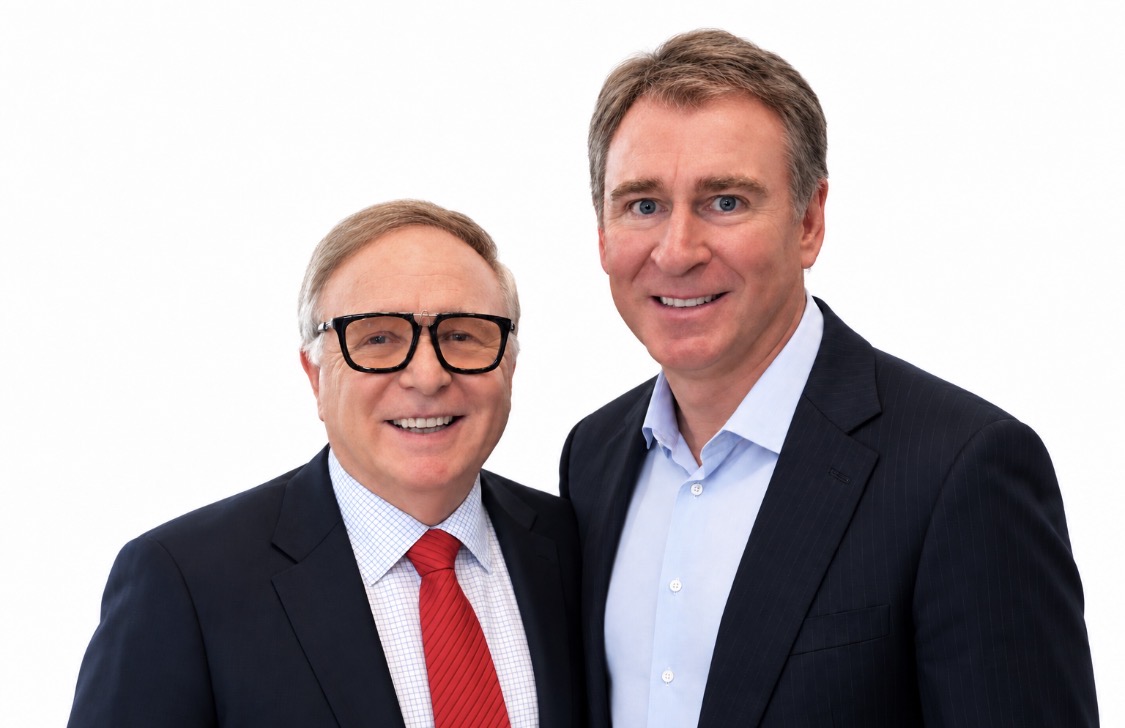
Photo: Mega-philanthropist Ken Griffin with Gabriel Erem, founder of Lifestyles Magazine/Meaningful Influence